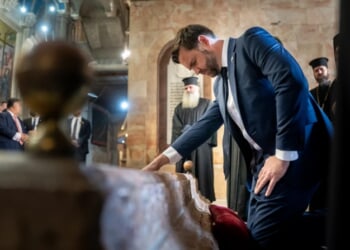
My family still celebrates St. Nicholas day on December 6th, a tradition my wife and I inherited from our parents. Our kids wake up to shoes stuffed with goodies brought by the holy 4th-century bishop. As they grow older, they will begin to understand the reason Nicholas practiced such generosity towards children and the poor: his belief that Jesus is one-in-substance with the Father, a truth Nicholas vigorously defended at the Council of Nicaea—the anniversary of which Pope Leo just commemorated in Turkey. It astonishes me how naturally children connect past, present, and future, even from the youngest age: a man who lived almost two millennia ago just came to our house last night, and he’ll come again in a few weeks.
Connecting past, present, and future is precisely what we grown-ups do in this holy season of Advent: Jesus Christ, the Son of God, was born in Bethlehem two millennia ago, He comes to us now in the Eucharist, and He will come again in glory at the end of time.
If the midpoint of this wonderful story is “now,” then the midpoint of Advent—i.e., the third Sunday—teaches us how to live in the “now.” The beautiful Introit—the opening chant we hear at Mass—begins with a key imperative:
Gaudete in Domino semper! Iterum dico, gaudete!
“Rejoice in the Lord always! Again, I say, rejoice!”
This timeless chant is set in the first mode—the Dorian—contrasting with the more obscure Plagal and Mixolydian modes of the first, second, and fourth weeks. In a short span between the words “rejoice” and “always,” the voice climbs nearly an octave in an expression of irrepressible joy. The line includes subtle echoes of the previous weeks and allusions to the fourth. The text mixes St. Paul’s exhortation to the Philippians (4:4-6) with Psalm 85, giving us three further imperatives to orient our preparation for the Solemnity of Our Lord’s Birth—three things to do in the here and now as we recall what the Lord has done and look forward to what He will do.
Kindness
Modestia vestra nota sit omnibus hominibus.
“Your kindness should be known toward all.”
Notice that the Latin word modestia, despite its root connection with “modesty,” means much more than that. The Greek epieikes is best translated as “fairness,” “gentleness,” or “kindness.” The point is that, because the Lord is near, we are to be godlike. We are to show forbearance and consideration to others.
This could mean something as simple as not laying on the horn when the driver in front of you doesn’t notice the light has just turned green. It may mean keeping your temper when your two-year-old breaks a glass as she tries to clear the table. It may mean allowing a fellow shopper to take the last set of Bluey figurines even though she arrived at the shelf five seconds after you did. Modestia means mildly putting up with inconveniences and putting the needs of others before ours. If Christ lives in our hearts, could anything possibly bring us greater joy?
Peace
Nihil solliciti sitis.
“Do not be anxious.”
Taxes. Rising energy costs. Political instability. Looming international conflicts. There are a thousand reasons to be anxious, no more or less than when Jesus was born, and no more or less than there will be two thousand years from now. St. Paul uses the Greek verb merimnaō, which literally means to be pulled in different directions by a multitude of various distractions. Sound familiar?
Have you ever sat at your computer to write an email to that estranged relative or friend, only to open your inbox and find fifteen less important messages to reply to? Is coffee or tea something you drink while scrolling through the catastrophic news stories on your phone, or something you taste and savor in itself? Does a plethora of seemingly worthwhile cares—replacing a light bulb, organizing the pantry, inspecting your HVAC—get in the way of a twenty-minute game of Monopoly with your eight-year-old? Advent reminds us that nothing is lost in postponing, waiting, or simply being present.
Prayer
Sedin omni oratione et obsecratione cum gratiarum actione petitiones vestræ innotescant apud Deum.
“But in everything, by prayer and petition, with thanksgiving, make your requests known to God.”
Both the Latin and Greek—innotescō and gnōrizéstō—mean “to make known,” “to reveal,” or “to give to understand.” Quite a strange thing to “let God know” what you need, no? Who better knows what we need than God? The point, of course, is not to make God aware of what we need, but to acknowledge ourselves both what we really need and the fact that only God can give it.
The prepositions pros in Greek and apud in Latin both mean “in the presence of,” in the sense of standing right in front of the person. Think of the difference between telling yourself “I don’t need to take time to pray today because God already knows what I need,” and “No one knows better than God what I need, so why don’t I spend fifteen minutes today talking with Him?” As the passage from Paul also makes clear, begging God for something we need is inseverable from thanking Him for what we already have.
If you’re a parent, you know just as well as I that food prices are soaring. As we prepare dinner, what thoughts are turning in our hearts? Irritation over how little is left of our paycheck after going to the grocery store, or gratitude that we have a job to put food on the table? Each time we ask God to help us find a side hustle to keep the family afloat, we should also thank Him for His generosity in giving us something to eat.
How to live in the “now?” How best to remember what God has done and thank Him for it? How best to look forward to what He will do and praise Him for it?
Rejoice, be kind, don’t worry, and pray. That’s the message of Sunday’s Introit. That’s the simplicity of the scriptural lesson it teaches.
The Introit ends with a look toward the past: Benedixisti Domine terram tuam: avertisti captivitatem Jacob. “You have blessed your land, O Lord. You have restored the captives of Jacob.”
Whenever tempted this Advent season—whenever on the brink of sadness, meanness, anxiety, or lack-of-prayerfulness—remember how the Lord has favored His land. Remember how He has set us free from our sin. The grace this Advent season brings exceeds our wildest imagination, and the joy this Christmas promises is beyond all telling.
Photo by Hassan Pasha on Unsplash