The first moving naval “torpedo” was physically attached to the submarine that used it—with perhaps predictable results.
On Wednesday, the Pentagon confirmed that the Iranian warship IRIS Dena was sunk by a single Mk 48 underwater torpedo while operating in the Indian Ocean. US Secretary of Defense Pete Hegseth told reporters it was “the first sinking of an enemy ship by a torpedo since World War II.”
That’s far from accurate. Torpedoes have been used only a handful of times since World War II, but there are at least two confirmed instances in the eight decades since, with a third likely occurring as recently as 2010. Hegseth probably meant to say that it was the first time since World War II that a US Navy vessel had sunk an enemy warship with a torpedo.
What to Know About the Mk 48 Torpedo
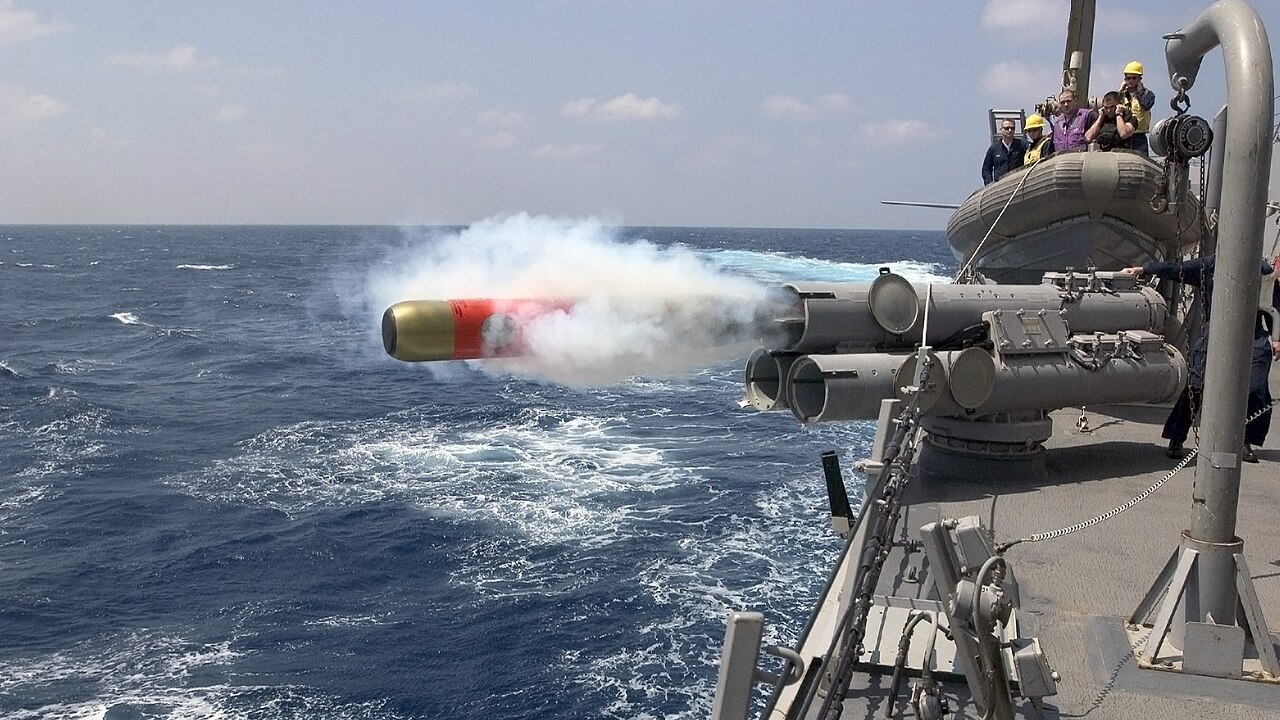
The US Navy confirmed that the IRIS Dena was sunk by the aforementioned Mk 48. Produced by defense giant Lockheed Martin, the ordnance has been steadily upgraded over the past five decades and is among the most advanced in service today.
As Brandon J. Weichert wrote for The National Interest in August 2024, “The Mark 48 torpedo, developed by the Naval Sea Systems Command, is one of the most advanced and lethal undersea weapons in the US Navy’s arsenal. Introduced during the Cold War, it was designed to counter Soviet submarines and surface ships.”
The Mk 48 Mod 7 Common Broadband Advanced Sonar System (CBASS) employs wire guidance, which allows the submarine to maintain direct, real-time command over the torpedo after launch, but the ordnance is also outfitted with advanced sonar that allows it to engage a target if the wired connection is lost. The torpedo is powered by a high-speed electric motor, allowing it to travel at more than 60 miles per hour—far faster than any submarine ever built.
Unfortunately for the Navy, the capabilities of the Mk 48 don’t come cheap. Each torpedo costs roughly $4.2 million.
The Mk 48 Torpedo’s Specifications
- Year Introduced: 1972
- Number Built: Unknown (likely thousands)
- Length: 19 ft (5.8 m)
- Weight: 3,700 lb (1,680 kg)
- Diameter: 21 in (530 mm)
- Engines: Swash-plate piston engine
- Top Speed: 65 mph (104.6 km/h)
- Range: Depends on speed; ~31 mi (50 km) at lower speeds
- Armaments: 650 lb (295 kg) high explosive warhead
The First “Torpedoes” Were Just Naval Mines
The name “torpedo” comes from the Latin tropidus, meaning numb—referring to the “torpedo paralysis” that resulted from the shock of the electric ray fish. Who chose the name is unclear, but for much of its existence, it was a very different weapon.
Early torpedoes were far from slender underwater missiles capable of being fired at an enemy vessel. Instead, they were stationary, submerged explosive mines designed to detonate on contact with an enemy ship’s hull. It was these weapons that led Union Admiral David Glasgow Farragut to reportedly issue the command “Damn the torpedoes, full speed ahead!” during the assault on Mobile Bay, Alabama, on August 5, 1864.
The modern concept of the naval torpedo evolved from spar torpedoes, which were essentially explosives mounted on long poles that exploded on contact with an enemy ship. Such ordnance was widely employed by Confederate forces in the American Civil War, including on its groundbreaking submarine, the CSS Hunley. In February 1864, the Hunley used a spar torpedo to strike and sink the USS Housatonic, a conventional ship—marking the first time a submarine had ever sunk a ship in combat. Unfortunately, the blast from the torpedo also sank the Hunley itself with all hands—demonstrating the limitation of an explosive physically attached to the ship carrying it, and prompting subsequent inventors to study ways to launch it outward instead.
The “Whitehead Torpedo” Was the First Modern Naval Torpedo
Just as warship design was evolving, so too were the weapons.
The first self-propelled torpedo was developed in the late 1860s by British inventor Robert Whitehead. It was powered by compressed air and had a range of just 200 yards, traveling at 6.5 knots. It wasn’t significant in range or speed—yet the cold-running Whitehead design remained the basis for all future torpedoes, even to this day.
“The development of the modern torpedo began in the 1860s, when Whitehead invented a mechanism to control the depth,” Dr. Katherine Epstein, a history professor at Rugters University whose work focuses on military technology, wrote in an email to The National Interest.
According to the United States Naval Undersea Museum in Keyport, Washington, the Austrian Empire was the first country to show interest in the torpedo. In a deal that would seem astonishing to any modern defense contractor, Vienna “purchased manufacturing rights in 1869 but granted Whitehead permission to continue selling torpedoes to other countries. The British Royal Navy purchased some Whiteheads in 1870 and began manufacturing a British version in 1871.”
It is doubtful that Austria could have maintained a monopoly on the design anyway—but sharing it freely was likely a decision it came to regret. Soon, countries across Europe, and then Asia, saw the potential of Whitehead’s design. Interestingly, the United States Navy did not, at least not at first. It made several attempts to develop a torpedo independently, but by the 1890s, it also turned to Whitehead and licensed the design.
“The next major improvement was the application of a gyroscope in the 1890s to control the torpedo’s course,” Epstein said. “Together, the gyroscope and depth mechanism made the torpedo the world’s first guided missile. Finally, just after the turn of the century, navies began to add ‘superheaters,’ which heated the compressed air that powered torpedoes and enabled them to run at higher speeds and for longer distances—nearly 50 knots at shorter ranges and more than five miles at lower speeds.”
Military Engineers Built Land Torpedoes, Too
By the dawn of the 20th century, torpedoes had been nearly exclusively self-propelled, underwater projectiles. The keyword is “nearly” as there were other types of weapons that employed the name.
Among these was the “Bangalore Torpedo,” developed in the city of Bangalore, India, by British Army officer Captain R.L. McClintock while attached to the Madras Sappers and Miners. It wasn’t a sea-based weapon, but instead was a pole charge used by combat engineers to clear obstacles. Why it employed the name “torpedo” is unclear—either harkening back to the original meaning of “torpedo” in the sense of a stunning explosive charge, or in reference to the weapon’s naval torpedo-like shape.
What is worth noting is that the Bangalore Torpedo was employed in combat on the Western Front of World War I, and was used to break through fortifications at Normandy Beach during the D-Day landings in World War II—famously depicted in that role in the iconic 1998 war film Saving Private Ryan.
Run Silent, Run Deep
Torpedoes—the moving sea-based missiles, that is—became the primary weapon used by submarines to sink enemy vessels during World War I, and continue to be employed in the same role more than a century later. In addition to being fired by submarines, torpedoes were developed to be dropped from aircraft into the water, giving rise to the interwar “torpedo bombers.” A Fairey Swordfish bomber biplane famously used a torpedo to land a critical hit on the German battleship Bismarck in May 1941, disabling its rudder and preventing it from escaping a British naval task force closing in.
Early advances were on guidance and power, with post-World War II development focused on greater range, homing technology, and other specialized capabilities.
The Mk 48 Mod 7 CBASS is just one of several advanced torpedoes in service with the major navies of the world today. The UK’s Spearfish Mod 1 and the US Navy’s Mk 54 Lightweight torpedo are also described as highly capable underway ordnance that can serve in anti-surface and anti-submarine roles.
Torpedoes remain effective as they can strike a vessel below the waterline, causing catastrophic flooding. Because the explosion occurs underwater, the force is also compressed directly onto the hull, resulting in maximum destruction.
That is why the modern torpedo remains an effective weapon even in the 21st century.
About the Author: Peter Suciu
Peter Suciu has contributed to dozens of newspapers, magazines, and websites over a 30-year career in journalism. He regularly writes about military hardware, firearms history, cybersecurity, politics, and international affairs. Peter is also a contributing writer for Forbes and Clearance Jobs. He is based in Michigan. You can follow him on Twitter: @PeterSuciu. You can email the author: [email protected].