Mitchell Johnson (born in 1964) has been visiting Paris and other parts of France, such as Meyreuil near Aix-en-Provence, since 1989, when he was earning a master of fine arts at New York’s Parsons School of Design. A Parisian sojourn, which could extend indefinitely, was long considered a necessity for any aspiring artist. This was no longer true for Johnson’s generation. Nevertheless, the Munich-born Hans Hofmann (1880–1966), who inspired Johnson via several of Hofmann’s students, injected elements of the School of Paris—a somewhat ambiguous term that included several different and not always compatible styles—into his “push and pull” theory that had a great influence on American art. Not quite a well-off Jamesian pilgrim gallivanting around Europe, Johnson, who today lives in the San Francisco Bay Area, traveled to Paris with money he earned from construction jobs.
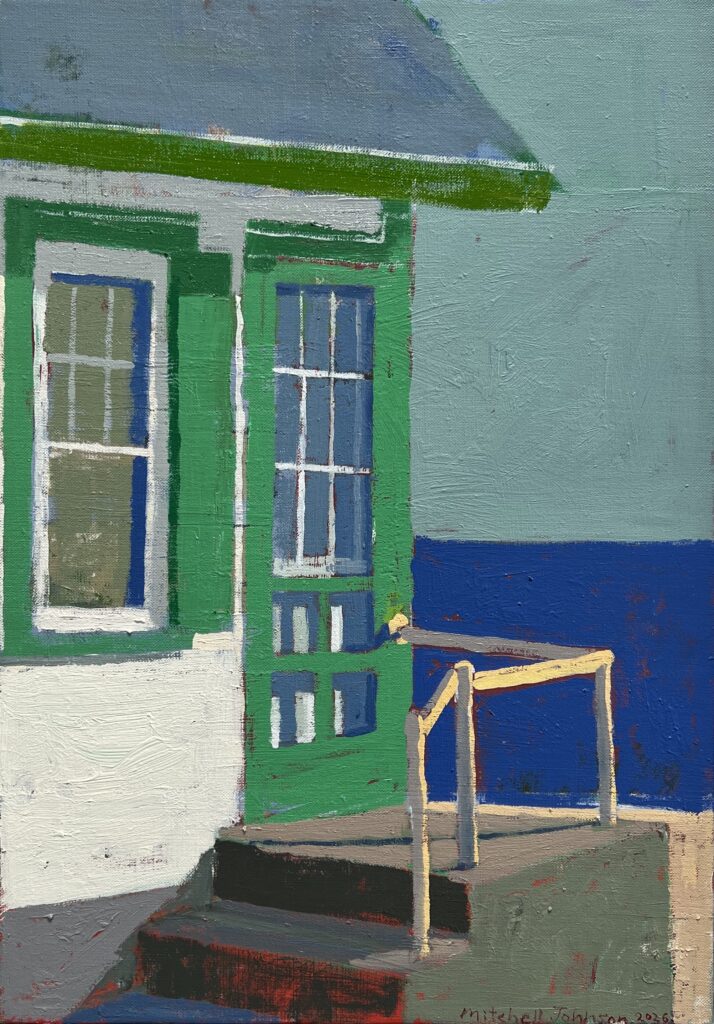
Paris and Aix were a revelation to Johnson, and he has been returning on a regular basis ever since. His Iranian-born wife, the writer and chef Donia Bijan, also has French connections, having studied at the Cordon Bleu culinary academy. It was only in 2018 that Johnson began painting in Paris while recovering from a bout of influenza there. Many of the twenty-five pictures in “Mitchell Johnson: Personal Color” in Galerie Mercier in Paris’s seventh arrondissement were made in the city during the last year, so the paintings are still fresh. The show also includes scenes of Tuscany, Morocco, New York’s Lower East Side, and North Truro, in Cape Cod, Massachusetts, which Johnson discovered in 2005. His son Luca reveals in an article for Whitehot Magazine that Johnson stays in the same motel room in Truro, from which he observes how the colors of the cottages’ walls change from “from bright white to soft grey” at different times of the day. Two magical pictures from 2025, each titled North Truro (Dusk), exemplify Johnson’s technique. At a casual glance, the two pictures may seem as identical as their titles, but differences emerge the longer you look. In one the cottage is closer to the viewer than the other and contains a flash of yellow light next to the window and close to the side door. Screen Door (North Truro), completed this year, shows the side of a white, green-shuttered house by a deep wintry-blue sea.
Paris and Cape Cod could link Johnson to Edward Hopper, even if that artist liked to underplay the role of European painting in his art. Hopper, arriving in Paris in 1906, stayed at a Baptist mission on the rue de Lille, five minutes away from Galérie Mercier. Works like L’aprés-midi du printemps (1907)and Le Pont Royal (1909) show that Hopper had absorbed Impressionist elements, which remained with him after his return to America. Hopper discovered Cape Cod in the 1930s and returned and painted there every year until his death in 1967.
Luca Johnson and Galerie Mercier’s press release mention the connection between Hopper and Johnson, but Hopper may be something of a red herring. The Stanford art historian Alexander Nemerov compares Johnson, rather, to Fairfield Porter. Nemerov also says that Johnson’s paintings “suggest” the art of Pierre Bonnard, Edouard Vuillard, Giorgio Morandi, and Josef Albers. (Nemerov’s essay is a favorite of Johnson’s.) The choice of “suggests” is essential since Nemerov observes that Johnson’s oeuvre does not betray many overt influences, let alone any “heroic artistic struggle.” Still, Morandi and Alpers were clearly formative for Johnson when he discovered them at the Museo Morandi in Bologna in 2005. But if he had to pick one painting as his favorite, Johnson would choose a small piece by Ambrogio Lorenzetti from the Louvre, as reported by Arts Intel. Johnson admires the Old Master’s use of color, which creates “the visual experience that makes a painting,” as well as his architectural forms that structure his pictures and give it “visual music.”
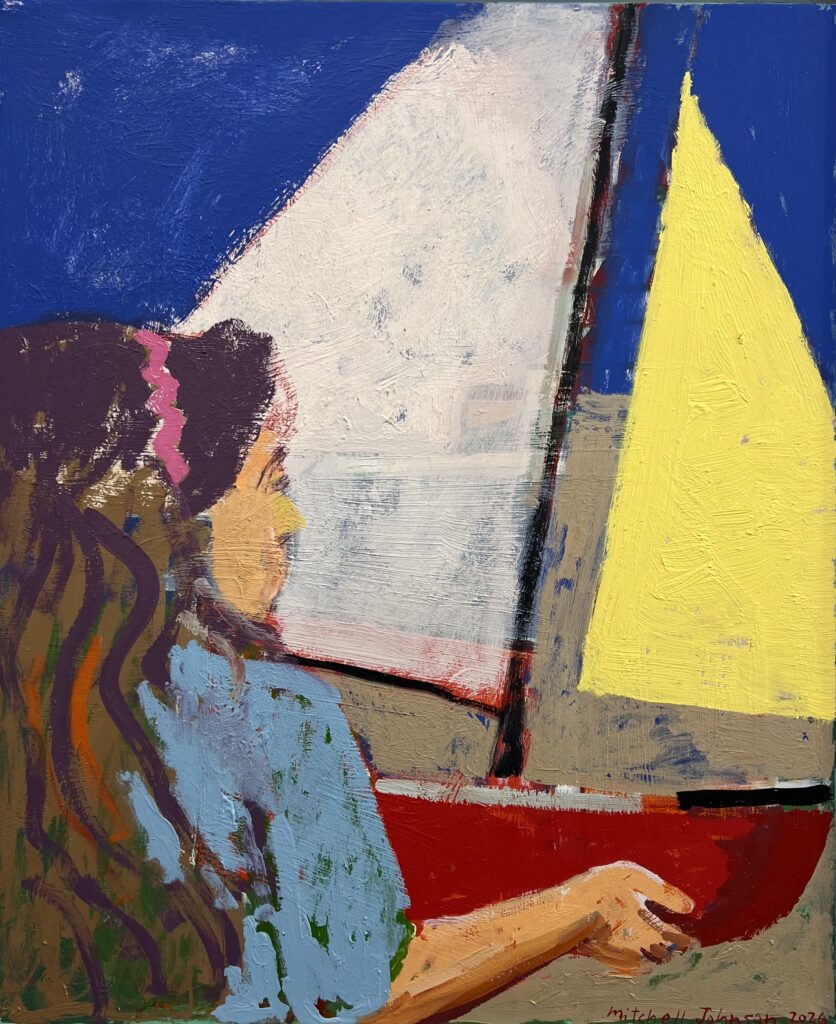
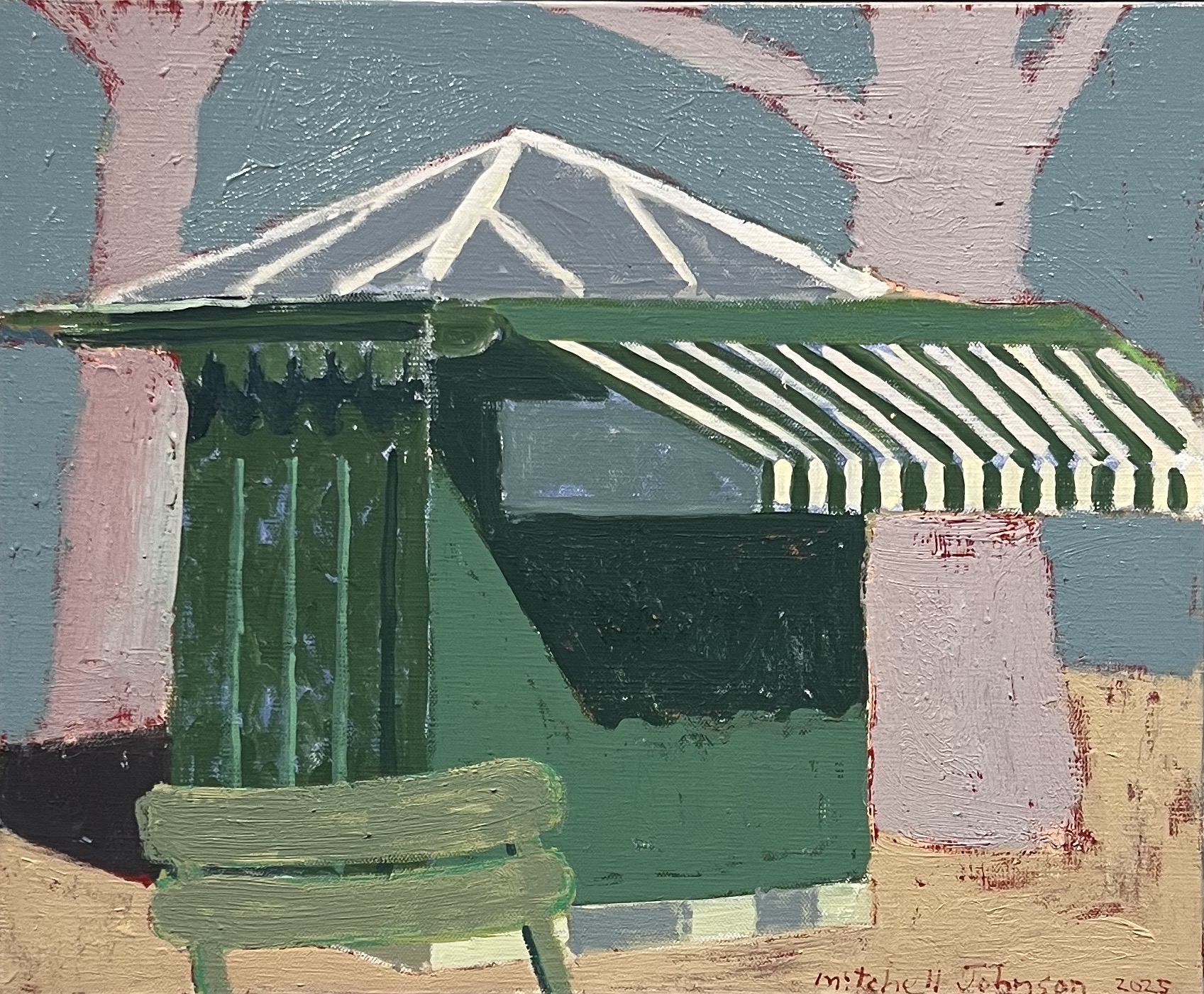
Johnson rarely includes people in his pictures. An exception in the exhibition is a painting of a young woman in a sundress with a mobile phone shading half her face. In another work we see a young girl launching a toy sailboat in a basin in Paris’s Luxembourg Garden. Johnson must have spent a lot of the autumn of 2025 in the Luxembourg, at least judging by the numbers of paintings set there. Luxembourg (Yellow and Orange) shows two shadowy figures standing on the garden’s sandy ground and chatting as they hold blue and red stripped umbrellas. Yellow and orange hues come from the tree leaves. Luxembourg Kiosk represents a shut green-and-white pavilion surrounded by large trees with majestic bare branches praying to the sky. Johnson’s art gives a sense of serenity, which is rare in a world of ever-increasing turmoil. The walls and bridge in Louvre (Blue and Red) (2025) seem of frozen sand; blue and red come from the boat passing under the bridge. Paris Ladder (2025) features green and pink rooftops and a white ladder sticking up among them, while Four Windows Rue Guisarde from the same year contains splashes of white paint on a sand-colored wall.
Describing these scenes only hints at the subtleness of these pictures. This small collection of Johnson’s paintings is a revelation to me and is likely to delight others as well. An added pleasure was to see two recent issues of The New Criterion, together with books about Johnson’s work, on a long table next to some of the artist’s pictures.