The concertmaster came out and played an A on the piano, for the orchestra to tune. The first piece would be a half step up—in the key of B-flat minor. The piece was the Tchaikovsky Piano Concerto No. 1. Is it the most famous piece in B-flat minor? Probably, alongside Chopin’s “Funeral March” Sonata.
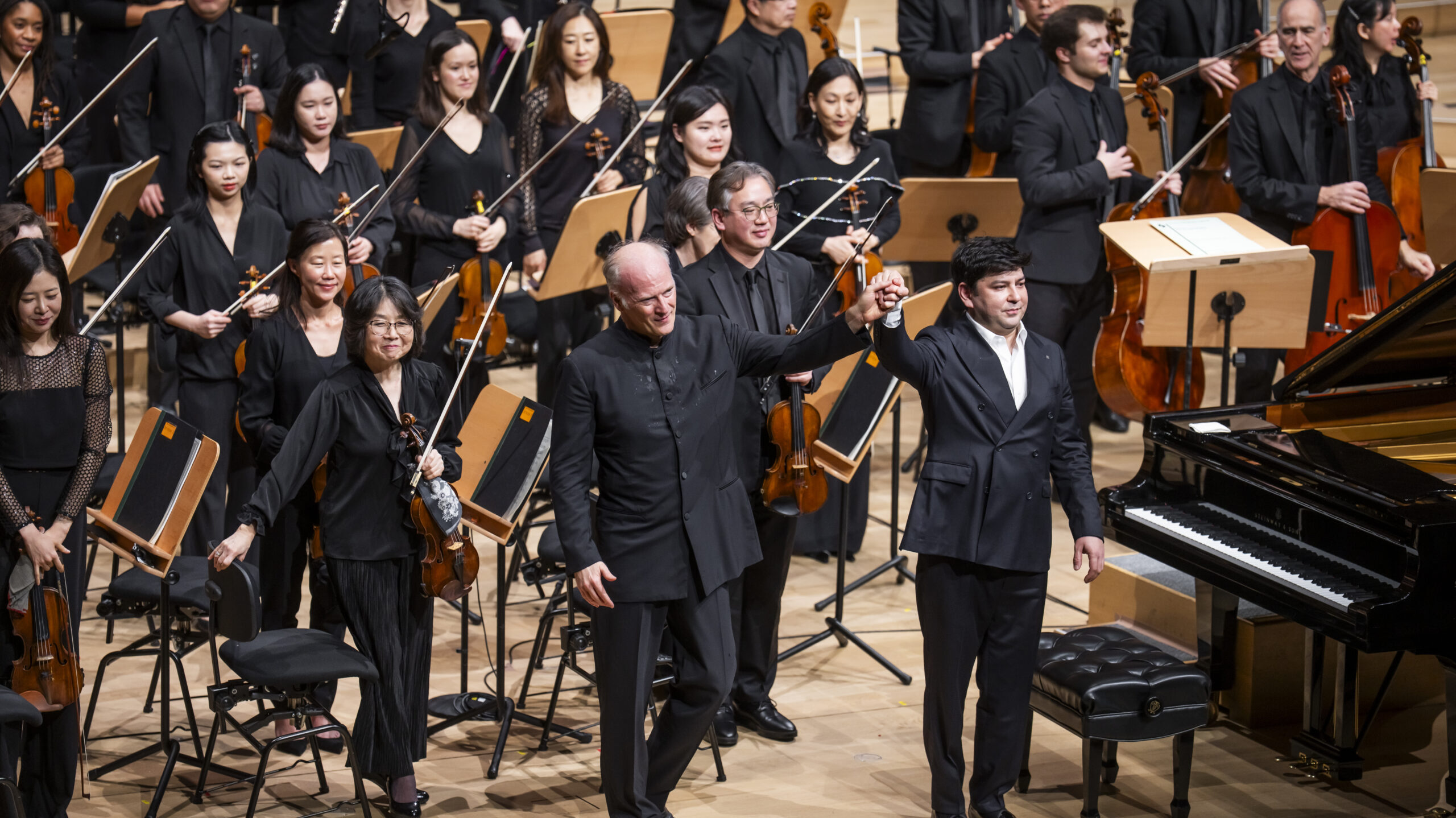
This was a concert of the New York Philharmonic on Friday morning. The conductor was Gianandrea Noseda, the Italian who serves as the music director of the National Symphony Orchestra in Washington. The pianist was Behzod Abduraimov, the young man—youngish (thirty-five?)—from Uzbekistan.
A piece such as the Tchaikovsky concerto—a very, very familiar piece—can be a problem. If you’re a pianist or conductor, you don’t want it to be a cartoon. A stereotype. At the same time, you don’t want to be willfully unconventional. You don’t want to perform the piece differently for difference’s sake.
One thing I always say is: “If a piece is hackneyed, it’s not its fault. Other people hackney it. The music is innocent.” I also think of Lorin Maazel, who in an interview with me said, “If you become jaded because of overexposure, the problem is yours, not the composer’s.”
To begin the Tchaikovsky concerto, the Philharmonic’s horns were a little blatty. The pianist, however, was exemplary in his chords: tight and free. Hang on, how can you be tight and free at the same time? The chords were played very crisply—and with freedom, bounce, and assurance.
He has a stupendous technique, Abduraimov. He can play so fluidly—so “horizontally”—you can hardly believe the piano is a hammer instrument. He’s a bit of a head-nodder: he tends to nod his head as he plays. Such players are seldom fluid—but Abduraimov is.
I wrote in my notes, “conscientious octaves.” What could that possibly mean? How can octaves be conscientious? They were not merely tossed off. Given his technique, Abduraimov can make musical choices with those octaves—those blizzards of octaves.
For him, the Tchaikovsky concerto is not much greater a technical challenge than a Haydn sonata. The only question that confronts him is: “What do I want to do musically?”
Some of his rubato, I thought—his license with time—was a little cutesy. Also, I think that some of the first movement lacked drive. But you always wanted to know what this pianist would do next. His phrasing in the cadenza was positively Cortot-like.
I must say, I hated—yes, hated—the pause before the final chord. (The final chord of the first movement.) I think a stricter tempo there is much more effective. But I’ll tell you what I loved: Abduraimov’s acknowledgement of the applause after the movement. He did not get up and bow, but he turned to the audience and smiled.
An audience would be nuts not to applaud after the first movement, and Tchaikovsky would be appalled. “Where did I go wrong?”
At the beginning of the second movement—the middle movement—the flutist Alison Fierst intoned her tune nicely. Some of this movement, I thought, was a little slow and disjointed. But Abduraimov did some dizzying things (no surprise). We heard plenty of lacy filigree.
To begin the finale, Abduraimov was not at his most articulate. The music, which is “ethnic,” could have been more sharply defined. But some of his playing was downright liquid.
In an opera review last week, I described a soprano as “liquid.” A pianist is not supposed to be—but it’s possible.
Let me say about the conductor, Maestro Noseda, that he really felt Tchaikovsky’s syncopation. He felt it in his shoulders and expressed it that way. The long and great crescendo that leads to the concerto’s climax, he built shrewdly.
Mr. Abduraimov played an encore, and he stuck with virtuosity: in the form of La campanella, a Liszt étude. It is in a very unusual key: G-sharp minor—which is less unusual when you realize that it’s no different from A-flat minor (no different in sound, that is).
In his Liszt, Abduraimov was fantastically—I’m going to have to use this word again—fluid.
After intermission, there was a symphony: No. 4 in C minor, by Shostakovich. When Noseda began it, I thought, “Yes. You can’t be afraid to be brash in Shostakovich. Shostakovich wants you brash there.” Some of the string phrases were carved out of rock (or so they seemed). Shostakovich wants that, too.
Besides brashness, what other “Shostakovich qualities” are in the Symphony No. 4? Intensity. Fear. Humor (gallows humor)? Puckishness. Savagery.
Throughout the symphony, Mr. Noseda knew what he was doing, and I believe the composer would have approved.
His symphony is practically a concerto for orchestra, or at least a work that showcases many first-chair players. I will cite just a few from Friday morning’s concert.
Julian Gonzalez arrested attention on his bassoon. Nick Masterson did the same on his English horn. Anthony McGill did the same on his clarinet. (Jauntiness is one of Mr. McGill’s outstanding qualities, and one of Shostakovich’s too, as it happens.) Joseph Alessi was rich and glowing on his trombone. And Frank Huang, the concertmaster, played sweetly.
The final pages were the picture of uneasy peace. Of an anxious restfulness. When the symphony was over, the audience was rapt, not making a sound. Is that because Noseda had his hands in the air, to ward off applause? Oh, no. That is (often) a cheap trick. Noseda’s hands were down by his sides. He, with Shostakovich, had simply produced the right atmosphere.