Evolution has not disproved the existence of God; it has proved that it could not take place without God. G.K. Chesterton made the point with his accustomed wit and clarity: “It is absurd for the Evolutionist to complain that it is unthinkable for an admittedly unthinkable God to make everything out of nothing, and then pretend that it is more thinkable that nothing should turn into everything.”
Charles Darwin produced the most pretentious book ever written, The Origin of the Species, in which he failed to prove the origin of a single species. Nonetheless, its influence was spectacular and proved conclusively that what people want to believe can be stronger than truth. Through Darwin’s work and that of his disciples, evolution was promoted to Evolutionism, absorbing into itself both philosophy and religion.
The German-born British philosopher and economist, E.F. Schumacher declared, in A Guide for the Perplexed, that “Evolutionism is not science; it is science fiction, even a kind of hoax. It is a hoax that has succeeded too well and has imprisoned modern man in what looks like an irreconcilable conflict between ‘science’ and ‘religion’.”
The distinguished journalist Malcolm Muggeridge is in perfect agreement with Schumacher: “I myself am convinced that the theory of evolution, especially to the extent to which it has been applied will be one of the greatest jokes in the history books of the future. Posterity will marvel that so flimsy and dubious an hypothesis would be accepted with the incredible credulity it has.”
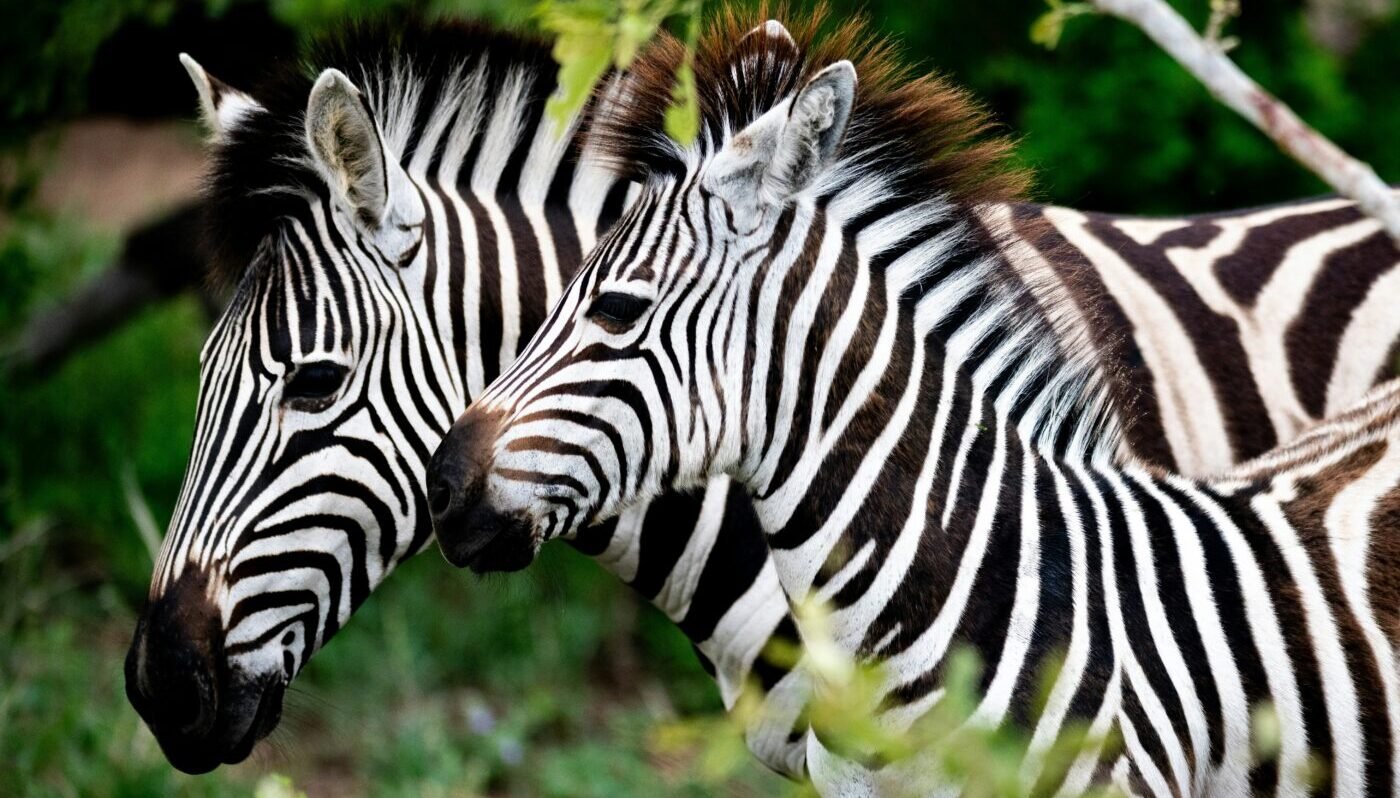
I will offer a refutation to Evolutionism by a cursory examination of a dazzle of zebras. (The collective terms “zeal” and “herd” also refer to a group of zebras).
What we first notice about the zebra is its black-and-white stripes—and these are not mere ornamentation. Zebras that live in African plains, where it is hot and where trees are few, need cooling. Black absorbs heat, white reflects it. There is scientific reason to believe, therefore, that the zebra’s black-and-white stripes form cooling corridors which lower its body temperature. Researchers have discovered that body painting in terms of alternating black-and-white colors may work for people in tribal communities.
Zebras are highly social animals. As a herd, their alternate black-and-white stripes function as camouflage and confuse their enemies. A dazzle of zebras can bedazzle its predators, like the black-and-white pinwheel can confuse sight. The striped pattern that characterizes the zebra is unique to each one, much like fingerprints. However, while humans cannot recognize their own fingerprints, zebras are born with the ability to recognize an individual zebra by the unique pattern of his stripes. This is of great help for a mother zebra when she is looking for her offspring.
A zebra never sleeps alone. It always sleeps in the herd for protection. Yet, we must ask, how does this instinct develop? It is not the result of chance modifications. Moreover, it applies to all zebras and not only those who were modified in this direction. Instinct is God’s gift to every animal.
A zebra has a muscular sheet within its skin that reacts so quickly to touch that it can flick away a blood sucking insect before it can bite. The zebra, like all animals, is a marvel of instinct, endowment, and fitness.
None of these zebra features are explainable by Darwinian evolution. Darwin held that an individual organism changed as a result of chance encounters, one modification at a time. Gradually, over a multitude of years, and the result of numerous modifications, a new species would be formed (or evolved). But this was pure theory, plausible as it might appear, and Darwin failed to prove in any instance that this gradual metamorphosis actually produced a new species.
In addition, the changes that Darwin observed were all related to individual members of a species. There is nothing in his theory that deals with synchrony, that is, changes in one individual that are harmonious with changes in another individual of the same species. One zebra has black-and-white stripes. But how is it that this zebra can recognize the individuality of another zebra? There must be synchrony that allows different organisms to be in harmony with each other. Why do zebras have affection for other zebras? How is it that they are altruistic enough to mate, but only with members of the opposite sex?
Darwinism speaks to the development and change of the individual organism. He is at a loss to explain how aptitudes in one animal fit perfectly and practically into aptitudes of another animal of the same species, but never for a member of a different species. The alignment between members of the same species requires an altogether different level of explanation than what Darwin or his disciples could provide.
The God hypothesis becomes reasonable. It is infinitely beyond the realm of pure chance that billions of cells (in the Zebra or in the human) could be organized into a living and functioning unity. Natural selection shines no light on this. Darwin does not account for the existence of fauna and flora prior to any subsequent changes.
Zebras have two outstanding features. They function very well and have been around for millions of years. Secondly, they are beautiful. Who but an omnipotent God could so splendidly harmonize function and beauty?
Photo by Jochen van Wylick on Unsplash