This March, American Contemporary Ballet presented two masterpieces by George Balanchine: Concerto Barroco and La Source. Led by its artistic director and founder Lincoln Jones, ACB has distinguished itself by its combination of neoclassicism and sensual modernism, always with live music. As a professional dancer who once performed in ACB’s Nutcracker Suite, I have long been an admirer of the company’s approach to ballet. While each of these works presents challenges in a small space, the company did justice to Balanchine.
The ballet’s black-box style theater, actually a sleekly converted office space on the bottom floor of the Bank of America building in downtown Los Angeles, allows audiences to enjoy Balanchine in an elegant and freshly intimate way. Entering through the curtains, one finds a cocktail area on one side and a pianist playing mood music under a blue light on the other, separated by the black Marley dance floor, over which one has to walk to get to the seats. Draped curtains partition off the audience from the dancers preparing for performance “backstage.” It feels midway between a speakeasy and a cocktail soirée.
In keeping with the salon-like theme, the evening began with the violinists Michael Freed and Ani Sinanyan playing Johan Halvorsen’s Passacaglia, a virtuoso adaptation of a movement by Handel. The two musicians attempted to one-up each other, a dynamic mirrored in the opening ballet that followed.
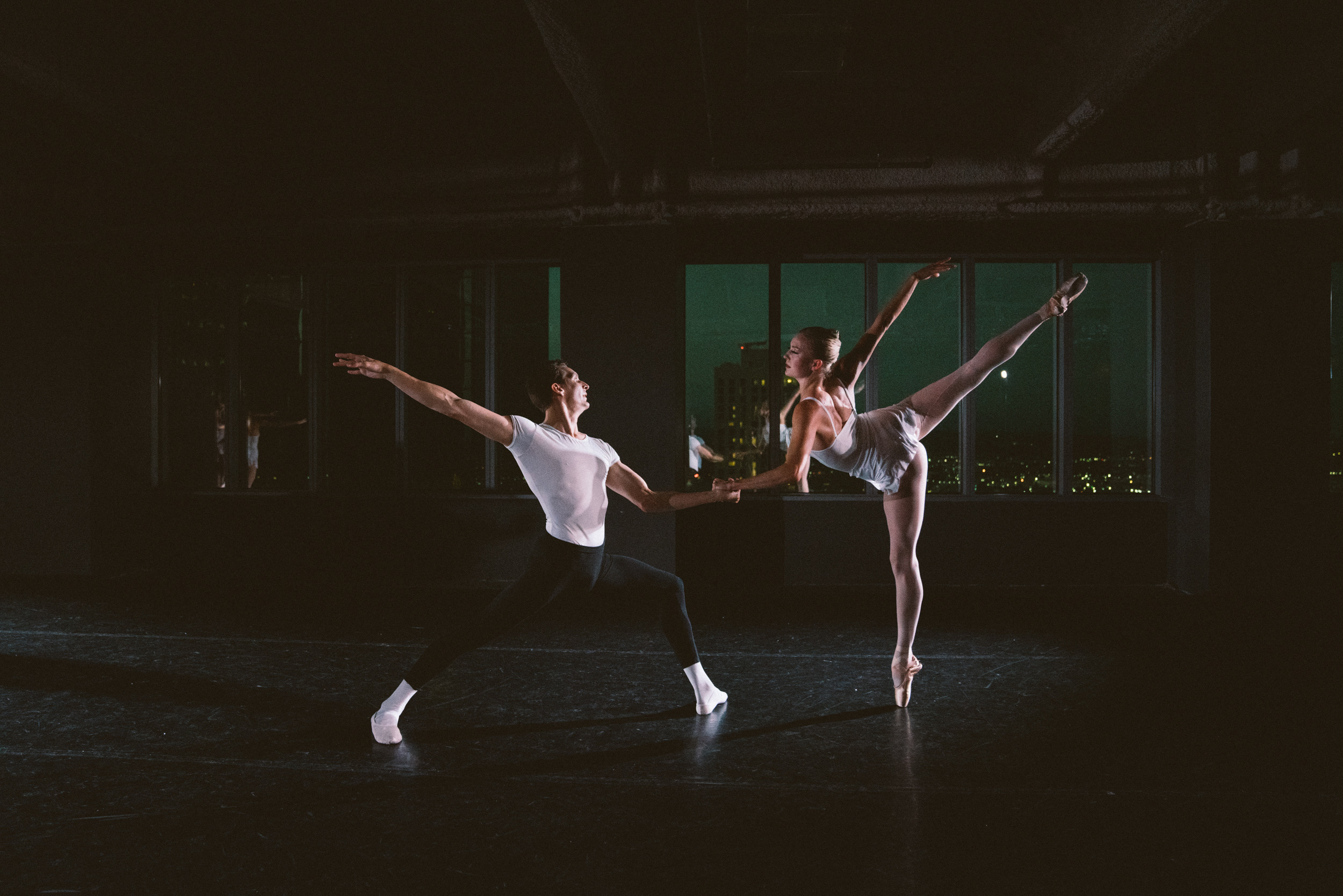
Concerto Barroco is set to Johann Sebastian Bach’s Concerto for Two Violins and features eight corps women and two female principals, the First and Second Violin, danced by Madeline Houk and Annette Cherkasov respectively. The two amazonian performers danced in counterpoint, arms and legs crossing in sharp and musically accented diagonals.
In the second movement, the male principal (Maté Szentes) enters to support Houk’s First Violin. A standout dancer in the company, Houk possesses a refined sense of line and tempo, moving with the music and displaying the purity, detachment, and lack of ego that neoclassical ballet requires. Szentes also has a certain aloofness that Balanchine might have liked. He was a calm and reassuring partner, carrying Houk around through the fluid formations of the corps, promenading her in arabesque, as her leg flew over the heads of the ensemble in geometrical formations.
The final movement was an exercise in devilishly precise footwork for the corps, who danced the difficult tempos in unison, the way Balanchine would have liked, each step married to lightning-quick notes, no doubt thanks to the coaching of the Balanchine repetiteur Zippora Karz. Sitting so close to the stage, one can discern the dancers’ audible breathing, the glisten of their sweat, and their eyes darting subtly to check their spacing with the other corps ladies. One appreciates the intricacy of Balanchine’s corps work, as well as the precise virtuosity of the soloists.
This neoclassical work is one of Balanchine’s earlier American ballets, having premiered with the American Caravan Ballet on its South American tour in Rio de Janeiro in 1941. Originally, Balanchine had intended for it to be an exercise for his students at the still-nascent School of American Ballet. It featured designs by Eugene Berman, which were eventually scrapped for the now-familiar black-and-white practice clothes. Today, it is a technical challenge for any ballet company.
Following an intermission, Sinanyan on the violin and Jay Tilton on the celloperformed Jean Sibelius’s Duo for Violin and Viola in C major. In featuring classical musicians as an overture to each ballet, Jones acknowledges the respect Balanchine had for his musical forefathers. After all, ballet arises only from musical notes, which receive visual counterparts in dance.
La Source was the sprightly follow-up, with music by Léo Delibes. Its fast footwork lends it a perfumed French air, likely inspired by Violette Verdy, the ballerina who first performed the principal role. With her lightning jumps, willowy port de bras, and an immense sensitivity to music, Verdy gave Balanchine’s ballets an energy of her own, even if she was shorter than the typical, leggy Balanchine ballerina. Dancing Verdy’s role was the young Cecilia Johnson, partnered again by Szentes. Quincey Smith was the soloist leading a familiar corps of eight. Johnson danced the solos with a warm presence that belied the technicality of the richly compacted dance phrases. Szentes’s variations followed with surprising changes of direction and batteries that carried through the French influence. While the shallow dance space barely allowed for the circular manège jumps capping the variation, Szentes proved capable of adaptation.
A program of two one-act ballets can be considered rather modest, even for a chamber company such as ACB. If there was a through line in the program, it could be inferred from the fact that both ballets featured the same number of dancers: eight corps women, two female soloists, and one male principal. Between the sleek mathematical futurism of Balanchine’s Concerto and the fleeting French insouciance of La Source, Jones appears to be making a statement about the infinite combinations that Balanchine found within the classical tradition and its eternal, finite vocabulary.
In his program notes, Jones alludes to the fact that Balanchine saw himself as the inheritor of a tradition, not the avant-garde reinventor that his reputation as the “Father of American Ballet” might suggest. Balanchine is performed more today than other dance innovators of the twentieth century precisely because he did not rebel against tradition but rather absorbed it. As Jones writes, “While the artistic statements of erstwhile reinventors now look quaint and dated, many of Balanchine’s ballets now seem of the future.” In the early 1930s, before Balanchine achieved prominence in America, many critics saw the likes of Hanya Holmes and Doris Humphreys as the originators of a new American dance. The novelty of their muddled earthiness, however, proved fleeting, whereas Balanchine’s works, when performed well, often seem as if they were choreographed yesterday.
Today, formerly traditional Balanchine companies, such as Pacific Northwest Ballet and Charlotte Ballet, increasingly have their dancers trade in pointe shoes for shin-length socks, in which they perform various combinations of rolling around on the floor. While such soapy rebellions should not be rejected out of hand, the musical salon that ACB offers is infinitely more memorable and impactful.