Music loves a centennial as much as the next industry, maybe more. Last year, music marked two centennials (at least): that of Pierre Boulez, the French composer and conductor; and that of Dietrich Fischer-Dieskau, the German baritone (who took up the baton later in his career).
This year, the music world is honoring the centennial of György Kurtág, the Hungarian composer (and pianist, too). But here’s the difference: Mr. Kurtág is still with us.
Elliott Carter, the American composer, lived to 103 (about a month short of 104). I interviewed him on the eve of his hundredth birthday, in 2008. He greeted me at the door of his home and had been reading, on his sofa, essays on art by Meyer Schapiro.
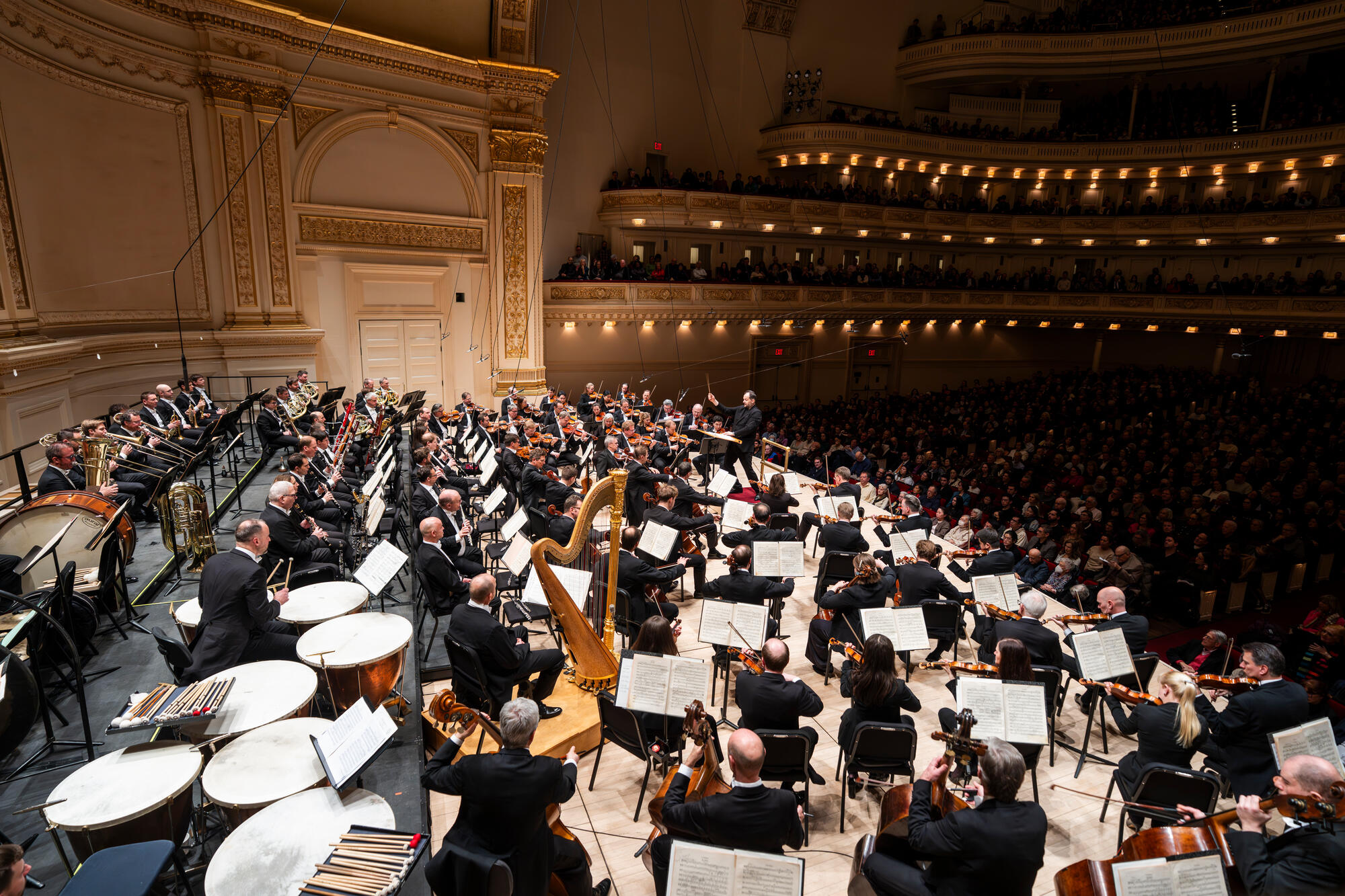
On Saturday night, the Vienna Philharmonic Orchestra opened its concert at Carnegie Hall with a piece by Kurtág. The VPO played three concerts at Carnegie. The first was on Friday night, the third on Sunday afternoon. I will address—more like lament—the first concert in a forthcoming chronicle for the print magazine. And I will address the third concert here on the site tomorrow.
Conducting these concerts was Andris Nelsons, the Latvian who is the music director of the Boston Symphony Orchestra and who is a frequent guest of the Vienna Philharmonic—which has only guests, not a music director.
Saturday night’s concert opened with Kurtág’s Petite musique solennelle: en hommage à Pierre Boulez 90. Kurtág wrote this piece in 2015 in honor of Boulez’s ninetieth birthday. Boulez would die before turning ninety-one. The piece can be heard as an elegy. It’s true to its name: a little solemn music.
He is a remarkable craftsman, György Kurtág. His musical intelligence is unshowy. It’s maybe a credit to the world that he got so famous while being so unshowy.
Next on the VPO program was a Mozart symphony: No. 36 in C major, nicknamed the “Linz” (because Mozart wrote it in that city while returning to Vienna, where he lived, from Salzburg, where he was from). Before the symphony began, I thought of something a member of the orchestra told me in 2024. I quoted him in my “Salzburg chronicle” that year:
First, people said that we really shouldn’t play Baroque music. It is not “correct” for an orchestra like ours to play Bach, Handel, and the others. Now people are saying we shouldn’t play Classical music, including Mozart.
I went on to comment,
For almost two centuries, the Vienna Phil has played Mozart—symphonies, concertos, operas—conducted by such Mozarteans as Gustav Mahler, Richard Strauss, Bruno Walter, Wilhelm Furtwängler, Josef Krips, Karl Böhm, and James Levine. Were those men wrong? Was the orchestra wrong? If the Vienna Philharmonic ever drops Mozart, it is Mozart who will be wronged.
On Saturday night, the “Linz” was nicely turned out. Basically graceful, and never incorrect. But there was an air of sleepiness over the whole affair. The music sometimes could have used more . . . punch?
After intermission, there was a Dvořák symphony: No. 6 in D major. This is an underplayed, underprogrammed, Dvořák symphony, it seems to me. We regularly hear No. 7 in D minor, No. 8 in G major, and No. 9 in E minor (“From the New World”).
(Never mind, for now, that people use different numbering systems for the Dvořák symphonies.)
You know what is also underplayed and underprogrammed? No. 5 in F major. My colleague Antoine Leboyer has pointed this out. Several years ago, the Berlin Philharmonic and its chief conductor Kirill Petrenko had great success with No. 5.
Dvořák composed his No. 6 in 1880. It had its Carnegie Hall premiere in 1892, a year after the hall opened. Doing the conducting was Antonín Dvořák himself.
For many, the pièce de résistance of the Symphony No. 6 is the third movement, the Scherzo—which brings us a furiant, defined by Merriam-Webster as “a spirited Bohemian dance tune in 3/4 time with shifting accents.”
How was the Vienna Philharmonic on Saturday night? Fine. Principal players did their jobs. The French horns were reliable. The flute could have charmed the birds out of the trees.
But I could have used more . . . punch, verve—abandon, even. That dance could have been more sharply etched.
Saturday night’s concert was better than Friday night’s—significantly. But Sunday afternoon’s? Oh, my. I’ll tell you tomorrow.