
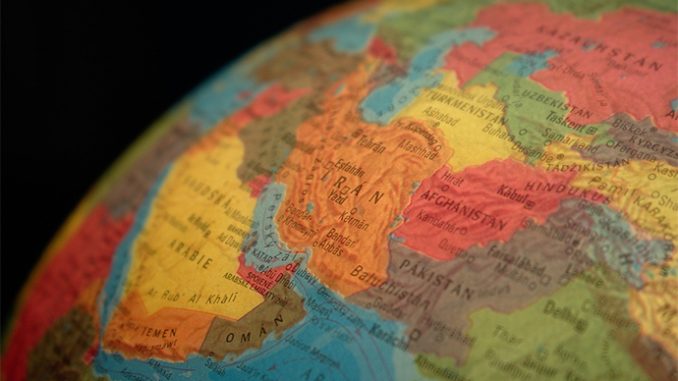
The present war with Iran has been negatively appraised by many Catholics. Some of the arguments advanced by these critics are of poor quality, characterized by irrational suspicion and animus, but others are serious and respectable. As a reluctant supporter of the conflict, I wish to strike a different note and contend that, on balance, the war is just, lawful, geopolitically warranted, and consistent with conservative principles and President Trump’s stated foreign policy prescriptions and objectives.
Let’s start by assessing the conflict’s justice. Fundamentally, this is a war of national defense. Since its founding in 1979, the Iranian regime has had the United States in its crosshairs, literally and figuratively. Beginning with the 444-day hostage crisis, it has persistently targeted American assets and harassed and killed American citizens. The hands of the Iranian regime are drenched in American blood. As recently as 2024, it was scheming to assassinate American citizens—including President Trump – on our own soil. Granted, some of the most infamous acts of Iranian aggression were effectuated by its proxies. But these proxies were and are trained, supplied, funded, and directed by the Iranian regime.
Therefore, far from being a hypothetical and imminent threat, Iran is a real and present threat to America’s property and people in the region and beyond. Little surprise, given the regime’s motivating ideology, an apocalyptic and messianic variety of Shia Islam, which envisions Iran as a divine instrument wielded by God against infidel powers. Against this backdrop, the regime’s shadowy nuclear program (the status of which is admittedly uncertain) represents a fearsome and persistent problem for the community of nations, and its impressive missile program stands as an intolerable hazard to the regional order and our interests therein.
However, even a defensive war must meet certain criteria to guarantee its justice. First, the damage of the aggressor must be lasting, grave, and certain. I have already shown that Iran has spent fifty years killing American citizens, destroying American property, and undermining American interests. It will not desist from this course of action, given its ideological foundations, internal dynamics, and strategic incentives. This is the indisputable teaching of history.
Second, all reasonable alternatives to war must be unavailing or untenable. Again, we have spent fifty years exhausting other remedies. Despite our carrots and sticks, the Iranian regime remains obstinate and decidedly set on exporting violence and terror abroad in furtherance of its brand of revolutionary Shia Islam. Absent drastic measures, the regime will remain essentially belligerent, paranoid, and expansionistic.
Third, there must be a genuine prospect of success. The immediate aims of this war are to punish and weaken the regime, to eliminate the remnants of its nuclear program, and to severely disrupt its missile capacity—such that it will be unwilling and unable to assail the United States in the foreseeable future. These goals are well-defined and feasible to obtain. They are even now being accomplished. In less than a month, the United States has shattered the regime’s command and control structure and considerably degraded its military. If operations continue apace, another month or so will likely find the regime significantly reduced and disintegrated, susceptible to an imposed settlement on American terms.
Fourth, a war must not create evils that are more abundant and grave than the evils it resolves. This is the hardest criterion to defend, being so speculative. It is possible that our intervention might go awry or prove ineffective, leading to chaos and instability, and intensifying the cycle of revenge, thus making a bad situation worse. Without a doubt, Trump has taken a huge gamble: high risk, high reward. However, it is not at all unlikely that the regime will emerge chastened, impoverished, stripped of its most lethal implements of war—and consequently unable to project force beyond its borders in a meaningful way. Plausibly, the regime will collapse and be succeeded by one that is relatively benign, or perhaps it will endure under the sway of more cooperative elements, after the model of Venezuela.
We have confirmed the war’s basic justice. But what of its legality? Some maintain that the Constitution reserves the authorization and initiation of military force to Congress. This is not correct. Rather, the Constitution empowers Congress to “declare War” (Article I, Section 8, Clause 11). But “authorization” and “initiation” are not within the sense of the word “declare” as used at the time of ratification, as evidenced by then-contemporary English dictionaries. Additionally, drafts of the Constitution, by Butler and Hamilton, for instance, indicate that a “field command” concept of the Presidency was entertained and discarded.
Indeed, it has been compellingly argued that the power to declare war and the power to make or engage in war (and, more broadly, to undertake military action short of war) are distinct, with the latter vested squarely in the President by virtue of his role as Commander-in-Chief. Per usual, Congress relies on its control of the purse and the threat of impeachment to regulate the President’s conduct. (Ironically, the constitutionally dubious War Powers Act tacitly acknowledges the discretion of the President in this domain, insofar as it contemplates and thus permits him to unilaterally undertake military action for short periods.)
Note that the United States has only declared war eleven times in connection with five conflicts, and not once since 1942. However, since 1789, the President has overseen and carried out hundreds of military operations, some with prior congressional consent, some with subsequent congressional ratification, and some without any specific congressional input or affirmation whatsoever. As a matter of prudence, it may be preferable for the President to consult with Congress in connection with military action. But as a matter of law, the necessity of such consultation is debatable.
Not only is the war with Iran just and legal, it is also geopolitically rational and strategically warranted. We have already seen that the Iranian regime is a deadly, dedicated, and longstanding antagonist of America. However, we must appreciate that Iran is not really about Iran. Rather, it is about China. (In this, it is like Venezuela, which was also about China.) There is only one serious threat to American peace and prosperity: the People’s Republic. It alone can displace us as global hegemon and gradually turn the mechanisms and structures of the international order against our nation, with all the precariousness that entails (see post-Soviet Russia).
The “small world” of the modern age will always have a hegemon, and that hegemon will enjoy a singular degree of tranquility and abundance. Currently, we have hegemony; China wants it. This dynamic sets up a collision. We will come to blows with China in the next decade, most probably. When this tremendous conflict arrives, it must be contained to East Asia, else it will exact a horrible toll on our nation.
To ensure its confinement to that far theater, America must get the greater Western house in line, which means rolling back Chinese influence in Europe, Africa, the Americas, and the Middle East. Iran functions as a forward operating base for China, just as Venezuela did prior to the capture of Maduro. Few in the West appreciate the economic and military links between Iran and China, making it difficult for them to grasp the geopolitical import of the present struggle. Indeed, this “minor war” might well prevent a “major war,” for ultimately China’s willingness to decisively contest American hegemony depends on its ability to leverage and activate occidental strategic subordinates, chief among them Iran.
From a conservative perspective, there is good reason to question this conflict. War always consumes blood and treasure, and often enough it subverts republican institutions, feeds corporate cronyism, and aggrandizes the federal government. Yet conservatives are ultimately Augustinian realists, committed to shrewdly managing the affairs of state with an eye toward the harsh realities of fallen human nature.
In fact, the United States has been regularly engaged in armed conflict since its establishment, for we are a vast country with global interests and a keen sense of destiny. Over the past two and a half centuries, we have made war in, on, or against Britain, Mexico, Spain, Cambodia, France, Germany, Lebanon, Turkey, Russia, Vietnam, Grenada, Afghanistan, Libya, Yugoslavia, Panama, Romania, Cuba, Italy, China, Somalia, Syria, Iraq, and others besides. This is the cost and consequence of imperium, which we grasped at from day one, and finally inherited in the wake of World War II.
There is in the conservative tradition a laudable tendency to look askance at foreign adventures. But this skepticism has always been balanced by a clear-eyed view of America’s far-reaching interests in a dangerous world, and, in recent times, a dutiful recognition of our role as the key guarantor of international order. We have enemies, and when they aggress against us, they must be dealt with sharply and swiftly, else our dominion (which redounds to the benefit of the whole world) will be disturbed and havoc ensue.
Finally, we must address the odd notion that this war marks some kind of shocking betrayal by Trump. The President has been an open and avowed Iran hawk since the hostage crisis. In fact, he publicly mused about seizing Kharg Island in 1988. He stated plainly in his famous golden escalator speech that he would not abide a nuclear-armed Iran, and in his first term, he took the audacious steps of exiting the Obama-era JCPOA and assassinating top IRGC commander Qassem Soleimani.
Trump is not and has never been an isolationist or non-interventionist. His highly idiosyncratic foreign policy is best described as sovereigntist or Jacksonian. His criticism of American war-making has been more or less confined to conflicts he deems “stupid” (i.e., open-ended ground operations that involve nation-building and democracy-sowing). It was entirely predictable that Trump would strike Iran, given his record and considering the relatively favorable outcomes of his earlier exercises of American might. No one who has listened carefully to his words can reasonably register outraged surprise.
A war merits our reluctant support if it is just, legal, strategically advisable, and consistent with sound principles and existing policies of a generally successful character. Such is, I think, the case here. Of course, we must not celebrate the conflict with Iran. Many have perished—men, women, children. Many more will perish. The death of a human being, even a wicked one (especially a wicked one!), cannot be adequately lamented. Moreover, we must hold our leaders accountable for mistakes made and misdeeds perpetrated in the prosecution of the endeavor. Yet we cannot shrink from the tragic necessities of circumstance, lest we give room to the schemes of malefactors, and thereby forsake any sure hope of temporal peace and prosperity.
If you value the news and views Catholic World Report provides, please consider donating to support our efforts. Your contribution will help us continue to make CWR available to all readers worldwide for free, without a subscription. Thank you for your generosity!
Click here for more information on donating to CWR. Click here to sign up for our newsletter.