George Balanchine, the Russian choreographer known as the father of American ballet, will always be synonymous with the New York City Ballet. But on the West Coast, San Francisco Ballet, under the aegis of the artistic director Tamara Rojo, is now honoring its own roots as a Balanchine company.
Lew Christianson, one of the company’s founders, was an alumnus of Ballet Society, which preceded the New York City Ballet. He also held the distinction of being the first American dancer to take on the title role in Balanchine’s Apollo. Christianson brought Balanchine’s ballets to San Francisco upon assuming the directorship, and one of his successors, Helgi Tomasson, was also a product of Balanchine’s School of American Ballet.
Despite this history, it’s hard to remember the last time San Francisco Ballet mounted an all-Balanchine program. The French-leaning technique of the company is more rounded and smoother than the angular, accented technique that Balanchine inspired, but a combination of refined classicism and Balanchine modernism can yield sublime results, as a recent performance of Balanchine’s Diamonds, Serenade, and Stars and Stripes proved.
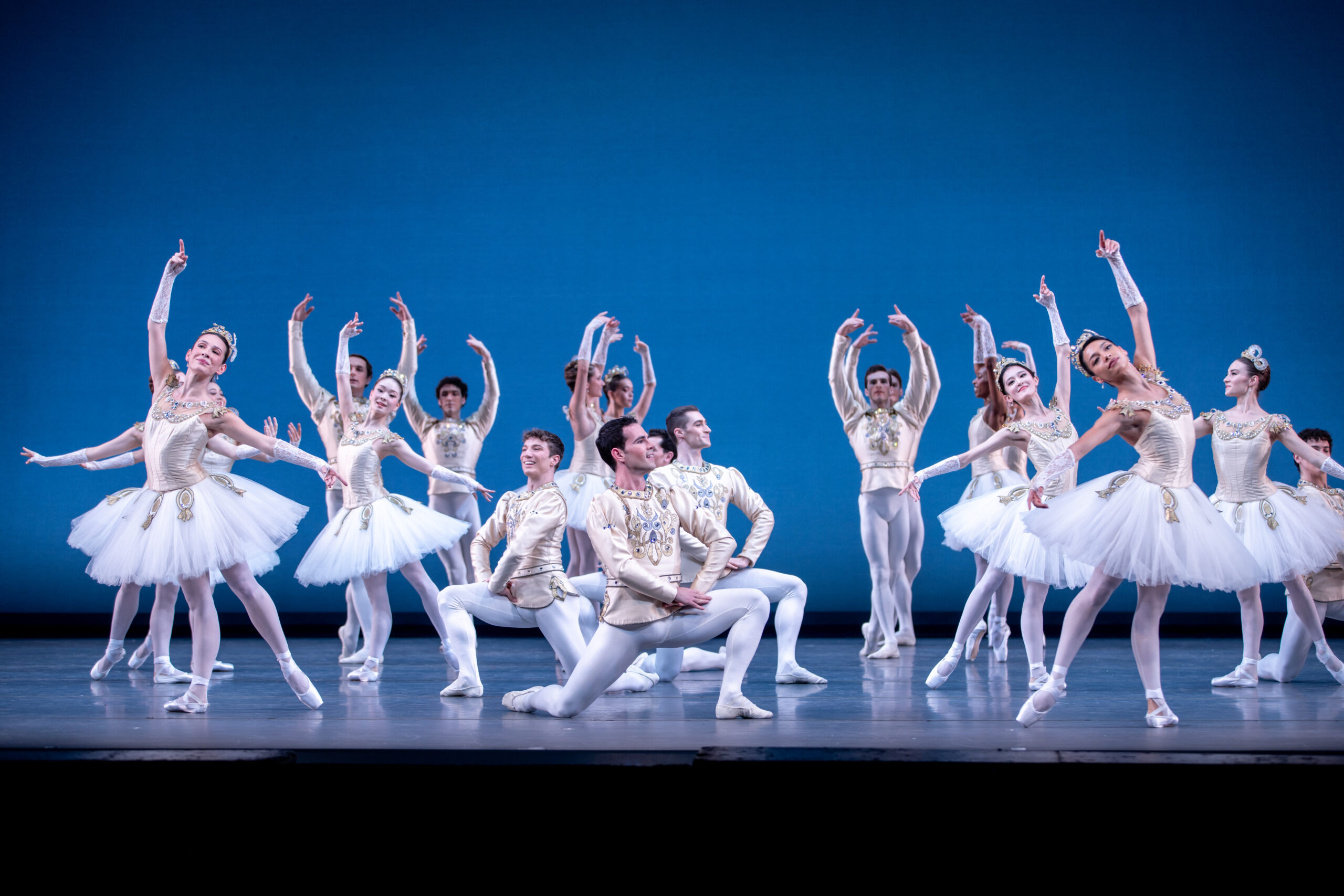
The evening opened with Diamonds, which demonstrated the technical prowess of the entire company. It is the finale of Balanchine’s three-act storyless ballet Jewels, a chef’s platter of standalone balletic techniques—united only by the designer Karinska’s jewel-inspired costumes. Diamonds nods to Balanchine’s roots in the Imperial Russian Ballet and is set to Tchaikovsky’s Symphony No. 3 in D Major, Op. 29.
Staged by the Balanchine repetiteur Sandra Jennings, Diamonds is perhaps the most prestigious work to mount, requiring absolute synchronization among the corps de ballet. But the high point of the piece is its romantic pas de deux: here, Sasha De Sola and Harrison James begin by walking toward each other from opposite corners of the stage. At one point, James kneels and holds De Sola’s hand as she balances in arabesque, elongating her leg behind. De Sola lets go and floats weightlessly in an arabesque turn before spiraling away from him, executing a seamless double turn where most dancers only manage a single.
Balanchine had intended the role to be interpreted as a princess, rather than as a queen, carrying the ethereal, regal sweetness that his greatest muse, Suzanne Farrell, embodied so well. De Sola succeeds in channeling Farrell’s essence while making the role her own.
In the finale, seventeen couples emerge from upstage together in a polonaise procession, reminiscent of Marius Petipa classics such as Swan Lake and Sleeping Beauty. Under Jennings’s guidance, San Francisco’s corps of dancers were faithful to Balanchine’s style and tempos.
Executed with characteristic precision, Serenade, set to Tchaikovsky’s dreamy Serenade for Strings in C, Op. 48, followed. It is Balanchine’s first ballet (choreographed in America in 1934) and his quintessential work. The curtain opens with seventeen moonlit women in ethereal blue skirts, each with one arm raised, as if shielding herself from the sun. Recalling the beginning of a ballet class, they turn their feet out in unison to first position.
Although a ballet about ballet itself, Serenade also has moments of winsome humanity. Balanchine is known to have been inspired by rehearsal mishaps and built them into the ballet, such as when the Waltz Girl, performed here by Jasmine Jimison, arrives late to the corps formation just before the start of the “Waltz” movement. The Waltz Boy, danced by the lyrical Wei Wang, taps her on the shoulder as if to awaken her. The “Waltz” and “Russian Dance” movements are filled with flowy shows of formation, powerful jumps by the Russian Girl (the principal dancer Nikisha Fogo), and elegiac digressions, at the end of which the Waltz Girl spins out of control. Her hair falls from her tidy bun, cascading over her shoulders as she falls to the floor, another happy accident that Balanchine borrowed from rehearsal. A man (Joshua Jack Price) enters from upstage, one arm outstretched, and makes his way blindly to the girl on the floor. Behind him trails the Dark Angel (Elizabeth Powell), one arm wrapped around his waist, the other crossed over his eyes.
In the “Elegy” movement, Balanchine plays on artistic and mythical tropes, inspired no doubt by his years wandering through European museums while on tour with the Ballets Russes impresario Sergei Diaghilev. The Waltz Girl and the man meet in a striking tableau reminiscent of Antonio Canova’s neoclassical sculpture Cupid Revived by Psyche’s Kiss. For his interpretation, Balanchine adds to Eros and Psyche the presence of the foreboding Dark Angel. The Waltz Girl dances with the Eros figure until she falls limp in his arms. Upon awakening, she runs to the embrace of a mother figure only to slip through to the floor. The Waltz Girl is then lifted by three men in blue, carried upstage on their shoulders, her arms outstretched, chest open, welcoming the light from above.
Although Balanchine insisted it was plotless, Serenade almost certainly tells some kind of story. “Elegy” has been interpreted as a dream or culmination of a girl’s journey as an artist. There may be more melancholy at play, however. In her new book, Balanchine Finds His America, Elizabeth Kendall writes that the choreographer had known young ballerinas who lost their lives, including his former classmate Lidia Ivanovna at the Imperial Ballet School, who died in a tragic accident in 1924. Extrapolating, Kendall notes that the “equation” of a girl so divinely gifted that she must meet doom in the end is the animating force behind the classics that Balanchine revered growing up, such as Giselle and Sleeping Beauty.
Following an intermission, Stars and Stripes begins with bright, brassy Americana scored by John Phillip Sousa and arranged by Hershey Kay. Originally performed in 1958, it is Balanchine’s tribute to his adopted country. San Francisco did well to put this showstopper last.
In their soldier costumes, Misa Kuranaga and Joseph Walsh performed with all the infectious energy of a high-school gym squad. Kuranaga executed spirited double piqué turns as Walsh ran toward the audience with boyish verve. Neither had any trouble keeping up with the lightning tempos set by the conductor Martin West, who honored the hallmark speed of Balanchine’s musicality.
This baton-twirling fest concluded with an American flag as the backdrop. Lest this be taken as overly patriotic, however, when the curtain came back up for bows, each dancer waved a flag of his own choosing, one or two pride flags appearing in the throng.
Aside from the rather misplaced cosmopolitanism, Stars and Stripes served as a bubbly finish for San Francisco Ballet’s program. As Valentine’s Day weekend confections go, these works were a success and featured appropriate amounts of overcrossed fifths, elbowy port de bras, and tasteful affectation.