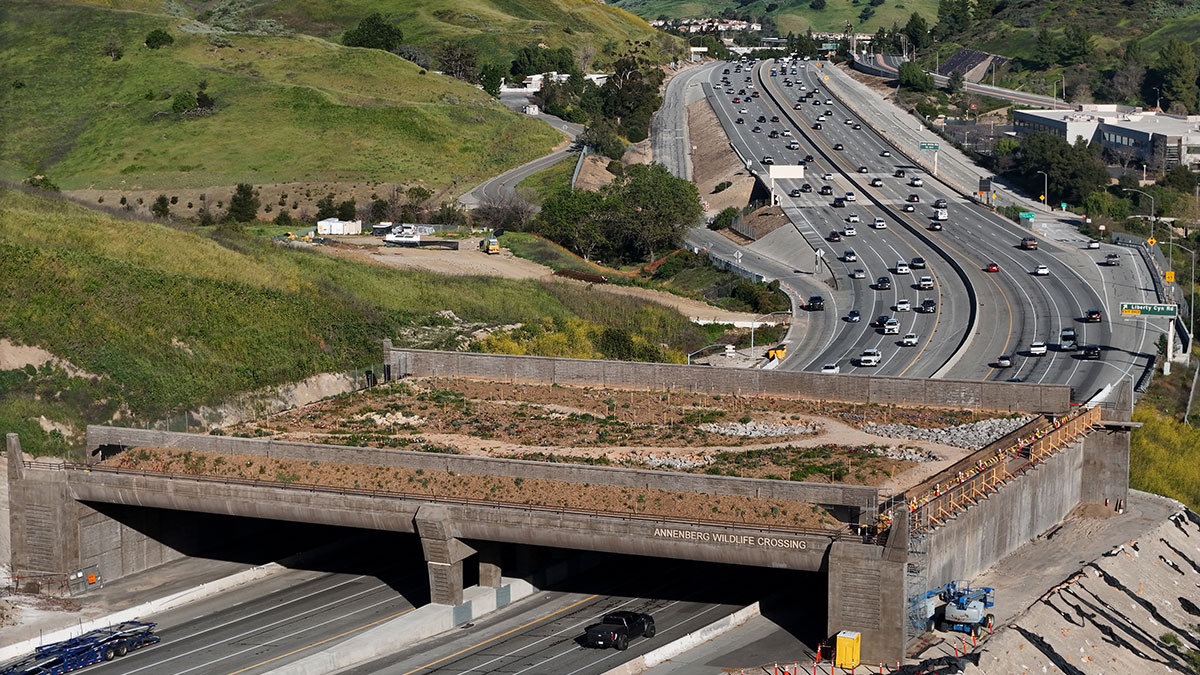
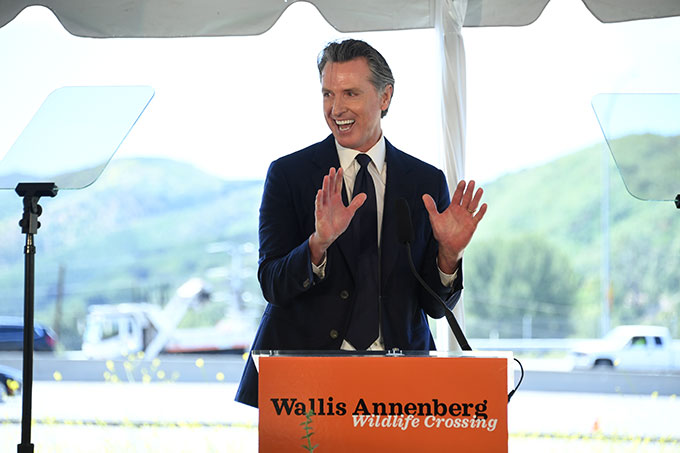
In 2022, California Governor Gavin Newsom broke ground on the Wallis Annenberg Wildlife Crossing (WAWC), a project featuring an overpass for animals atop ten lanes of the 101 Freeway in Southern California. At the ceremony, Newsom boasted that the state had committed $54 million. He promised to “complete the job within another $10 million,” before seeming to hedge on whether that final sum would do the trick. Officials projected a 2025 completion date for the overpass, and estimated that the entire project—which includes the bridge and other ancillary developments—would cost $92 million, some of it coming from private philanthropists.
Nearly four years after the ceremony, the bridge is past due and the project some $21 million over budget. What was supposed to be the world’s largest wildlife crossing has become a jobs program for environmentalists, with taxpayers on the hook for what WAWC leader Beth Pratt told us is an overpass “for everything from monarch butterflies to mountain lions.”
Finally, a reason to check your email.
Sign up for our free newsletter today.
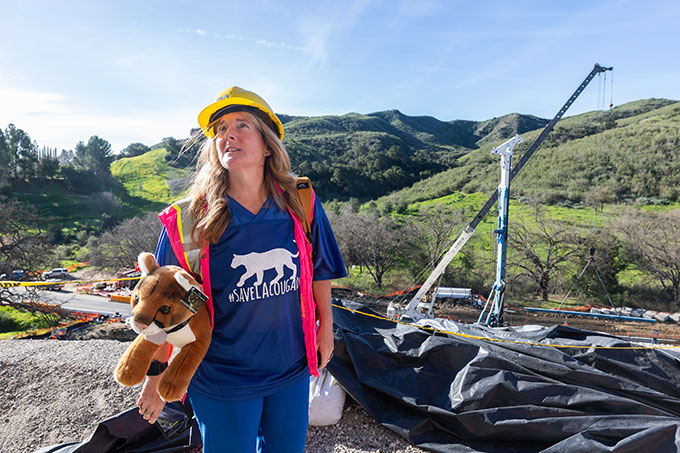
Pratt, a cougar-sweater-wearing environmental activist who serves on WAWC’s Partner Leadership Team, is the program’s public face. She is also a regional executive director of the National Wildlife Federation. In 2021, the group received a $25 million grant from “Wallis Annenberg and the Annenberg Foundation” for the bridge that bears the late philanthropist’s name.
That money apparently was not enough. This past January, donning a hard hat and a “#SAVELACOUGARS” jersey, Pratt announced a possible $21 million overage. She effectively blamed President Trump, attributing the multimillion-dollar overrun to “tariffs, inflation, [and] labor problems.”
“There’s no boondoggle,” she said. “Given the times we’re living in,” a potential $21 million overage is “not that bad.”
In response to our request for comment on the cost increases, Pratt argued that they were consistent with those faced by other construction projects.
Within days of Pratt’s announcement, the California Transportation Commission funneled another $18.8 million to the project, well exceeding the governor’s $10 million cap. The project’s total price tag now reaches about $114 million, reportedly including some $77 million in state funds. Newsom’s office pointed us to a press release in response to our request for comment.
Why has a project primarily consisting of a bridge for animals cost over $100 million? One reason is that Newsom and WAWC’s philanthropic supporters apparently don’t mind it becoming a patronage program. As the WAWC-endorsing Wildlife Crossing Fund notes, citing the California Department of Transportation’s estimate, “for every $1 billion spent” on wildlife crossings, “13,000 jobs are created.”
Some of these jobs are absurd. The National Wildlife Federation’s WAWC website claims that “[o]ur Native Plant Nursery”—apparently funded by the nonprofit SAMO Fund and other “partners”—“has prioritized hiring Indigenous team members to help steward the plants that will vegetate the bridge.” The nursery’s co-manager said she makes an “offering” after collecting seeds, sometimes including pieces of her hair.
Or consider the ways one of the nursery workers and her associates have spent their time. The nursery’s founding manager worked with “helpers and volunteers” to “seed scout[]” across the Santa Monica Mountains. Her associates on the “design team” received “feedback from all the various project partners”—including state and federal bureaucrats—for their plant list.
A group of experts apparently adds to the operation’s expense. A fungi whiz, Pratt says, worked as a WAWC habitat designer, periodically scrutinizing root samples under a microscope. A contracted soil scientist said his process involves assessing local dirt to “rebuild it . . . as close to nature as possible.”
One reason California supposedly needs this overpass is to ensure the safety and genetic diversity of mountain lions in the Santa Monica Mountains, where only about a dozen non-kitten cougars live at any given time. While bridge proponents claim that the local mountain lion population could otherwise face extinction, researchers suggest the bridge is not the only solution to ensure their survival.
According to a 2016 paper published by the Royal Society, the mountain lion population living in and around the Santa Monica Mountains is “demographically vigorous.” Still, the paper argues, the population could face “rapid extinction” if it becomes less genetically diverse.
While bridge proponents have cited this study, the researchers say adding just one new mountain lion to the population per generation was apparently sufficient to reduce extinction risk. If Newsom and the philanthropists were really interested in protecting these lions, $114 million could likely fund translocations for thousands of years.
At the groundbreaking ceremony, Newsom envisioned WAWC as a catalyst for the construction of wildlife crossings across the state. California, he boasted, set aside $105 million “to replicate projects like this all up and down the state.” Pratt reportedly thinks “hundreds more crossings are needed.”
Californians can’t afford it. The Newsom administration projects a $2.9 billion budget deficit for 2026–2027. The state legislature’s nonpartisan fiscal advisor had published steeper estimates and claimed the deficit could rise to $35 billion in coming years.
If the state wants to fund a nine-figure overpass project for animals, it should turn to the Annenberg Foundation, which holds $1.27 billion in net assets. (The foundation did not respond to our request for comment.) California taxpayers shouldn’t have to spend another cent. Gavin Newsom, unfortunately, seems committed to bankrolling what for now is a multimillion-dollar bridge to nowhere.
Top Photo: The Wallis Annenberg Wildlife Crossing (Kevin Carter/Getty Images)
City Journal is a publication of the Manhattan Institute for Policy Research (MI), a leading free-market think tank. Are you interested in supporting the magazine? As a 501(c)(3) nonprofit, donations in support of MI and City Journal are fully tax-deductible as provided by law (EIN #13-2912529).
Source link