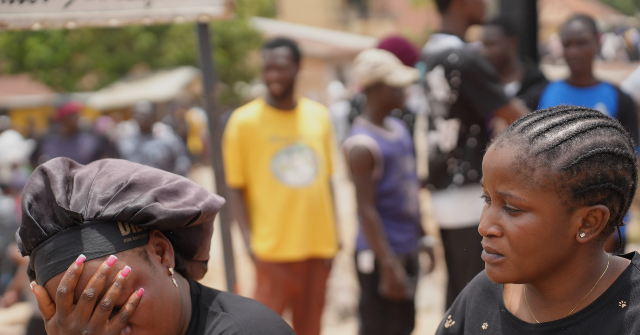
A community that lost over two dozen members to an invasion of unknown gunmen on Palm Sunday, the beginning of the holiest week of the year for Christians, experienced a resurgence of mob attacks on random locals on Wednesday following the lifting of a curfew, Nigerian government officials confirmed.
The attacks, widely believed to be linked to the years of genocidal violence that Nigerian Christians have faced in the country’s Middle Belt region, targeted the Angwan Rukuba of Jos, the capital of Plateau state. Plateau has experienced some of the most gruesome attacks by jihadists, typically migrating from the majority-Muslim north, seeking to displace the local Christians. Many of these attackers are ethnic Fulani jihadists, though the government has not yet identified a single attacker associated with the Palm Sunday massacre or the subsequent targeting of Jos.
Government authorities in Plateau responded to the killings on Sunday night by imposing a curfew to limit movement and prevent further violence. The curfew appeared to work, according to local reports, but once it expired on Wednesday, mobs of men flooded the capital, destroying local property.
“Hoodlums and irate mobs reportedly attacked motorists and passers-by in several parts of the city, sparking fresh fear and panic among residents,” the Nigerian newspaper Vanguard reported. “Our correspondent gathered that a young man walking along the road leading to the University of Jos Permanent Site was hacked to death by hoodlums. Several motorists around Terminus, Bauchi Road, and Gangere areas also had their windscreens smashed.”
The Daily Trust, another national newspaper, reported that the attacks were not limited to the site of the Palm Sunday massacre, but occurred throughout the regional capital.
“Although there is no official casualty figure, our correspondent saw several injured people being taken to hospitals as security agents and officials of the Nigerian Red Cross evacuated lifeless bodies,” Daily Trust reported. “Youths threw stones at security personnel, who responded by firing into the air to calm the situation. There was reinforcement of security personnel to douse the tension.”
The University of Jos in the capital reportedly ordered a full evacuation on Wednesday after the attacks began and local social media outlets became flooded with panicked messages of students and others in the area. The University of Jos Alumni Association issued a statement demanding “round-the-clock patrols, intelligence-led surveillance, and rapid response units to ensure that any potential threats are proactively addressed and swiftly neutralised.”
Nigerian government authorities have offered little clarity on the initial triggering incident prior to this mob attack: the Palm Sunday massacre. As with the attacks on Wednesday, local media and government officials only refer to “hoodlums” or “gunmen” as the assailants, almost entirely ignoring the religious dimension of targeting Christian communities on Palm Sunday. According to eyewitnesses, assailants on motorcycles arrived on Sunday evening and began shooting “indiscriminately” at random people on the street. At least one local humanitarian aid worker described the attack as targeting Christians.
Experts have identified a larger number of such attacks timed around the most important Christian holidays. Speaking to reporters during a press briefing in December, journalist Steven Kefas with the Observatory for Religious Freedom in Africa explained that, in his research, he had found that, “In the last ten years… most of the attacks in the Middle Belt take place on Sunday, it’s something I’ve documented personally: most of the attacks take place on Sunday or an eve to a particular Christian festival.” He did not find a similar pattern around Islamic holidays, though jihadists do also kill fellow Muslims.
The official government death toll of the attack on Sunday stands at 28 people, but some local reports indicate that at least 30 people were killed, accusing the government of downplaying the attack.
The Daily Trust reported on Thursday that attacks resumed on Wednesday, according to some individuals on the ground, as a result of rumors that jihadists were looking to target a local church. Thursday marked a Christian holiday known as Holy Thursday or Maundy Thursday in which Christians mark Jesus’s Last Supper and his detention shortly before his crucifixion, which is observed on Good Friday.
According to the newspaper, the “majority” of its local sources said that Christians had “heard some hoodlums wanted to invade Anguwan Rukuba to burn a church” and attempted to defend the church.
“People started moving to the church area to protect it. Before long, there was a confrontation in Nasarawa Gwom between both sides,” an anonymous local told the Daily Trust.
The governor of Plateau state, Caleb Mutfwang, visited the national capital, Abuja, and met with President Bola Tinubu on Wednesday. He confirmed to reporters there that authorities have not arrested a single suspect, nor have they identified any attackers.
“What happened on Sunday evening was quite unfortunate, but the situation has been brought under control now,” he nonetheless added. Responding to the attacks on Wednesday, he stated, “unfortunately, this morning (Wednesday), there were some looters who tried to disrupt the peace again, but I’m glad that the security forces working together were able to calm the situation as at 12 this afternoon, and so presently the situation is well under control.”
“It’s an act of terrorism, because whatever religion you belong to, it does not give you any basis to come and do the kind of actions that were done on Sunday,” he asserted, without specifying whether he believed any religion was related to the violence. “We’re therefore hoping that going forward, we’ll deal with this as criminality and make sure that these kind of actions do not repeat themselves.”
Tinubu has faced growing criticism, both from his own people and international human rights advocates, for taking little action to protect the persecuted Christians of his country. Nigeria has for years been documented, by sheer number of people killed, as the deadliest place in the world to practice Christianity, despite the fact that over 40 percent of the population is Christian.