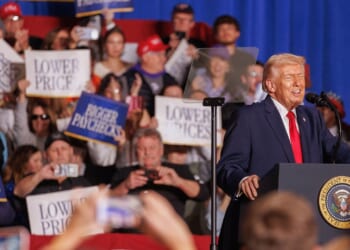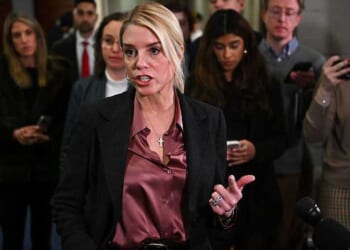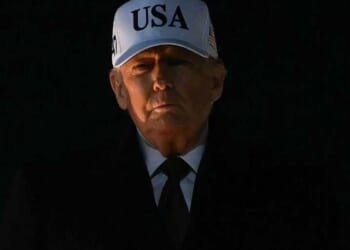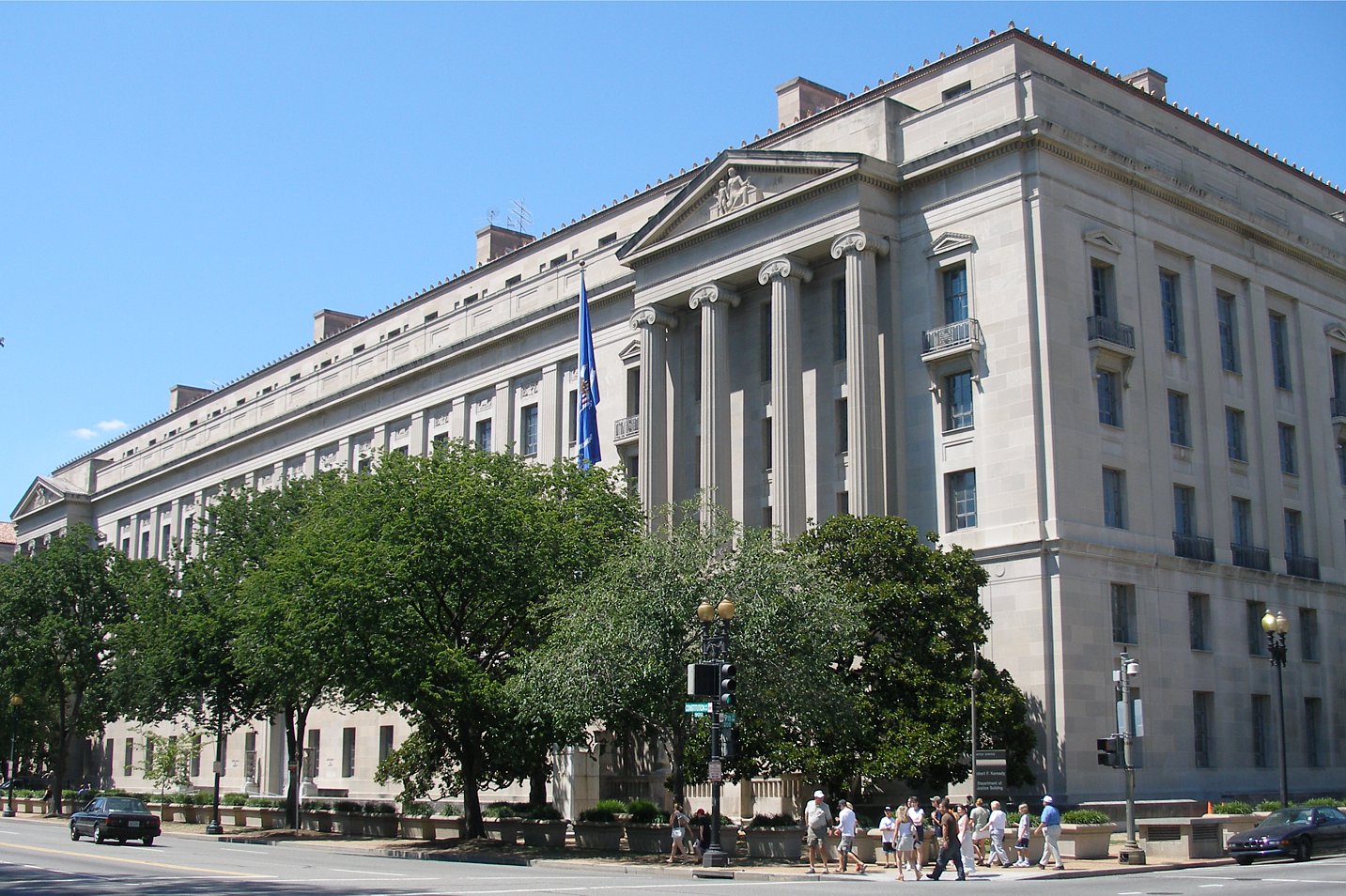
President Trump has decided to fire Attorney General Pam Bondi due to dissatisfaction on several fronts, including her handling of the Jeffrey Epstein files and recent arguments before the Supreme Court that did not go well. According to reports, the president is thinking about replacing her with Deputy Attorney General Todd Blanche or Lee Zeldin, the director of the Environmental Protection Agency.
Ms. Bondi should be excused for her handling of the Epstein files, though it was a mistake for her to dangle red meat in front of the Democrats and the plaintiffs’ lawyers in the form of the Jeffrey Epstein files.
That, however, was a mistake anyone in her position could have made. She may have failed to anticipate moves by the plaintiffs’ lawyers, but who would have guessed that Democrats would seize on a scandal that implicated their own donors and officeholders in the unlikely event that the files might embarrass the president?
In any case, in firing his attorney general, President Trump may have brought on some serious political complications for his administration, because in this political environment it is going to be difficult to confirm a successor in a divided Senate. Among the fifty-three Republicans in the Senate, there are at least four—Collins, Murkowski, Rand Paul, and Tillis—who might not vote to confirm a successor absent promises a nominee could not make. There will be no Democrats to help out, save perhaps for Senator Fetterman.
Democrats, meanwhile, will have a field day before and during the confirmation hearings, raising issues about the management of the Justice Department and concocting scandals against President Trump. Democrats could attack the administration from a variety of angles: the construction of the new White House ballroom, the handling by the Justice Department of Trump’s lawsuit against the government, the makeover of the Civil Rights Division, various federal-court decisions knocking back several Trump administration policies, his family’s investment in cryptocurrency ventures, and others not yet thought of.
The appointment of Mr. Zeldin would be a double mistake, because it would take him out of the EPA, where his work has been notable, and into an unwinnable confirmation brawl. Mr. Blanche would be a better successor, and highly qualified to be attorney general, as well as loyal to President Trump, which would be a reason for Democrats to hold up his confirmation, as he would refuse to make the pledges demanded by Democrats to investigate the president.
As the deputy attorney general, Mr. Blanche will hold the position of acting attorney general on an interim basis, though there are those who say he is already running the department, which raises the question as to why a change was needed in the first place. In any case, with Ms. Bondi out and an interim attorney general in place, many claims would arise about the legality or propriety of Justice Department actions taken without a Senate-confirmed appointee leading the department.
There are lessons to be learned from President Trump’s appointment of William Barr in 2019 to succeed Attorney General Jeff Sessions. He was confirmed thanks to a Republican majority in the Senate but with votes from three moderate Democrats—on the basis of a promise to allow Special Counsel Robert Mueller to complete his investigation of Russian interference in the 2016 election. Mr. Barr also pledged to allow the publication of Mr. Mueller’s complete report, which the attorney general was not obliged to do. (He might have published a summary.)
It is a near certainty that in another confirmation battle Democrats would attempt to extract similar pledges from the nominee. Failure to make those promises would make it more difficult to achieve confirmation.
There is also a larger lesson here, going back to the Watergate scandal. President Nixon was forced out of office at that time due to one factor: he lost control of his Justice Department. That should not happen here, for many reasons, but President Trump should prepare for difficulties in getting a successor confirmed.
John Mitchell, his attorney general, resigned his post in early 1972 to direct the president’s reelection campaign—a signal error. Nixon replaced Mitchell with Richard Kleindienst, the deputy attorney general and a Nixon loyalist, successfully rebuffing a campaign led by Ted Kennedy to block confirmation. Unfortunately for Kleindienst, he was confirmed only days before burglars connected to the White House and the reelection campaign broke into the headquarters of the Democratic Party, setting off the Watergate scandal. Kleindienst stepped down less than a year later when two high-level White House aides resigned their posts due to Watergate related accusations. Kleindienst said at the time that, owing to his associations with those accused, he could not lead an investigation.
With Kleindienst out, Nixon appointed a new attorney general in the person of Elliot Richardson, a well-known liberal Republican from Massachusetts. In order to be confirmed, Richardson had to pledge to Senator Kennedy that he would appoint a special prosecutor to investigate crimes connected with Watergate. He did so knowing that a special counsel might begin investigations of President Nixon. One of his first acts was to file bribery charges against Vice President Spiro Agnew, leading to his resignation in October 1973. This was an early sign that President Nixon had lost control of the Justice Department.
Richardson soon appointed Archibald Cox as special prosecutor to investigate the scandal. Cox was the solicitor general in the Kennedy administration, a Democrat, and a professor of law at Harvard University. If Richardson wanted to appoint someone who would be sure to investigate the president, then he could not have found a better person than Cox.
Cox quickly set his sights on President Nixon and sought to subpoena the secret White House tape recordings of Nixon’s private meetings. Nixon claimed that these were privileged conversations and beyond the reach of the special prosecutor. He ordered Cox to desist from pursuing the tapes and then, when Cox refused, ordered Richardson to fire him. Richardson resigned as attorney general rather than carry out Nixon’s order, thus leaving the job temporarily in the hands of Robert Bork, the solicitor general. Bork soon appointed Leon Jaworski as special prosecutor, who picked up where Cox left off in pursuing the White House tape recordings. He eventually succeeded, thanks to a ruling from the Supreme Court, which led to Nixon’s resignation.
The lesson for President Trump and for any Republican president is clear: be wary of opening up a vacancy at the Justice Department. There are unknown dangers lurking ahead.