“Repugnant immorality and obscene triviality” was how Austrian censors described Rigoletto, forcing Giuseppe Verdi to change the setting and several other plot points in the months leading up the opera’s 1851 premiere in Venice. A hit from the start in a city rocked by revolution and eviscerated by an Austrian siege that had ended in surrender just two years earlier, Verdi’s middle-period masterpiece was staged by Palm Beach Opera to conclude its sixty-fourth season.
A tale of seduction, curses, and assassination, the opera does have a moral lesson: the futility of revenge, a trope that runs throughout Verdi’s operas. Following the censors’ objections, the royal French setting of Rigoletto’s inspiration, Victor Hugo’s 1832 play Le roi s’amuse (censored in France after its first performance), was watered down to an Italian ducal court that hadn’t existed for two centuries.
Rigoletto’s title character mocks and humiliates everyone at the Duke of Mantua’s decadent court but conceals his sensitive devotion to protecting his daughter, the innocent Gilda, from the louche horrors of the world. Rigoletto is cursed by the outraged Count Monterone, whose daughter the Duke has seduced, and he soon loses Gilda to conspirators. They bring her to the unimpressed ruler, who had already spotted her in church and had begun seducing her. Consumed by his desire for vengeance, Rigoletto hires the conveniently available assassin Sparafucile to murder the Duke, only for Gilda to intervene and sacrifice herself in his place. After hearing the oblivious Duke sing out a reprise of his famous aria on the fickleness of women, “La donna è mobile,” Rigoletto discovers his daughter’s death and is left alone in the world to lament the old man’s curse.
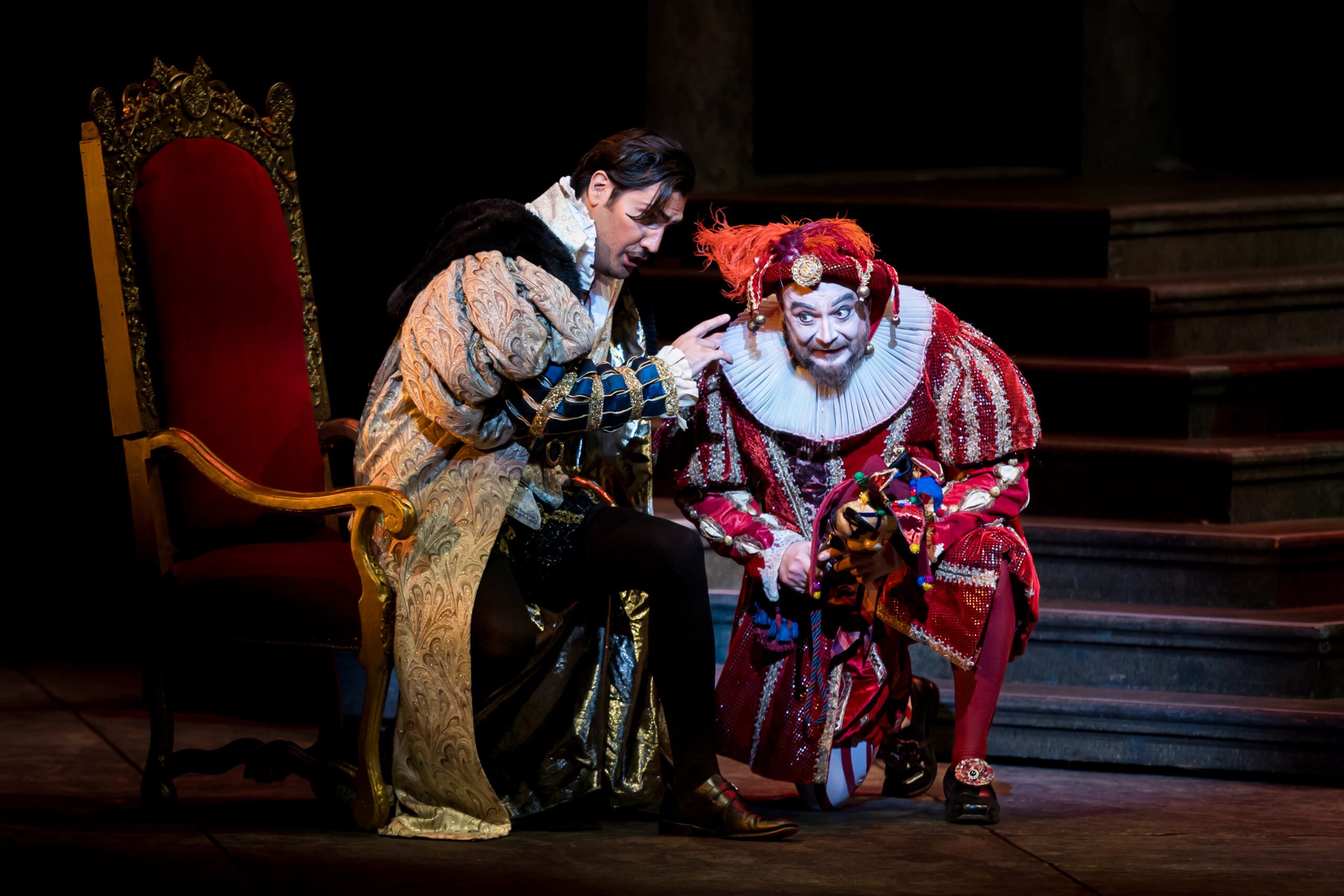
Robert Dahlstrom’s lavish sets, originally designed for Seattle Opera, replicate the grandeur of ducal Mantua. In this production, Rigoletto enters under cover of darkness—a pantomime during the opera’s brief prelude. Darkness falls again for the back-alley scenes, where dilapidated houses host Gilda’s seduction and mistaken murder. At other times, however, the Renaissance court emerges in exuberant color. The sumptuous costumes, created by the designer Zack Brown in the 1980s for Washington National Opera, remain fresh and evocative of previous wearers such as Anna Netrebko, Joseph Calleja, Ingvar Wixell, and Denyce Graves.
Vladislav Sulimsky, long associated with Saint Petersburg’s Mariinsky Theatre and recently triumphant in Verdi baritone roles in Europe, brought arresting emotion to Rigoletto’s tormented self-loathing. Nowhere was this clearer than in his Act II tantrum, when his rage at the courtiers who abducted Gilda yields to a softer paternal plea for mercy. Sulimsky also acquitted himself well in the reflective Act I monologue “Pari siamo,” a meditation on his character’s similarity to Sparafucile and a verbal assassin’s contemplation of a literal one. The high A flat that conventionally concludes the rhythmic march tune of the duet “Si, vendetta” did not quite materialize, but the overall performance was compelling.
The young soprano Aigul Khismatullina triumphed here in February in Bizet’s Pearl Fishers. Her Gilda revealed rock-solid technique with appealingly crystalline coloratura in the role’s signature aria, “Caro nome.” Carefully practiced, this is a voice that will go far.
The star American tenor Jonathan Tetelman, in the role of the Duke, was sometimes forced in supporting his upper range, but he nevertheless sang with passion. He was at his best in more sensitive singing, especially in the plangent aria “Parmi veder le lagrime,” when the Duke despairs of Gilda’s disappearance. The opera’s most famous tune, “La donna è mobile,” came off as a more casual affair but had an appealing lightness.
The bass Morris Robinson sang a devilish Sparafucile, complete with a sustained low F on the final syllable of his name, delivered as he exited after his introduction to Rigoletto. The mezzo-soprano Elissa Pfaender was a seductive Maddalena, whom Sparafucile, her brother, deploys to ensnare the Duke. Members of Palm Beach Opera’s young-artists program filled out the supporting cast. The baritone Mario Manzo’s thunderous Monterone proved the standout voice.
The company’s music director David Stern, the son of Isaac Stern, conducted a balanced performance with a particular sensitivity to the ensemble scenes and the occasional interventions of the chorus.