Azerbaijan is coming to realize that its deep military ties with Israel are exposing it to Iranian ire.
Last week, the foreign ministers of Azerbaijan and Iran, Jeyhun Bayramov and Abbas Araghchi, respectively, had another telephone call. Once again, they discussed the regional situation, and once again, the conversation revealed just how fragile the détente between Baku and Tehran truly is.
Araghchi raised the issue of security and environmental risks following the Israeli strike on the Iranian Caspian city of Bandar Anzali. He emphasized the need for Azerbaijan (and other Caspian states) to adopt a “firm stance” and condemn the strikes. But Bayramov was not there simply to listen. He delivered Baku’s expectation regarding the completion of the investigation into the drone attack on the airport in Nakhchivan from Iranian territory weeks earlier.
The exchange captures the essence of the moment. Both sides are trying to prevent escalation, but the underlying tensions remain acute. The fragile balance is strained by Azerbaijan’s deep ties to the United States and Israel. Neither Baku nor Tehran wants a full rupture. But the longer the US-Israeli campaign against Iran continues, the harder that balance becomes to sustain.
For the better part of the past decades, the alignment between Israel and Azerbaijan has been working to the benefit of both sides. Israel provided Azerbaijan with billions of dollars worth of cutting-edge military technology that proved decisive in the 2020 and 2023 Nagorno-Karabakh wars against Armenia.
In return, Azerbaijan offered Israel a strategic intelligence foothold on Iran’s northern border, and a reliable energy partner—around 40 percent of Israeli oil imports originate in Azerbaijan, shipped via the Baku-Tbilisi-Ceyhan (BTC) pipeline.
Hawks in Washington championed this axis as a triumph of American-backed regional security architecture. Baku was portrayed as a reliable counterweight to Iranian influence, a pro-Western bulwark willing to take strategic risks in exchange for Israeli ties.
But the alleged Iranian drone attacks in Nakhchivan revealed the fault line that no amount of boosterism could paper over. Aliyev’s “iron fist” rhetoric plays well at home against Armenia, but Iran is not Armenia. The tactics that proved devastating against a poorly equipped Armenian defense would be suicidal against a power capable of striking back with overwhelming force against Azerbaijan’s exposed energy infrastructure.
That infrastructure—the BTC pipeline and the gas fields—sits within easy range of Iranian missiles. Under the US-Israeli attack, Tehran has demonstrated a willingness and capability to strike across borders, as the Persian Gulf countries are painfully learning.
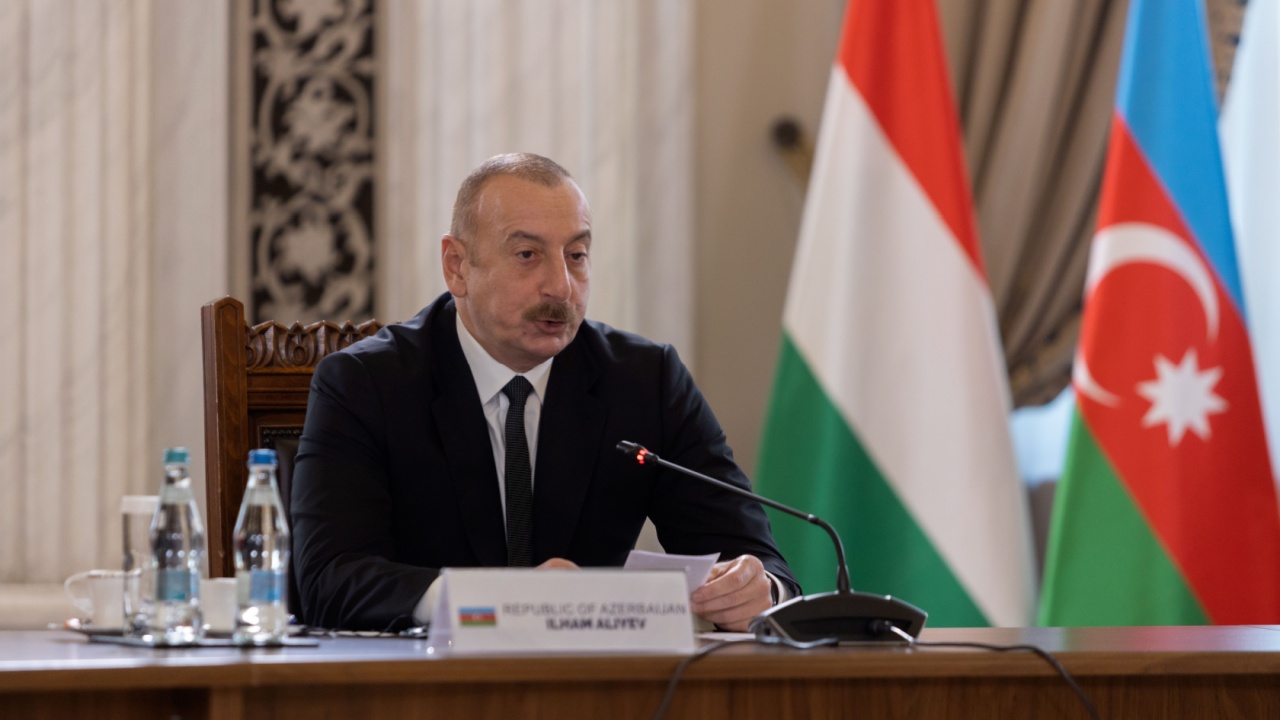
In a direct confrontation with Iran, Azerbaijan would likely be the loser. President Ilham Aliyev understands his vulnerability. This is why, when the moment came for Baku to reciprocate Israeli support against Armenia by opening a northern front against Iran—with Iranian drones landing in Nakhchivan as a perfect casus belli—Aliyev refused, even as he called the incident “an act of terror.”
All he did was to close the land border with Iran for four days, then quietly reopen it after a phone call with his Iranian counterpart, Masoud Pezeshkian. The drive for de-escalation was accentuated by Baku sending around 80 tons of food and medicine to Iran as humanitarian aid for Nowruz—the Persian New Year holiday widely celebrated in both countries. Iranian foreign minister Araghchi thanked Baku for the gesture in Azerbaijani, which his counterpart Bayramov reciprocated in both Azerbaijani and Persian.
The Nowruz shipments were not merely a diplomatic nicety. They were a signal—to Tehran, to Washington, and to Jerusalem—that Azerbaijan is charting a cautious course.
What further diminishes Aliyev’s standing in Washington in the context of the war on Iran is the quiet collapse of the long-standing “South Azerbaijan” fantasy. For decades, Iran hawks built the case for Azerbaijan as a frontline state that could, with enough support, help crack Iran open from the north, leveraging Iran’s large Azeri-speaking population against Tehran. Aliyev himself fueled that perception by occasionally referring to the Iranian Azerbaijanis as his “compatriots” and referring to Baku as a “beacon of hope” for them.
Yet the much-hoped-for Azeri uprising never materialized, even though the mass protests that swept Iran in January 2026, followed by the US-Israeli strikes in February and March, presented, on the face of it, a window of opportunity. Iranian Azeris, except for a few ethno-nationalist exiles, did not look to Baku for liberation. They remain deeply integrated into the country’s political, social, and economic fabric.
To make Aliyev’s balancing act even more precarious, Turkey, Baku’s paramount strategic partner, has been increasingly targeted by Israel as the next major threat, with opposition leader and former Prime Minister Naftali Bennett openly framing it as “the new Iran” and vowing to confront that supposed threat. The narrative painting Turkey as the head of the “Sunni axis” supposedly containing Qatar, Syria, and Hamas is gaining ground in Israeli and hawkish American circles. Indeed, differences between Ankara and Baku on Israel are not new, and so far, they have been effectively managed. Still, the recrudescence of Israeli-Turkish tensions will, sooner or later, push the limits of Aliyev’s hedging.
Aliyev thus faces a genuine dilemma. Israel remains an asset in at least two critical respects. It is the source of Azerbaijan’s military technological edge over Armenia and retains formidable lobbying power in Washington that Baku is counting on to repeal Amendment 907 of the Freedom Act. This was adopted in 1992 under the influence of the Armenian lobby to prevent Azerbaijan from benefiting from the US military aid, although various US presidents have waived its provisions.
These assets now come with a price that is rapidly exceeding their value. Even if Iran emerges weaker after the war, its regime is unlikely to be dislodged and is, in fact, evolving in a more hardline direction. While in the past Baku could count on tested de-escalatory mechanisms, such as high-level diplomatic dialogue with the supreme leader and the president, the future policies of the Islamic Republic are much more likely to be determined by the Islamic Revolutionary Guard Corps (IRGC). They are far more skeptical of Baku and view it as a security threat due to its Israeli ties.
Geography and military asymmetry underscore the simple fact that Iran is a neighbor Azerbaijan cannot afford to provoke. Once the current confrontation reaches its next phase—whether through diplomacy or deeper conflict—expect Baku to quietly begin disentangling itself from a relationship whose costs now outweigh its benefits.
About the Author: Eldar Mamedov
Eldar Mamedov is a Brussels-based foreign policy expert. He has degrees from the University of Latvia and the Diplomatic School in Madrid, Spain. He has worked in the Ministry of Foreign Affairs of Latvia and as a diplomat in Latvian embassies in Washington and Madrid. Since 2009, Mamedov has served as a political advisor to the Social Democrats on the European Parliament’s Foreign Affairs Committee (EP) and is in charge of the EP delegations for inter-parliamentary relations with Iran, Iraq, and the Arabian Peninsula. Find him on X: @EldarMamedov4.