Tuesday’s F-35 crash in rural Nevada marks the first accidental loss of the fifth-generation fighter jet since January 2025.
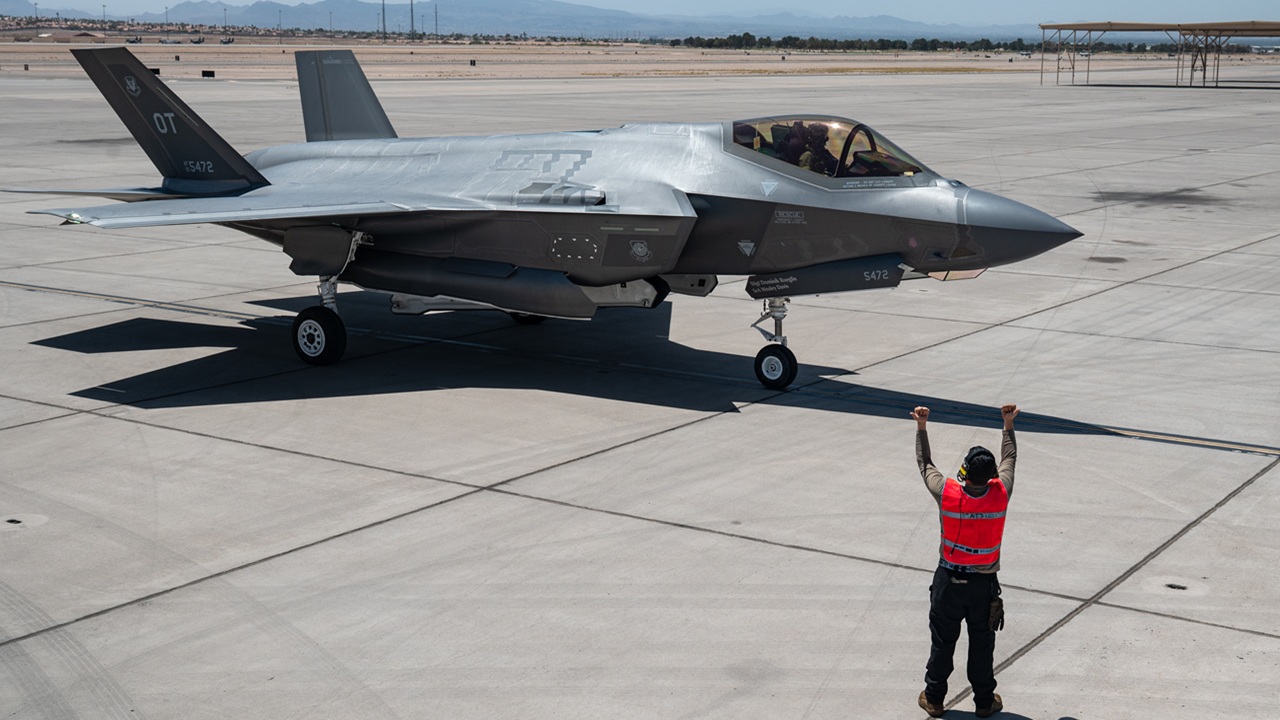
On Tuesday, the United States Air Force confirmed that a conventional takeoff and landing (CTOL) F-35A Lightning II fighter jet operating from Nellis Air Force Base (AFB), Nevada, crashed in the Mojave Desert. The pilot was able to eject from the aircraft and suffered minor injuries.
“Nellis Air Force Base tells News 3 the pilot is safe, having reported minor injuries. An F-35 from Nellis AFB crashed north of Las Vegas, and emergency responders are on scene,” KSNV News 3 Las Vegas announced in a post on X (formerly Twitter).
Nellis AFB operates the Nevada Test and Training Range, which consists of nearly 3 million acres of land and has 5,000 square miles of “restricted airspace,” according to Air & Space Forces.
The 57 Wing also confirmed that the aircraft was assigned to the base, and that the incident occurred north of Las Vegas and around 25 miles northeast of Creech AFB.
“An F-35 from Nellis AFB crashed north of Las Vegas today. The incident occurred approximately 25 miles northeast of Indian Springs, Nevada, within the controlled airspace and restricted federal property of the Nevada Test & Training Range,” the 57th Wing wrote. “Emergency responders are on-scene and there is no impact to populated areas. The pilot is safe and being treated for minor injuries. The safety of our personnel and the community remain our top priority.”
The cause of the crash is unclear, but an investigation is underway.
The F-35 Lightning II’s (F-35A) Specifications
- Year Introduced: 2015
- Number Built: 1,000+, all variants (A, B, and C)
- Length: 51 ft 4 in (15.7 m)
- Height: 14 ft 4 in (4.36 m)
- Wingspan: 35 ft (10.7 m)
- Weight (MTOW): 70,000 lb (31,800 kg)
- Engines: One Pratt & Whitney F135-PW-100 afterburning turbofan
- Top Speed: ~1,200 mph (1,930 km/h) / Mach 1.6
- Range: ~1,380 mi (2,220 km) with internal fuel
- Service Ceiling: 50,000 ft (15,240 m)
- Loadout:
- 1 × GAU-22/A 25 mm rotary cannon (internal on F-35A only)
- Internal bays: Up to 4 × AIM-120 AMRAAMs or 2 bombs + 2 AMRAAMs
- External hardpoints: Up to 18,000 lb (8,160 kg) of ordnance (compromises stealth)
- Aircrew: 1
F-35 Crashes Are Rare, but Sometimes Happen
This is the first confirmed loss of an F-35 this year, and it comes just weeks after another Lightning II was forced to make an emergency landing in the Middle East after being hit by Iranian ground fire while taking part in the ongoing Operation Epic Fury. That incident marked the first time an F-35 has ever been downed by enemy action, although the extent of damage to the airframe in question remains unclear.
The F-35 is among the most advanced combat aircraft in service today, and crashes are rare. The last confirmed mishap occurred in January 2025 at Eielson AFB, Alaska. An Air Force investigation determined the crash occurred after hydraulic fluid in the plane’s landing gear apparatus froze in the sub-zero temperatures, making the landing gear unable to deploy. The pilot in the aircraft—from the 355th Fighter Squadron, 354th Fighter Wing, based at Eielson AFB in Alaska—reportedly participated in a 50-minute conference call with Lockheed Martin engineers to resolve the issue while still in the air. In that incident, the attempts to land the aircraft actually exacerbated the problem; the low altitude tricked the F-35’s onboard computer into thinking the plane had already landed, leading to other failures and eventually precipitating the crash.
The pilot in that incident successfully ejected. The Air Force investigation noted that “the pilot suffered minor injuries related to the ejection,” but the F-35 had been “destroyed upon impact with a total loss valued at $196.5 million.”
Two United States Marine Corps F-35Bs, the short takeoff and vertical landing (STOVL) variant of the Joint Strike Fighter, were lost in separate incidents in 2023. The first went down in rural South Carolina in September 2023, after the pilot ejected, with the wreckage only located after a 30-hour search. The second incident occurred in December of the same year, during a flight from Fort Worth to Edwards AFB.
Just this week, it was announced that eight Albuquerque police first responders are suing the federal government for being exposed to hazardous chemicals following the crash of an F-35A after refueling at Kirtland AFB in May 2024.
About the Author: Peter Suciu
Peter Suciu has contributed to dozens of newspapers, magazines and websites over a 30-year career in journalism. He regularly writes about military hardware, firearms history, cybersecurity, politics, and international affairs. Peter is also a contributing writer for Forbes and Clearance Jobs. He is based in Michigan. You can follow him on Twitter: @PeterSuciu. You can email the author: [email protected].