A near-shootdown of an F/A-18 Super Hornet last week highlights the asymmetric threat posed by Iran’s shoulder-fired anti-air missiles.
Last week, a US Navy F/A-18 Super Hornet was nearly hit by an Iranian MANPADS near the coastal city of Chabahar. The missile detonated near the F/A-18’s tail during a low-level strafing run. The aircraft survived the incident—but the incident highlighted the vulnerability of advanced aircraft to cheap, shoulder-fired missiles at low levels, highlighting how valuable relatively primitive portable air defense systems can be even in high-tech wars.
What Exactly Is a “MANPADS” System?
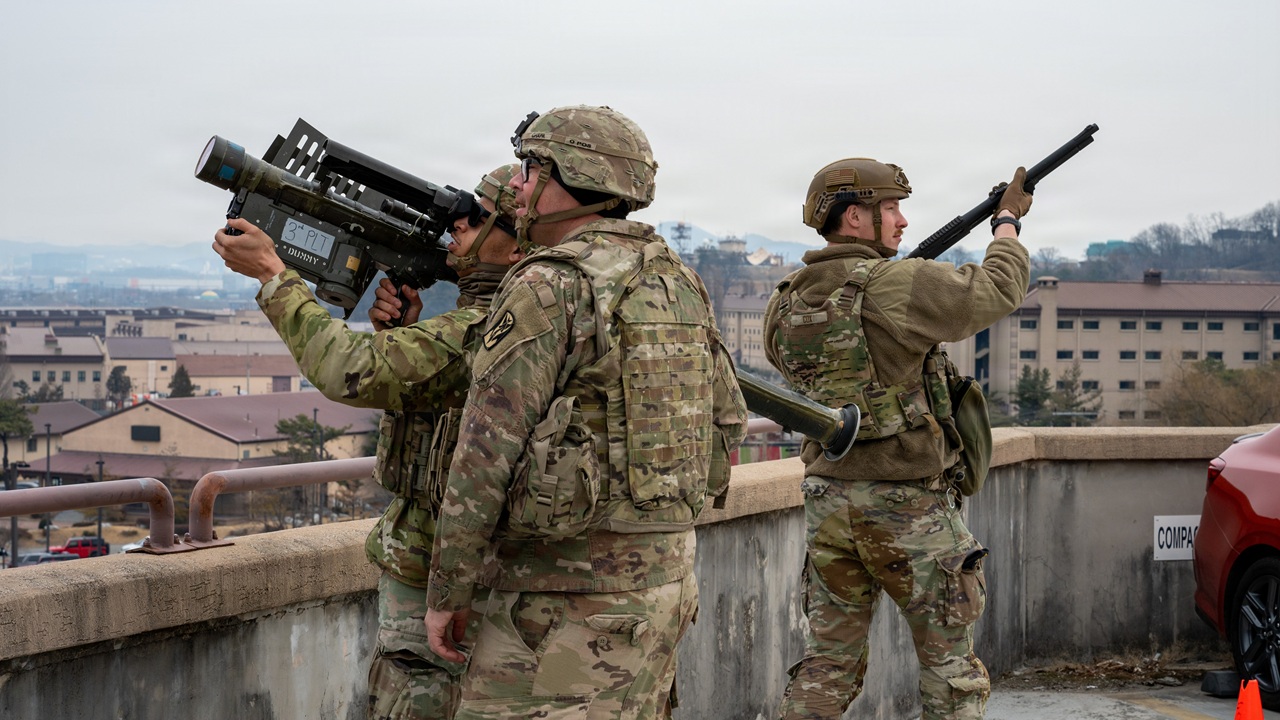
MANPADS is an abbreviation for “Man-Portable Air Defense System.” There are many different MANPADS systems in existence, but each is essentially a shoulder-fired surface-to-air missile.
The first MANPADS were developed in the 1950s and 1960s, but were initially constrained by their rudimentary targeting systems. As time went on, both Western and Soviet designers improved the missiles in their arsenals, leading to deadlier and deadlier systems. Perhaps the MANPADS’ most infamous hour came during the Soviet-Afghan War of the 1980s, in which the United States illicitly supplied thousands of FIM-92 Stinger MANPADS launchers to the Afghan mujahideen rebels, leading to the destruction of hundreds of Soviet helicopters and aircraft.
In general, MANPADS have a range of 3 to 6 miles and are generally effective below 15,000 feet. Using infrared heat-seeking guidance, MANPADS lock onto an aircraft’s heat signature (engine/exhaust). The guidance system allows the user to “fire-and-forget,” meaning they require very little training to operate—making them ideal for guerrillas and insurgent movements. And because MANPADS are easy to operate, mobile, and difficult to detect before launch, they remain a lethal anti-air tool despite their relatively humble nature.
MANPADS can be fired from just about anywhere. Because their guidance is based on infrared rather than radar, they are difficult to preempt. And effective MANPADS are more than 50 years old, and the technology involved is cheap and easy to mass-produce. In modern wars, it is fairly easy to saturate a battlespace with these mobile and hard-to-detect anti-air systems.
On the battlefield, MANPADS are highly effective against low-flying aircraft, particularly aircraft performing strafing runs or close air support, like the F/A-18 over Chabahar. Basically, MANPADS are designed to exploit the moment when advanced, multimillion-dollar aircraft are at their most vulnerable.
MANPADS are a great example of the persistent threat that Iran still poses to US forces. Even though Iran’s conventional air defenses have been severely degraded, MANPADS remain a threat to US aircraft. There is no obvious way for the United States to confront this threat; presumably there are thousands of MANPADS launchers scattered throughout Iran, and each one is capable of operating on its own, meaning there is no central command node to target. This requires American aircraft to operate at a higher altitude, reducing the effectiveness of close air support. The presence of MANPADS also imposes a cost asymmetry on the combatants. A MANPADS missile costs tens of thousands of dollars, whereas an F/A-18 costs $70 million.
About the F/A-18 Incident
The F/A-18 Super Hornet in question was conducting a low-altitude strafing run against targets in Chabahar in the daytime on March 25, likely with its M61A1 20mm cannon. The MANPADS used was probably a domestically-manufactured Misagh missile—an Iranian clone of the Chinese QW-1—launched from the ground near Chabahar.
The pilot responded to the launch by performing a high-G break turn, forcing the missile to overshoot. The missile exploded near the tail section, likely because the proximity fuse activated. The F/A-18 may have suffered shrapnel damage to the tail and engine area, but the aircraft remained stable and airborne and was able to safely return to base.
The aircraft survived because of pilot maneuvering, missile fuse timing, and potentially the deployment of countermeasures such as flares (intended to spoof the heat of the jet engine to the missile’s infrared homing system). Basically, the survival was a combination of skill and luck.
The incident will likely embolden Iran to increase low-altitude attacks against US aircraft—who are forced into closer range because the US has depleted, and wants to preserve, their standoff weapon arsenal. So while cheap and more sustainable, low-altitude strafing runs expose US aircraft to MANPADS.
About the Author: Harrison Kass
Harrison Kass is a senior defense and national security writer at The National Interest. Kass is an attorney and former political candidate who joined the US Air Force as a pilot trainee before being medically discharged. He focuses on military strategy, aerospace, and global security affairs. He holds a JD from the University of Oregon and a master’s in Global Journalism and International Relations from NYU.