It is tempting to see Holy Week as purely spiritual and separate from the tensions and social variables of public life. However, the narrative of Our Lord’s Passion did not unfold in a vacuum. It transpired at the intersection of law, religious authority, public opinion, and imperial domination. That is why Holy Week was undeniably political then, as it remains so today.
Jesus was seen as a clear and present danger to the socio-religious status quo by the Temple authorities. The Roman authorities subsequently saw Him as a potential revolutionary and regional destabilizer. These two powers came together in a calculated, efficient, and merciless way to not only snuff out the life of the rural preacher from Galilee, but also His radical message of selfless love and allegiance to truth overall.
In the Gospel of John, we read of a heated interaction between the Sanhedrin in chapter 11, where they warn, “If we leave him alone, all will believe in him, and the Romans will come and take away both our land and our nation” (Jn. 11:48). This is not merely a theological concern about the efficacy of Jesus’ words, asked by pious priests; it is pure political fear from an established authority seeking to protect itself from outside pressure.
What is interesting is that the mere existence of Christ was enough to shake the foundations of the temple authorities. Then, as today, corrupted systems are threatened by the truth, and their natural reaction is oftentimes to lash out. Or, in the case of Pontius Pilate, to claim ignorance of the truth in an attempt to deny culpability.
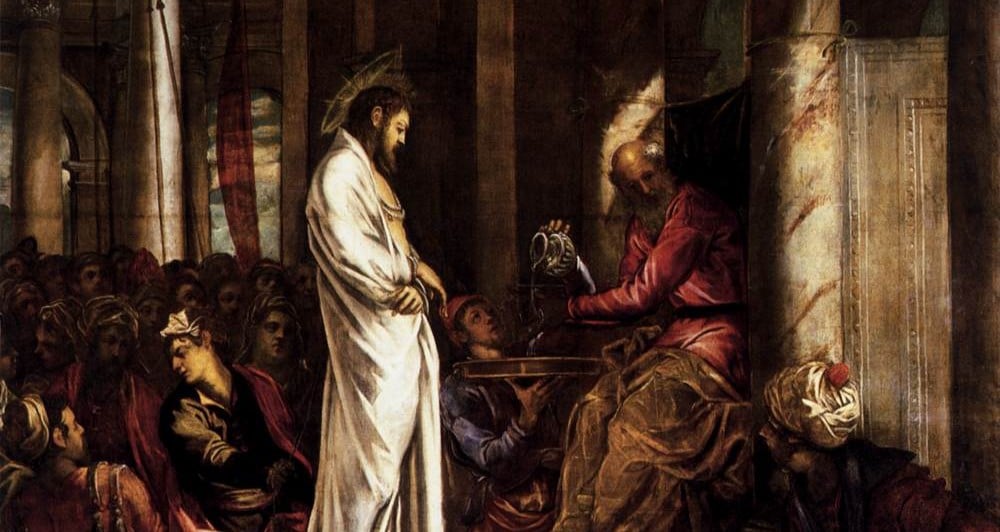
Pilate is the most obvious example of political capitulation due to fear of the truth in the entire Passion story. While he finds no guilt in Jesus, he still succumbs to pressure and sees to Christ’s death. Pilate seals Jesus’ fate by washing his hands, a gesture of pure surrender, rather than scrupulous administration and governance. St. John Chrysostom pointed to these sorts of actions as morally bankrupt and inherently disordered when he said, “To sin by silence when they should protest makes cowards of men.” Pilate was put to the test and failed by ultimately choosing his standing and career over truth.
The crowd that had just a week earlier welcomed Jesus as their king and messiah, turned against Him and demanded His death by crucifixion. Public opinion is as unpredictable as the wind, and public sentiment can often hinge on variables that are completely unrelated to the matter at hand.
What the Passion of Our Lord points to so very vividly is that public opinion does not determine truth. In fact, there are times when truth is denied and rejected because of public opinion. The fear of the crowd determines what is accepted as truth, regardless of whether or not actual truth is anywhere to be found. Jesus does not speak against the crowd, nor does He beg for His release. He simply accepts the fickle nature of the people, understanding that His sacrifice is a product of that nature, but also its ultimate remedy.
What made Christ dangerous to the powers that be was not violence or a call to upend the political structures in place. He was dangerous to them because He exposed their hypocrisy by living selflessly and religiously authentically. He refused to conform. He spoke truth without regard for consequence, and when consequence eventually grabbed hold of Him, He accepted it and, like a lamb led to the slaughter, opened not His mouth.
That sort of life has always been and will always be politically disruptive. While not all political structures or governments are corrupt and evil, the nature of humanity dictates that they all require a level of acceptance and acquiescence that can potentially become morally problematic. Accepting the lesser of all evils is still accepting evil, just in a smaller dose.
Holy Week invites us to ask ourselves the question: where would we stand? Most people like to believe that they have the moral wherewithal to be the good guy in challenging situations. With the benefit of hindsight, most Catholics would proudly exclaim that they would have stood with Jesus and against the wishes of the crowd and that they would have been happy to explain just exactly what truth is to Pilate. However, our grand, idealized visions of ourselves don’t always line up with reality.
While we cannot go back in time to that fateful week in Jerusalem, Holy Week is an opportunity for us to examine how we interact with socio-political pressures today. The fact is, we did not exist during the first Holy Week because we were meant to exist for this Holy Week, and all future Holy Weeks that we will experience while on Earth.
The temple authorities, Pilate, and the crowd are all lost to the sands of history. But we exist now to relive Holy Week, year after year, with a set of priorities, principles, examples, warnings, and directives that were forged in the original story itself.
Holy Week and Our Lord’s Passion are not merely to be remembered once a year and then forgotten for the other fifty-one weeks. They are to be entered into with a sincere desire to walk with Christ and hold ourselves accountable in the modern world by comparing and contrasting our actions with those that we read of in the ancient world. Because the conflict that the Passion story reveals, between truth and power, conscience and convenience, has never ended. And it won’t, until He returns.
Image from Wikimedia Commons