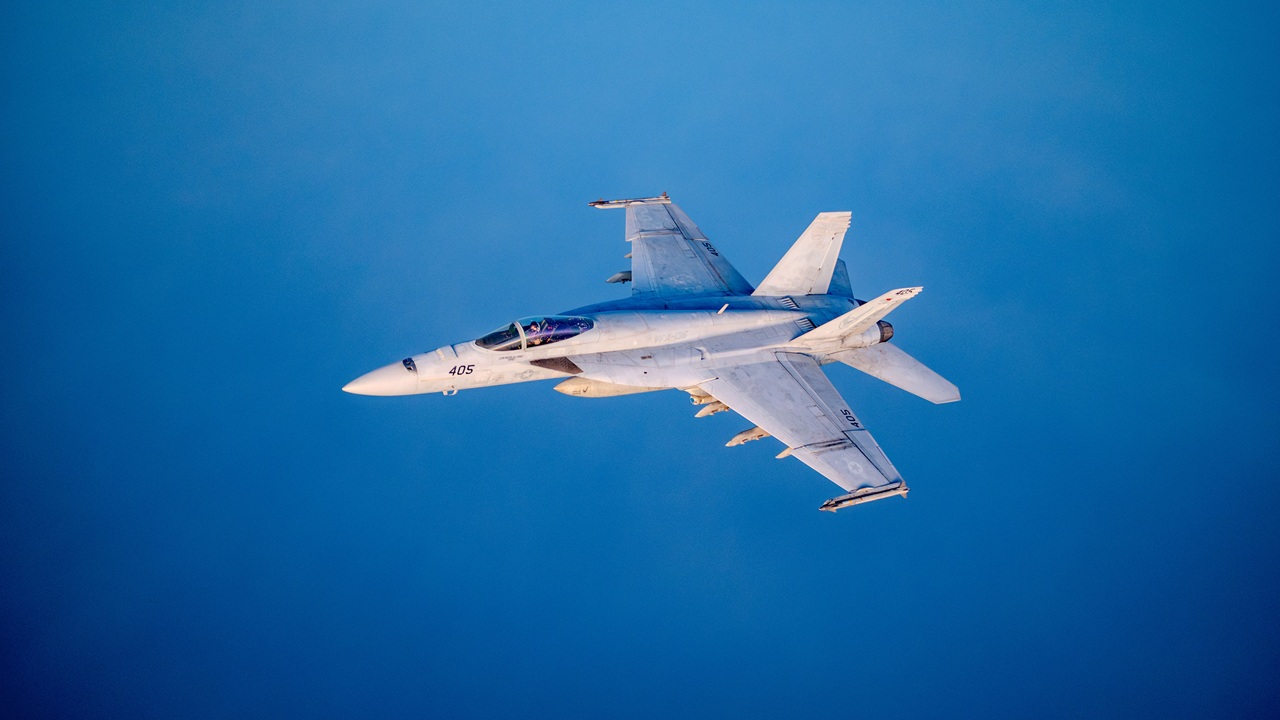
In one scene, the film’s main character arrives at his destination in an F/A-18 Super Hornet—but as he disembarks, the plane is nowhere to be found.
Project Hail Mary is Hollywood’s biggest film of the year to date. And like 2022’s highest-grossing film, Top Gun: Maverick, Project Hail Mary features naval aviation, albeit to a much smaller extent. Multiple aircraft are depicted in the film, along with one US supercarrier.
Project Hail Mary is not about naval aviation. It is a science fiction film about a science teacher, Ryland Grace (Ryan Gosling), who awakens on a spaceship in another solar system—initially with no recollection of who he is or how he got there. Most of the film takes place in outer space, with scenes on Earth interspersed in flashbacks.
Naval aviation plays a fairly small role in the film. Yet it’s there. And to an aviation enthusiast, the scenes involving military aircraft will likely serve as a brief high watermark. Sharp-eyed viewers will spot a number of ships and aircraft presently in service with the US armed forces.
Did the Project Hail Mary Filmmakers Show the Wrong Plane?
The few depictions of aircraft also potentially raise continuity issues. In one scene, Grace is transported to a US supercarrier—which serves as the staging ground for the film’s “Project Hail Mary”—in a two-seat F/A-18F Super Hornet. CGI depictions of the aircraft in flight clearly depict an F/A-18F. But bookend shots of Gosling on the ground before and after the flight show actual, physical aircraft that are clearly not F/A-18s.
So what are they? It’s hard to confirm; the aircraft were featured for a combined screen time of maybe 20 seconds from a close-in angle of the fuselage. The fuselage was distinctly tall and squared off, unlike an F/A-18. Some online commentary has suggested that the aircraft in question were actually SEPECAT Jaguars, which is absolutely plausible. The other leading suspect is the Panavia Tornado, which also features a similar fuselage.
One thing is clear, though: the aircraft shown was not an F/A-18. This makes sense: the F/A-18 is in active military service, and isn’t readily available for Hollywood filming. And because the use of the jet in the film was transitional and non-essential, the production wasn’t likely to go through the exhaustive process of securing US Navy permission and cooperation to shoot scenes aboard real aircraft carriers using real F/A-18s. Either the Jaguar or the Tornado would be much easier to procure for a day of shooting, and to the vast majority of the population, either of those aircraft would be indistinguishable from the CGI rendering of the F/A-18 shown in-air.
Project Hail Mary Showed Other Naval Aircraft as Well
The F/A-18 isn’t the only aircraft depicted in the film.
The E-2D Hawkeye is shown in digital footage, sitting on the deck of the carrier. Stacks of SH-60 Seahawk helicopters are also shown in the same shot. Of course, some observers have noted that the Seahawks are aligned in a non-standard deck configuration—but this is a fairly obscure point.
Naval aviation miscues aside, the Project Hail Mary production quality is very high. The small naval aviation miscues are forgivable sins; the film isn’t about naval aviation. The film relies on CGI, but not in a way that makes you feel like you’re watching a video game. And the scenes aboard the “Hail Mary” spacecraft are immersive and compelling, anchored in physical space rather than green screens or computer generated images. Should you see the film, keep an eye out for the F/A-18 stand-in—maybe you can confirm which aircraft is really used!
About the Author: Harrison Kass
Harrison Kass is a senior defense and national security writer at The National Interest. Kass is an attorney and former political candidate who joined the US Air Force as a pilot trainee before being medically discharged. He focuses on military strategy, aerospace, and global security affairs. He holds a JD from the University of Oregon and a master’s in Global Journalism and International Relations from NYU.