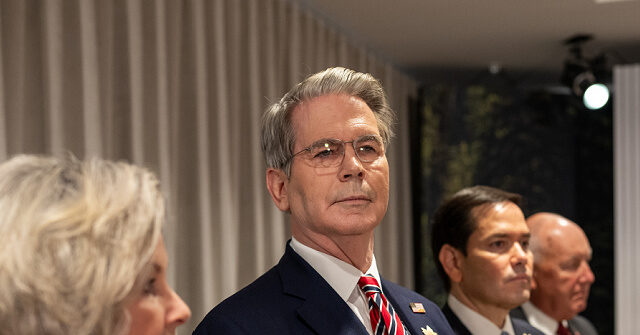
Treasury Secretary Scott Bessent stated that the Trump administration has received more than 700 tips through a Treasury Department reporting portal as the department announced new steps aimed at uncovering fraud involving Medicare, Medicaid, and other government healthcare programs.
Treasury Secretary Scott Bessent said the administration’s anti-fraud push is expanding rapidly, comparing it to “a suitcase in an airport — if you see something, say something.” Bessent said financial institutions are increasingly serving as “the front line in identifying financial fraud,” noting that suspicious activity reports have risen 20 percent under the leadership of President Donald Trump and Vice President JD Vance.
He pointed to unusual transfers by nonprofits such as daycare centers and hospice providers, saying that when they begin “wiring big, round numbers out, that’s a problem.” Bessent said the Treasury Department has already received “over 700 leads” through its reporting portal, many of which are now under active investigation. He said the government can pay whistleblowers “up to a 30% reward for the recovered funds.”
The Treasury Department on Monday announced a new anti-fraud initiative aimed at schemes involving Medicare, Medicaid, and other government healthcare programs. Treasury’s Financial Crimes Enforcement Network, or FinCEN, issued an advisory warning banks and other financial institutions that organized crime groups and transnational criminal organizations are increasingly using shell companies and straw owners to file false reimbursement claims. The agency said the schemes often involve “nonexistent, exploitative, substandard, or unnecessary medical care,” with fraudsters illicitly obtaining the names and identification numbers of beneficiaries and using “kickbacks and bribes to complicit medical professionals” to secure federal payments.
“President Trump has been clear that Americans have a right to know that their tax dollars are not being used to commit fraud,” Bessent said in a statement released with the advisory. “Under President Trump’s leadership, Treasury will continue to find and disrupt fraud schemes wherever they exist, and we will work with our law enforcement partners to hold perpetrators to account.”
FinCEN said the illicit proceeds are frequently moved through the financial system using wire transfers, digital assets, and other laundering methods, sometimes with the help of insiders at financial institutions. Treasury officials said suspicious activity reports related to health care rose 20 percent in 2025 compared with 2024, but warned that the reports likely represent only a small share of the fraud occurring nationwide.
The advisory, issued in coordination with the FBI and the Department of Health and Human Services inspector general, urged financial institutions to quickly report suspicious transactions and immediately alert law enforcement. FinCEN said fraudsters and transnational criminal groups are exploiting government healthcare benefit programs such as Medicare and Medicaid through “complex schemes that file false and fraudulent claims for reimbursement,” often using non-resident aliens as straw owners for newly created healthcare companies.
Treasury also announced that FinCEN has proposed formal rules for a new whistleblower program that would compensate people who provide actionable tips involving fraud, money laundering, sanctions violations, and other financial crimes. As Bessent previewed during his Minnesota visit, the proposal would allow eligible whistleblowers to receive between ten percent and 30 percent of monetary penalties collected in successful enforcement actions. FinCEN said the rules are intended to create “procedures for whistleblowers to provide information” and establish “protections for whistleblowers that provide information to FinCEN.”
A dedicated FinCEN portal launched in February is already accepting confidential tips from the public and financial institutions. The Treasury said any awards would be funded through penalties recovered under the Bank Secrecy Act and the International Emergency Economic Powers Act.
The latest Treasury initiative builds on Bessent’s January pledge to reward whistleblowers as federal investigators widened their scrutiny of Minnesota’s growing fraud scandal, which has involved allegations of misused child care, food assistance, and human services funds. “We know that these rats will turn on each other,” Bessent said at the time.