Iran’s F-5 Tiger II aircraft are decades old and utterly outmatched by modern American and Israeli aircraft—but Iran does not have anything better.
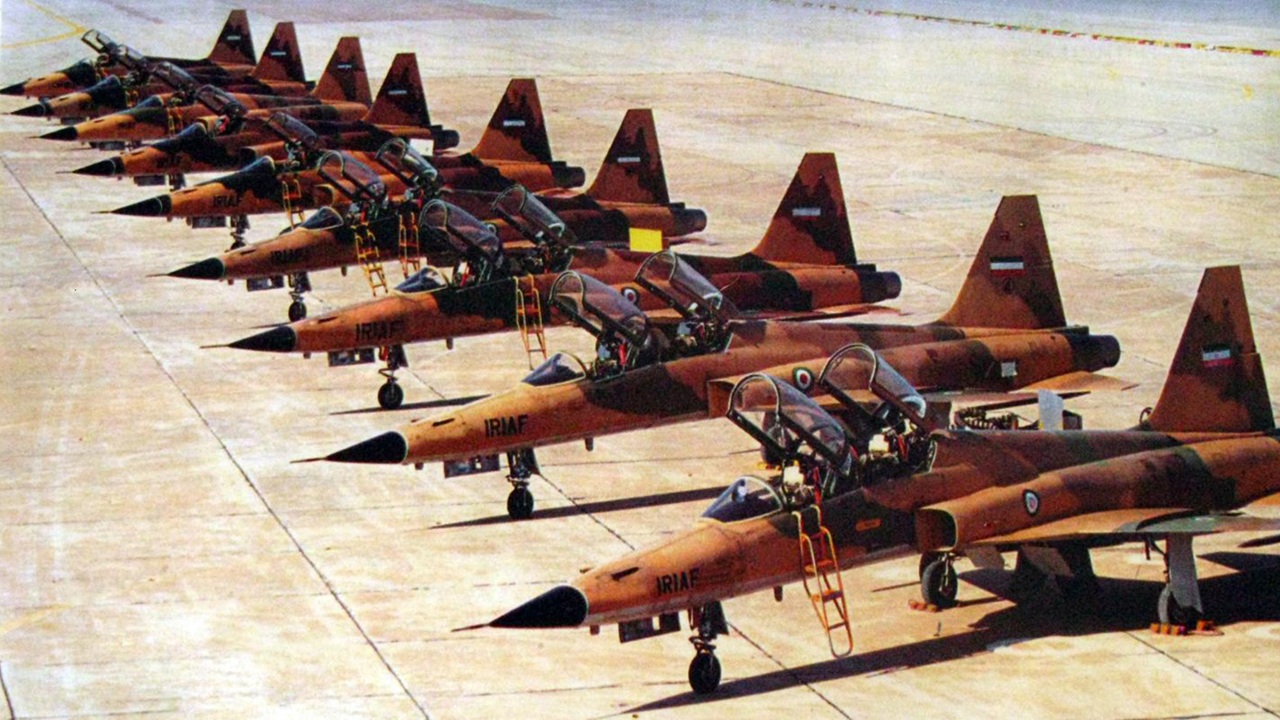
The Northrop F-5 Tiger II is a Cold War relic. Once a lightweight US export fighter, the F-5 is still a backbone fighter in the Iranian Air Force—a sanctions-imposed compromise, the shortcomings of which have been apparent during Operation Epic Fury. Set against modern aircraft, like the F-22 and F-35, the F-5 is clearly outmatched—but still used, because Iran simply lacks an alternative.
The F-5 Tiger II’s Specifications
- Year Introduced: 1972 (F-5E Tiger II)
- Number Built: ~2,500 (35–50 in service with IRIAF)
- Length: ~48 ft (14.7 m)
- Wingspan: ~26 ft 8 in (8.1 m)
- Weight (MTOW): ~24,700 lb (11,200 kg)
- Engines: Two General Electric J85-GE-21 turbojets
- Top Speed: ~Mach 1.6 (~1,050 mph / ~1,690 km/h)
- Range:
- ~350–550 mi (560–885 km) combat radius
- ~1,400 mi (2,250 km) ferry range
- Service Ceiling: ~51,000 ft (15,500 m)
- Payload: ~7,000 lb (3,200 kg)
- Aircrew: 1–2, depending on variant
How Iran Got—and Kept—the F-5 Fighter Jet
Prior to his overthrow in 1979, the pro-American Shah of Iran acquired the F-5 in the 1960s and early 1970s. Northrop delivered 140 F-5 aircraft to the Shah, who was attracted to the lightweight and low-cost fighter for its simple reliability and relative ease of maintenance.
Iran used the F-5 heavily during the 1980–1988 war with Iraq, mostly for ground attack and close air support roles. Despite its limited effectiveness in air-to-air combat, the F-5 did score a claimed kill against a MiG-25. So while the F-5 was not an elite platform, even by the standards of the 1980s, it was useful in combat and relied upon heavily.
Forty years later, Iran is down to about 35 to 50 operational F-5s, which are maintained through the cannibalization of old airframes and improvisational domestic parts production. Naturally, the aging aircraft have persisted maintenance issues; the avionics have degraded, the radar capability is limited, and their compatibility with modern missiles is extremely questionable. These aircraft are hardly sufficient for use in modern air combat. But Iran, heavily sanctioned for the better part of the last half century, doesn’t really have an alternative.
Even so, Iran has been able to relegate their F-5s to the background; the aircraft is no longer a frontline fighter. Instead, the F-5 is used for pilot training, light ground attack, and short-range air patrol. Occasionally, the jet is used for QRA (quick reaction alert) and as a secondary defense layer.
Notably, Iran has milked their F-5 fleet, turning the jet into an entire domestic fighter ecosystem through a variety of derivatives—the Saeqah, Kowsaw, and Azarkhsh. The Saqeh features twin vertical stabilizers and is marketed as a multirole light attack aircraft. The Kowsar featured upgraded avionics and a glass cockpit, and likely, improved radar. The Azarkhsh is an early indigenous modified version from the 1990s. But none of these domestic F-5 derivatives are revolutionary upgrades; they are fundamentally F-5s in terms of performance characteristics.
The F-5 and Operation Epic Fury
On March 1, on the second day of the Iran conflict, CENTCOM announced that two F-5s had been destroyed at Tabriz airfield while scrambling to take off. Another 5 to 10 F-5s are estimated to have been destroyed during airfield strikes (not air-to-air combat), further degrading the Iranian F-5 fleet.
Iran has used their F-5s during the conflict—mostly in a defensive posture, not local patrols and base defense. The F-5 does not have much offensive application against modern systems; it cannot penetrate modern IADS, and its air-to-air performance is sorely lacking. But the F-5 could potentially be used as a decoy to complicate coalition targeting.
Still, overall, the F-5’s survivability is extremely low in contested airspace, so don’t expect the Iranians to make much headway with their remaining F-5s—themselves a standing symbol of Iran’s failure to modernize its air force against the headwind of prohibitive sanctions.
About the Author: Harrison Kass
Harrison Kass is a senior defense and national security writer at The National Interest. Kass is an attorney and former political candidate who joined the US Air Force as a pilot trainee before being medically discharged. He focuses on military strategy, aerospace, and global security affairs. He holds a JD from the University of Oregon and a master’s in Global Journalism and International Relations from NYU.