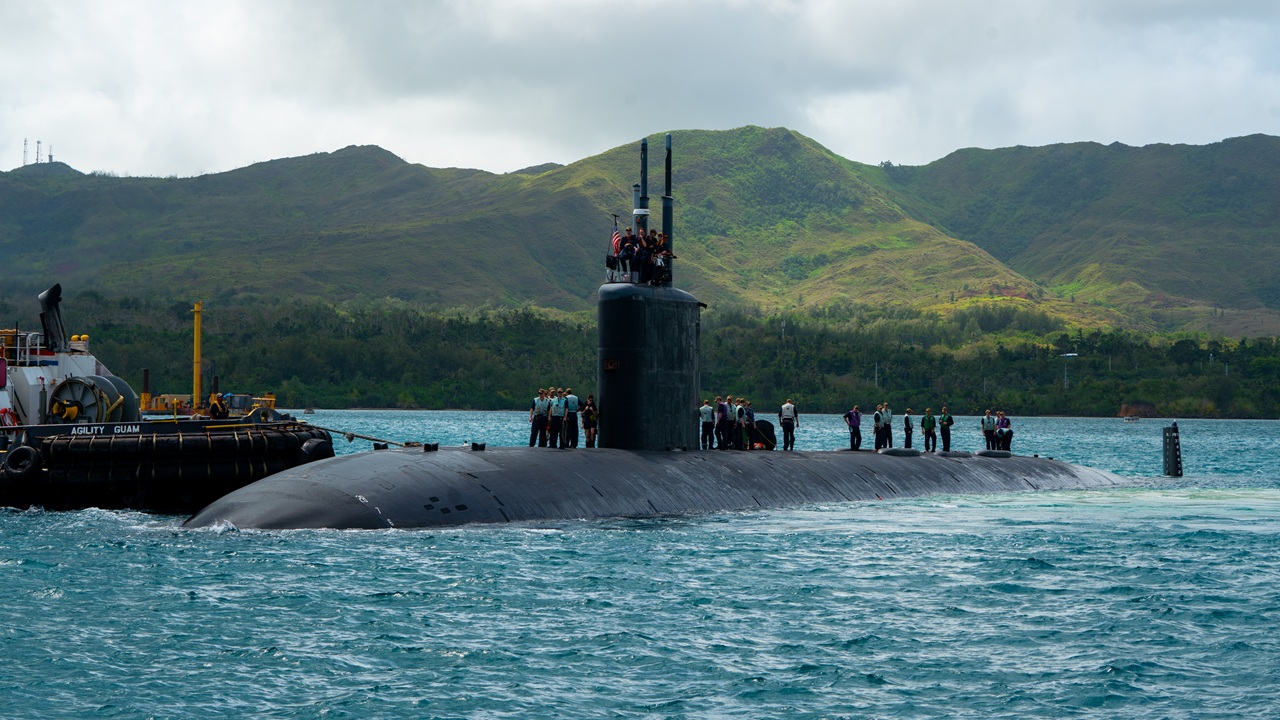
Submarines will spend hours or days tracking enemy vessels before carefully lining up a torpedo shot.
Earlier this month, a US Navy submarine sank the Iranian frigate IRIS Dena off the coast of Sri Lanka using a Mark 48 torpedo. Two days after the sinking, the Pentagon confirmed that the submarine involved in the incident was the USS Charlotte, a Los Angeles-class nuclear attack submarine—making it the first US submarine to sink an enemy ship since the end of World War II.
How a Naval Torpedo Strike Works
Sinking a ship with a torpedo may seem like a sudden and dramatic act. In reality, such a strike comes only after hours, even days, of preparation and tracking effort. Submarines rarely rush their attacks; instead, given their stealth advantage, they take time to gather information about the target vessel, calculating the most effective way to carry out a strike.
The strike process begins with detection. The primary method is passive sonar, in which the submarine listens for signs of enemy activity—chiefly propeller noise, machinery noise, and cavitation signatures. The sonar is “passive,” meaning that it does not emit any signature of its own, allowing the submarine to stay undetected. But the ocean is noisy—filled with shipping, biologics, and environmental acoustic clutter.
Once a prospective vessel is detected, the submarine must classify the sound based on an acoustic signature library. Each ship type has a unique sound fingerprint, and the detected sound must be cross-referenced against the library. This is critical, helping the submarine to avoid wasting a weapon (and the element of surprise) on an errant or low-value target.
Once the vessel is identified, the submarine continues tracking using continuous passive contact, building “target motion analysis” (TMA). The TMA tracks course, speed, and bearing through time and multiple bearing measurements—which are inferred mathematically, rather than with GPS—and which results in information that can allow for precise firing.
Next, the submarine must maneuver into position, adjusting for depth, speed, and bearing while aiming for a firing geometry advantage. Ideally, the submarine wants a flank shot, or an intercepting path. Crucially, the submarine must avoid being detected itself while maneuvering; the trick is to get close enough to fire, but not so close as to be detected.
Onboard the submarine, the fire control system computes the intercept point and the torpedo run path.
Finally, the torpedo is fired from a tube using a “water ram” or compressed air. During launch, effort is taken to minimize the noise produced and to avoid giving away the submarine’s position.
Submarines Aim for an “Under-Keel” Strike on Enemy Ships
Once the submarine enters the water, the torpedo’s propulsion and guidance activates. Initially, the torpedo follows a programmed path, which is often wire-guided back to the submarine; the sub can then update targeting or redirect the weapon, giving the torpedo flexibility if the target maneuvers. Mid-course, the torpedo will switch to active sonar or wake-homing (which follows the turbulence behind the ship and is very hard to decoy). In the final phase, the torpedo makes a high-speed approach, giving the target only seconds to react.
The most lethal mode of strike on an enemy vessel is an “under-keel” detonation, in which a gas bubble is created, pushing the hull upwards; then the gas bubble collapses, pulling the hull back down violently, breaking the keel. The keel is functionally the spine of the ship, so its destruction leads to catastrophic structural failure and quick sinking. This is the type of strike that took place against the IRIS Dena; from video footage of the strike, one can see the ship pushed upward in the water by the explosion, before falling down again and quickly beginning to sink.
Immediately after launching the torpedo, the submarine will begin maneuvering away, deploying decoys that change depth and speed in an effort to avoid counter-detection and retaliation.
About the Author: Harrison Kass
Harrison Kass is a senior defense and national security writer at The National Interest. Kass is an attorney and former political candidate who joined the US Air Force as a pilot trainee before being medically discharged. He focuses on military strategy, aerospace, and global security affairs. He holds a JD from the University of Oregon and a master’s in Global Journalism and International Relations from NYU.