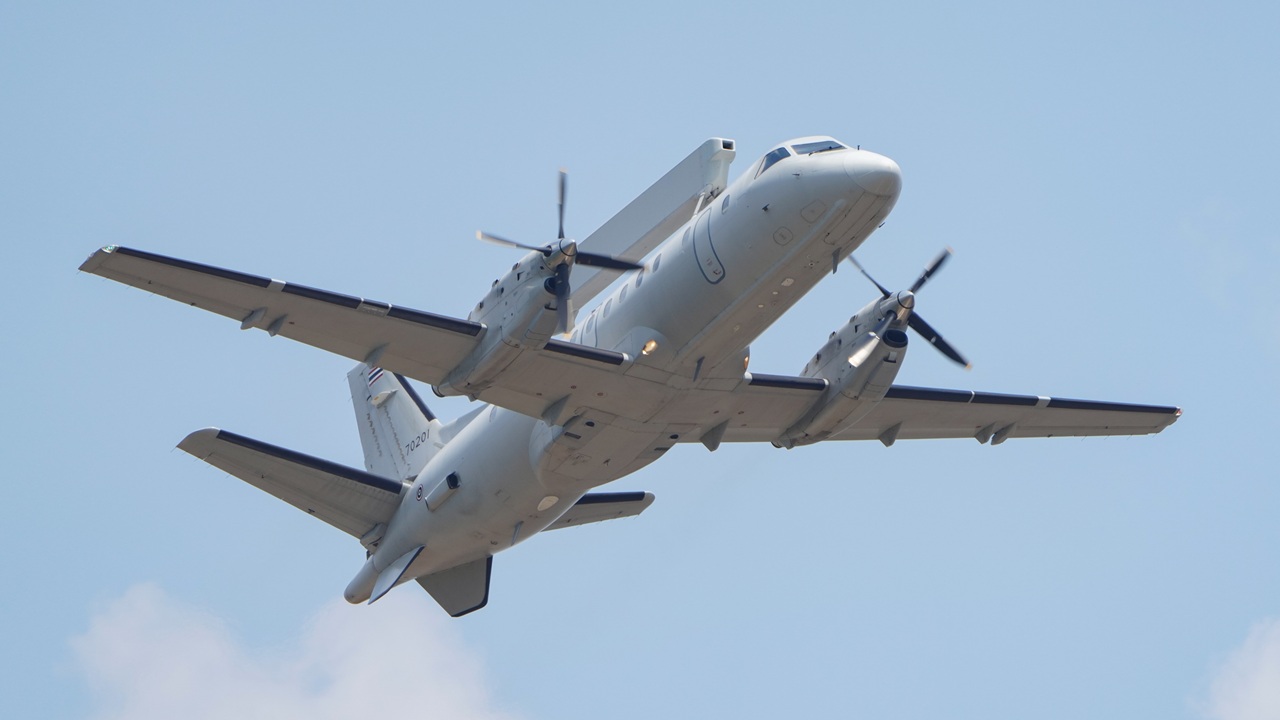
The introduction of two Saab 340 airborne early warning and control aircraft to the skies over Ukraine could have profound battlefield consequences.
Video has emerged purportedly showing a Saab 340 airborne early warning and control (AEW&C) aircraft in flight over Ukraine. While the date and location of the footage has not been verified, the aircraft’s presence in Ukraine is plausible; Sweden transferred two of the aircraft to Ukraine in 2024 as part of a broader aid package.
If the aircraft is indeed now flying in the skies over Ukraine, the Saab 340—though not as flashy as a fighter or a SAM system—represents a major upgrade to the country’s air defenses.
Previously, Ukraine had no domestic AEW&C capability—relying instead on the capabilities of the United States and its NATO allies. But now, with the possible addition of the Saab 340, Ukraine has a new layer of airborne defense, allowing for a pivot from a reactive to proactive air defense posture.
About the Saab 340
- Year Introduced: 1984
- Number Built: 459 (manufacturing ended in 1999; 200+ still in service)
- Length: 19.73 m (64 ft 9 in)
- Wingspan: 21.44 m (70 ft 4 in)
- Weight (MTOW): 13,150 kg (29,000 lb)
- Engines: Two General Electric CT7-9B turboprop engines (1,870 shp each)
- Top Speed: 524 km/h (326 mph)
- Range: 1,350 km (840 mi)
- Service Ceiling: 7,620 m (25,000 ft)
- Loadout: 34 passengers (civilian version), Erieye AESA radar (AEW&C version)
- Aircrew: 2 (civilian), 6 (AEW&C)
Why the Saab 340 Matters for Ukraine
The Saab 340 is a small turboprop aircraft built by Swedish manufacturing conglomerate Saab—better known in the civilian world for its cars and in military circles for its JAS 39 Gripen fighter jet—during the 1980s and 1990s. The Saab 340 was intended as a commercial plane, and around 200 of the aircraft are still used for air travel.
However, Ukraine’s two Saab 340s are built for military use, and both feature advanced Erieye AESA radars. The radar dramatically increases Kyiv’s ability to collect data on its adversaries; it has a 280 mile range, and can track roughly 1,000 air targets and 500 surface targets at the same time.
Operating at altitudes of roughly 20,000 feet, the Saab 340 can significantly enhance Ukraine’s situational awareness. The aircraft offers enhanced capabilities relative to ground radars, which are limited by terrain. Airborne radar offers look-down capability, which is far better at detecting low-flying drones and cruise missiles. This capability is critical to foiling Russia’s air attacks, which rely on swarms of Iranian-made Shahed drones and domestically manufactured cruise missiles to saturate Ukrainian air defense systems.
Tactically, the Saab 340 will offer Ukraine an early warning system, as the aircraft can detect threats far earlier, extending reaction time and reducing Russia’s ability to execute surprise attacks. The Saab 340 also serves as an airborne command node, assigning targets to fighters like the F-16 and Mirage 2000, improving intercept efficiency. And through sharing data with fighters and ground-based air defenses, the Saab 340 allows Ukraine to operate with a more complete and networked defensive system.
The Ukrainian Saab 340 fleet does face constraints. Saab provided Ukraine with only two of the aircraft, meaning Kyiv cannot execute 24/7 coverage. And because of the Saab 340’s capabilities and limited stock, they become a priority target for Russia. So Ukraine must frequently relocate their Saab 340s and keep them far from the front. Expect Ukraine to operate the Saab 340 from western Ukraine, with dispersed basing, thereby minimizing exposure.
Early Warning Aircraft Make Everything Else Easier for Ukraine
Strategically, the Saab 340 makes everything else in the Ukrainian defensive network more effective; through lifting the fog of war and supplying information, the Saab 340 improves the performance of fighters and SAM systems. But perhaps the biggest advantage is their counter-drone performance, given Russia’s extreme reliance on drone attacks so far.
Ukraine’s prospective addition of the Saab 340 speaks to the larger trends in modern air combat—in which one-on-one fighter performance has mostly been supplanted by integrated systems that sense, track, and coordinate. The Saab 340 is about information dominance, not pure kinetics. And despite Ukraine’s small fleet size, the addition of Saab 340s to its inventory is certain to have an outsized impact on the country’s defensive architecture.
About the Author: Harrison Kass
Harrison Kass is a senior defense and national security writer at The National Interest. Kass is an attorney and former political candidate who joined the US Air Force as a pilot trainee before being medically discharged. He focuses on military strategy, aerospace, and global security affairs. He holds a JD from the University of Oregon and a master’s in Global Journalism and International Relations from NYU.