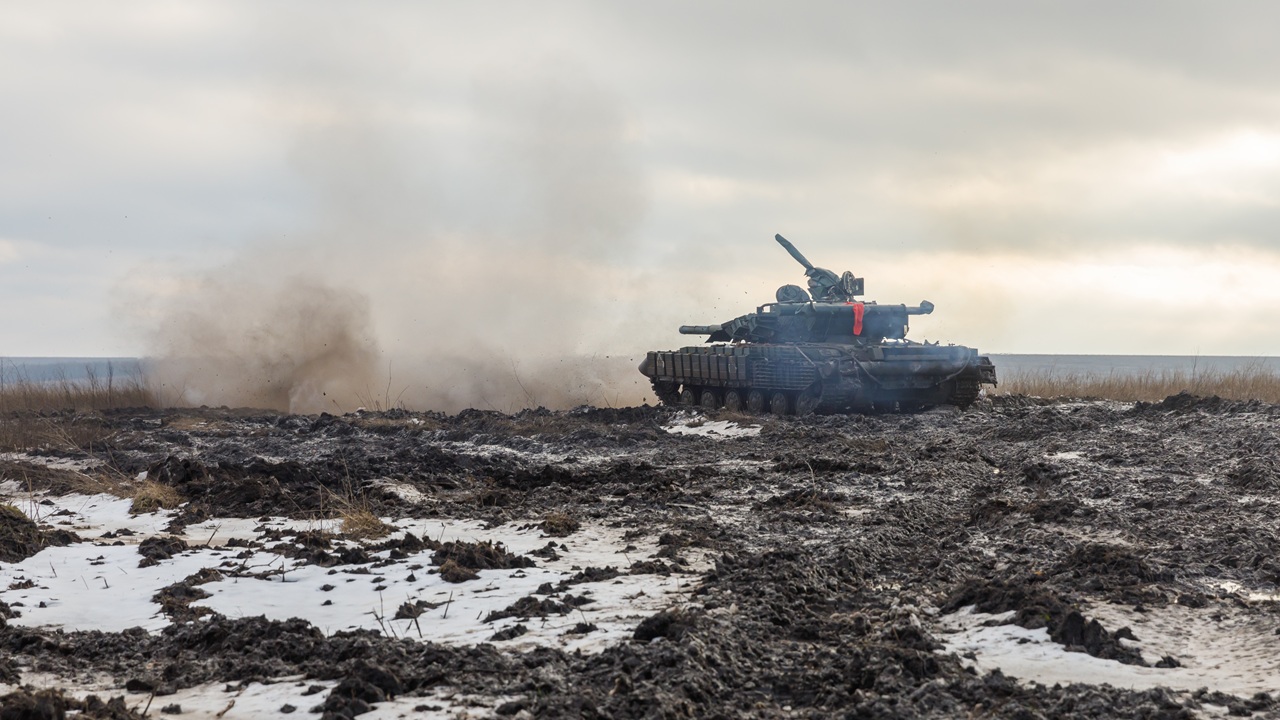
Russia’s attack has already cost the Kremlin around 10,000 casualties, with little to show for it in territorial gains.
After months of anticipation, Russia has launched its large-scale spring offensive in Ukraine. As winter subsided, the Russian military launched its anticipated spring offensive against Ukraine’s “Fortress Belt” in the Donbas.
Even though peace talks between the two combatants cooled following Russia’s reluctance to make concessions, a successful offensive campaign could give the Kremlin the necessary diplomatic tools for a negotiated end to the conflict.
The Goals of Russia’s Spring Offensive
Although the Kremlin has not outlined a clear objective for its spring offensive, Russian military leadership will most likely seek to enlarge its occupied territory in four key Ukrainian provinces in the south and southeastern part of the country: the Donetsk, Luhansk, Zaporizhzhia, and Kherson oblasts.
The Kremlin has claimed complete control of the four provinces, and even held a sham “referendum” in each in 2022 to give a legal veneer to their annexation into Russia. However, despite four years of conflict, the Ukrainian military still maintains varying control over the four frontline provinces.
To extend complete control over the four provinces, the Russian forces will need to crack Ukraine’s Fortress Belt, composed of fortified urban centers along the Donbas. Thus far, Russian progress has been limited and extremely costly. Russian casualties are already nearing 10,000 troops wounded and killed just a few days into the operation, according to Western estimates.
“Russian forces are unlikely to seize the Fortress Belt in 2026 but will likely make some tactical gains at a significant cost,” the Institute for the Study of War think tank assessed in a recent estimate about the Russian spring offensive.
Why Isn’t Russia’s Offensive Working?
Russia’s renewed offensive will most likely fail to achieve an operational breakthrough because the Kremlin has not addressed key structural shortcomings, including the effectiveness of its armed forces, as well as the capacity of the country’s defense industrial base to match the seemingly insatiable demands of the conflict.
“Russian President Vladimir Putin’s continued insistence that Russian forces maintain pressure along the entire frontline with continuous, albeit slow and grinding, advances is incompatible with the reforms the Russian military and DIB [defense industrial base] would need to implement to achieve a decisive battlefield victory in Ukraine,” the Institute for the Study of War added.
The Kremlin’s constant pressure for offensive operations across the frontline in Ukraine does not give sufficient space to the Russian military to address structural issues of organization, tactics, and training. The Russian military has begun some reforms, but they are still underway.
As a result of these shortcomings, Russian operations are trapped in a vicious loop of repetitive frontal assaults and casualties. Maneuver warfare—the type of warfare that could make a difference and achieve an operational breakthrough—needs time, space, and sufficient mobility and long-range capabilities to pull off. But the Kremlin’s strategy does not allow these necessary conditions.
The Russian defense industrial base also needs time and space to retool factories to produce the necessary weapon systems to fight a modern conventional conflict, including one-way attack unmanned aerial systems, artillery guns, and ballistic and cruise missiles. And the Kremlin has made the strategic choice to use many of its long-range systems against Kyiv and other Ukrainian cities rather than along the battlefield—hoping that “terror bombing” will erode support for the war in Ukraine and drive the government to make concessions at the peace table, although this strategy almost never works.
These structural limitations prevent the Russian offensive from achieving quick success. As a consequence, it is unlikely that the Russian forces will achieve significant gains in the short term to force the Ukrainian government to capitulate.
About the Author: Stavros Atlamazoglou
Stavros Atlamazoglou is a seasoned defense journalist specializing in special operations and a Hellenic Army veteran (national service with the 575th Marine Battalion and Army HQ). He holds a BA from the Johns Hopkins University and an MA from the Johns Hopkins’ School of Advanced International Studies (SAIS). His work has been featured in Business Insider, Sandboxx, and SOFREP.