Iran understands that the future of warfare lies in many thousands of low-cost, independent, and attritable systems. Does America?
There’s an old line from Dire Straits’ “Money for Nothing” that says, “That ain’t workin’, that’s the way you do it.” The line is meant as satire, but it lands uncomfortably close to the truth of the US Navy’s current predicament. When the world’s largest maritime power cannot reliably keep the world’s single most critical strait open to global commerce during a conflict—despite decades of intense preparation and rising budgets to match—something fundamental has broken. This isn’t a story about a single operational lapse. It is a story about a system that confuses inputs with outcomes, and is now finding out the difference between the two in the most visible way possible.
What the US Navy Is Doing Wrong
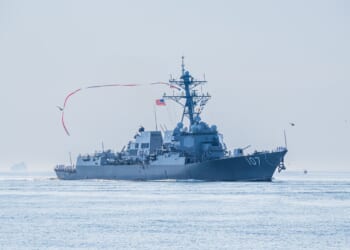
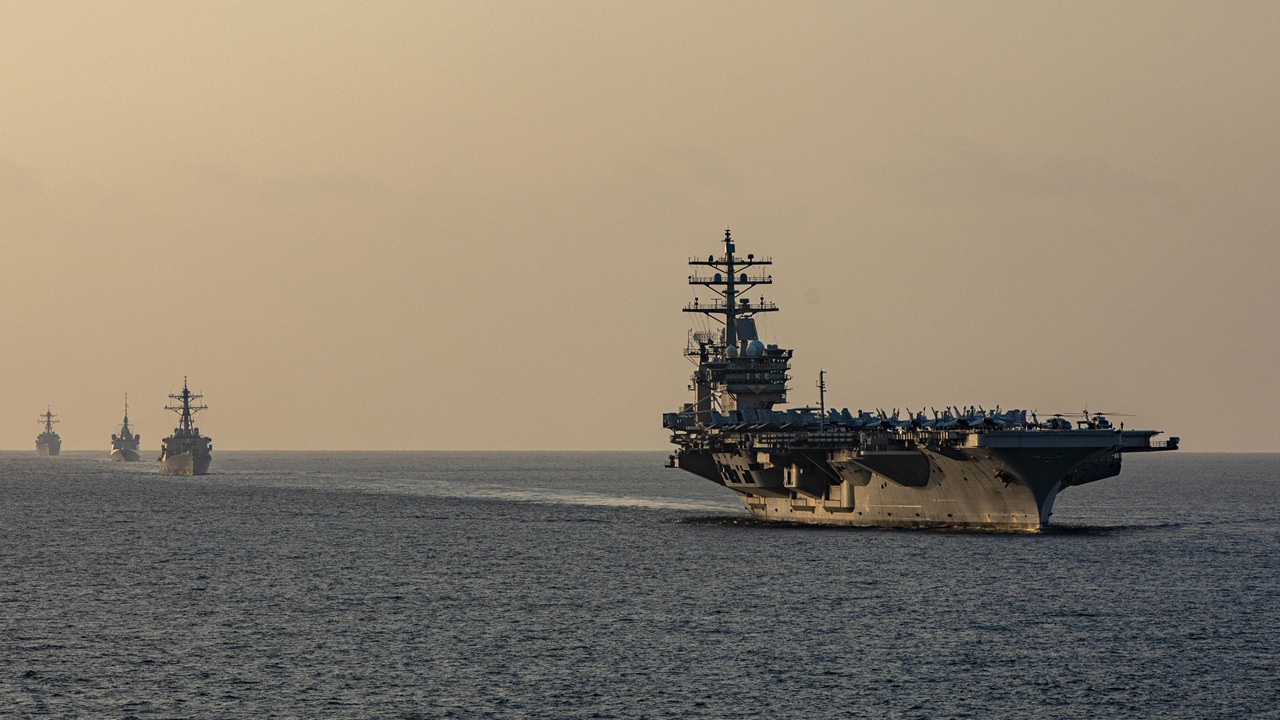
For years, the Navy has been optimized for presence, not control. Carrier strike groups signal resolve, destroyers patrol contested waters, and briefing slides glow with metrics of deployments and steaming days. But sea control—the unglamorous, grinding business of ensuring that commercial and military traffic can pass without disruption require something different. It requires depth: escorts, minesweepers, logistics ships, and ready munitions.
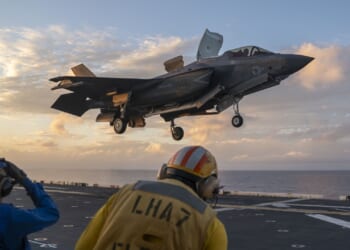
Weeks into Operation Epic Fury, the United States Navy has demonstrated extraordinary lethality. Carrier air wings have generated hundreds of sorties. Tomahawk salvos have obliterated Iranian air defenses and command nodes. A Los Angeles-class submarine sank an Iranian frigate with a single torpedo, the first American submarine kill since World War II. More than 60 Iranian naval vessels have been sunk or destroyed, and the CENTCOM Commander, Admiral Brad Cooper, has declared Iran’s conventional navy combat ineffective.
While these operational successes should be lauded, strategically, the Navy seems to be missing the proverbial boat. In spite of all its other successes, the Strait of Hormuz remains mostly closed, and over 150 commercial vessels sit anchored in the Gulf. The 20 million barrels of oil that transited the strait every day prior to the launch of Operation Epic Fury are now locked behind a chokepoint the most powerful navy in history cannot reopen. Meanwhile, Iran itself continues to export crude through the strait at roughly one million barrels per day. Tehran is operating the world’s most important energy chokepoint as a selective blockade, and the Navy has been unable to stop it.
The reason for the Navy’s failure is structural in nature. Over decades, Iran has built up a layered denial system across three domains—mines, missiles, and drones—and the Navy lacks the capacity to defeat any of them at the scale required. The missing element is a fourth: autonomy.
The US Navy Has No Answer to Iranian Naval Mines
Iran has thousands of naval mines in stock. Only a handful have been laid so far, but the sense of risk that they have created has halted commercial transit. A 2017 Office of Naval Intelligence report described the reliance Iranian military doctrine has on bottling up the Strait of Hormuz through mine-laying by diverse vessel types. The uncertainty around the volume and location of mines, and the catastrophic risk of losing an oil tanker worth hundreds of millions of dollars to one, combine to scare out insurers and prevent transit.
The Navy has no answer to this conundrum. In September 2025, it decommissioned its last four Avenger-class minesweepers from Bahrain, transitioning to unmanned systems deployed aboard select littoral combat ships (LCSs). Five months later, Iran began mining the Strait of Hormuz—and the counter-mine LCSs are located in the Strait of Malacca. The replacement LCS mine countermeasures mission package achieved initial operational capability in 2023, but was never scaled. Today, only three littoral combat ships carry two Mine Countermeasure (MCM) USVs each. This is the sum total of what the Navy can bring to bear against a 5,000-mine arsenal.
The timeline problem is equally damning. During Operation Desert Storm in 1991, it took a month just to transport the Navy’s minesweepers to the Gulf by heavy-lift ship, and clearance operations against roughly 1,300 Iraqi mines continued for months after the ceasefire. That was with dedicated MCM vessels and coalition support. Today, with no dedicated minesweepers and three LCS mission packages, there is no clearance timeline to speak of because there is no clearance capacity to begin one.
Nor can the United States count on its allies. After the tanker war of the 1980s, the Iranians evaluated the lessons learned and began to invest heavily in naval mines. The United States’ Gulf allies did not learn their part of the lesson; none of them have counter-mine capabilities. Nor has any counter-mine operator ever become a Chief of Naval Operations. The Navy has historically relied on NATO allies for counter-mine capabilities, but the United Kingdom and France are each in the middle of modernization—and do not appear eager to join the ongoing war.
Iranian Missiles Could Menace Gulf Shipping
Even if the mines were cleared, the Navy cannot escort commercial shipping through the strait at scale. Chairman of the Joint Chiefs of Staff Gen. Dan Caine has said that missiles, not mines, are currently the largest threat to merchant shipping in the Strait of Hormuz. Iran has used surface-to-surface missiles to attack commercial vessels in the northern part of the strait, and multiple vessels have been struck since the conflict began.
Missile attacks are marginally easier for the Navy to intercept than mines, and the Pentagon has floated the idea of escorting tankers in and out of the Persian Gulf in order to restore the flow of oil. Yet Energy Secretary Chris Wright has acknowledged that the Navy does not yet have the strength to escort tankers—while Lloyd’s List has assessed that even a best-case convoy scheme could restore only about 10 percent of normal tanker flow.
Iran’s coastal anti-ship cruise missile batteries, dispersed along the Gulf’s northern shore and on islands commanding the strait, pose a saturation threat to any surface combatant in these confined waters. This is why neither the USS Abraham Lincoln nor the USS Gerald R. Ford (before its recent fire) actually entered the Persian Gulf. The two supercarriers performed their respective strike missions from the Arabian Sea and Red Sea, hundreds of miles from the contested littoral zone. This does not amount to a declaration that aircraft carriers are altogether useless, but it is a concession that a $13 billion capital ship cannot operate in an area where it faces coordinated salvos from land-based launchers at close range. The same geography that makes the strait a chokepoint for tankers makes it a kill zone for escorts.
Iran’s Drones Are an Asymmetric Threat
Iran’s one-way attack drone inventory compounds the missile problem. Where anti-ship missiles demand hard-kill interceptors, drone swarms exploit gaps in the Navy’s ability to engage large numbers of slow, cheap, low-flying targets simultaneously. Iran’s use of drones makes the current situation fundamentally different from the 1980s tanker escort precedent.
Caine reported that Iranian drone launch rates have declined by 80 to 90 percent since the start of the operation. However, as some have rightly observed, the decline in observed launches is a behavior indicator, not a battle damage assessment. Iran may be recalibrating tactics with Russian assistance, stockpiling for larger coordinated salvos, or repositioning its inventory toward the strait in anticipation of escort operations. The pattern of Iranian strikes, which have followed a deliberate escalatory sequence from military installations to logistics hubs to energy infrastructure, is consistent with inventory management or capacity exhaustion.
Iran’s primary one-way attack drone, the Shahed-136, was designed to defeat precisely this kind of air campaign. It weighs roughly 200 kilograms, launches from a rail mounted on a pickup truck, and requires no fixed infrastructure. Prewar stockpile estimates range from several thousand to over 10,000. Iran has launched roughly 2,000 since the conflict began. Even if production has halted entirely—a contention for which there is no established evidence—Iran likely retains a large inventory.
History supports skepticism. During the 1991 Gulf War, US forces with full air superiority failed to confirm a single kill against Iraq’s truck-mounted Scud launchers, a system far larger and slower to deploy than the Shahed. During “Operation Rough Rider,” the US air campaign against the Houthis from March to May 2025, more than 800 American and British airstrikes against Houthi drone and missile sites in Yemen failed to suppress launches from Shahed-derived systems.
The drone threat is not a problem the Navy can bomb its way out of. The cost-exchange dynamics are disqualifying: each drone costs a fraction of the munitions required to shoot it down, and in sustained operations the defending fleet burns through magazine depth while the attacker’s production cost per unit remains negligible.
Autonomy Could Be a Silver Bullet for the US Navy
The technology to address each of these gaps exists. Unmanned surface vessels, equipped with mine-hunting sonar and influence sweep systems and built in the tens of thousands, could operate in contested waters without risking sailors’ lives. Autonomous interceptors and directed-energy systems can address the cost-exchange problem that makes kinetic shoot-downs of cheap drones unsustainable. These systems can be produced at scale and deployed forward to the locations where they are needed: the Strait of Hormuz now, and the Taiwan Strait tomorrow.
However, the Navy is not building them this way. The current trajectory across the Navy and the other services is to develop unmanned platforms tethered to manned systems—operating as adjuncts to destroyers, carriers, and infantry formations rather than as fully independent assets. This undermines the core advantage unmanned systems offer. An unmanned vessel that must remain within communications range of an Arleigh Burke destroyer to function does not remove the destroyer from the threat envelope. An “attritable” drone that requires a nearby manned command node is not attritable in any meaningful sense, because losing the command node means losing the entire capability. The manned-unmanned teaming concept as currently conceived imports the vulnerability of the manned platform into a system architecture whose entire value proposition depends on eliminating that vulnerability.
The Iran supplemental now being discussed on Capitol Hill must fund unmanned MCM and littoral ISR as independent programs of record with defined requirements for autonomous operation, not as mission packages bolted onto manned ships that cannot enter the waters where the mission needs to be performed. If Congress pursues another reconciliation package, unmanned mine countermeasures and littoral surveillance systems should be named priorities within it.
We have made this argument before. One of us called the Navy broken in 2022 and urged Congress to charter a commission to find the path forward. In September 2025, we argued that the carrier strike group had become a platform without a viable mission in contested littoral waters. The response from the Navy’s institutional leadership has been to double down on the platforms and procurement structures that produced this crisis.
Until this changes, the Navy will continue to find itself in a position that should be unthinkable for a maritime power: present, visible, and yet unable to fully deliver on its most basic mission. Or, to borrow again from “Money for Nothing,” a system that looks busy, spends freely, and still leaves the hard work undone.
About the Authors: John Ferrari and Dillon Prochnicki
Maj. Gen. John G. Ferrari is a nonresident senior fellow at the American Enterprise Institute. Over his 32-year US Army career, Ferrari, who is now retired, served as the director of program analysis and evaluation, the commanding general of the White Sands Missile Range, and a deputy commander for programs at the NATO Training Mission in Afghanistan. He has an MBA in finance and strategic management from the Wharton School at the University of Pennsylvania, an MA in national resource strategy and policy from the Industrial College of the Armed Forces (now called the Eisenhower School for National Security and Resource Strategy), and a BS in computer science from the United States Military Academy at West Point.
Dillon Prochnicki is a research assistant at the American Enterprise Institute.