The Primate Myth: Why the Latest Science Leads Us to a New Theory of Human Nature, by Jonathan Leaf (Bombardier, 320 pp., $21)
Ever since Darwin, biologists have believed that much could be learned about human nature from apes and monkeys, the primates with which we share common ancestry. Chimpanzees, in particular, our closest living relatives, are likely to reflect many features of our early primate nature given that we and they shared a common ancestor who lived some 7 million years ago, not so long on evolution’s time scale.
Finally, a reason to check your email.
Sign up for our free newsletter today.
Jane Goodall developed an approach for studying chimpanzees in their native habitat. These records, along with observations of chimp colonies in zoos, have shed light on every aspect of chimp behavior, from making tools to fighting wars. Primatologists have thereby gained many deep insights into the inferred wellsprings of human behavior.
The restraints and rule-following behaviors evident among chimps probably reflect the ancestral instincts from which human systems of ethics developed. Chimpanzees defend a home territory and, also like people, will seek to kill neighboring groups. The leading male chimp forms alliances with other males so as to dominate his community. He rewards his associates with mating opportunities—not so different from the coalitionary politics in most human societies, except that in these the rewards for fealty are not women as such but the land or wealth required to attract them.
Primatology is rife with controversy, as befits any active field of inquiry. It’s easy to forget that in looking at the chimpanzee we are seeing only a close cousin, whose behavior may in some cases have evolved far away from that of the common ancestor in which we are interested. Chimps have a cousin species, the far more peaceful bonobo, and experts argue as to which is the better guide to human behavior.
In his book The Primate Myth, Jonathan Leaf boldly disputes the premise that human nature can be inferred from that of chimps. People are so unlike primates that they should not be classified as primates at all: “Rather than be seen as primates, we should be placed in a separate order of mammals: Homo,” he writes.
In terms of language, for instance, dogs are far more like us than chimps are, he says. Dogs cannot speak, of course, but border collies can learn the spoken names for up to a thousand different objects. The many strenuous attempts to teach chimps to communicate with people have ended in failure, culminating in the experiment with Nim Chimpsky, whose handlers reluctantly concluded that his utterances—some quite lengthy—were essentially devoid of meaning and designed only to prompt more food.
Leaf believes we have far more in common—“stronger patterns of evolutionary connection”—with large-brained herd animals like horses, hippopotamuses, and elephants than with other primates. “Our anatomical likeness to primates conceals a series of fundamental dissimilarities,” he writes. “If we are to think of other animals as sisters and brothers, we would do better to look at the creatures with trunks and flippers.”
The hazard of seeing people as similar to chimps, in Leaf’s view, is that we will regard their faults as inherent in ourselves and hence ineradicable. “Primatologists have convinced our intellectual elites that warfare is a natural outgrowth of our primate impulses for violence and aggression,” he writes. In his view, people wage war because of their capacity for cooperation as soldiers, not from any innate propensity for violence.
It would be pleasant to side with Leaf against the primatologists and look instead to dogs and dolphins as the species whose behavior is most indicative of our own. Unfortunately, we are stuck with chimpanzees as our closest relatives, however violent and uncouth we may find them. Anatomy and genetics root us closer to chimps and bonobos than to any other living species. If humans belonged to a separate order of mammals as Leaf suggests, their ancestral line would have broken off from the mammalian branch independently of the primates, leaving its own distinct traces in the fossil record. No such traces exist.
Leaf, a playwright and novelist, deserves credit for challenging a central dogma of an expert group. Perhaps his best argument against always looking to chimps for our ancestral proclivities comes from the idea of convergent evolution. Evolution often reaches the same solution by different routes. There is an ecological niche for birds that feed on carrion—namely, vultures. But Old World vultures and New World vultures evolved independently from different ancestral species. Sabre-toothed tigers existed on both continents but with entirely different pedigrees, one being a mammal and the other a marsupial.
Leaf argues that the highly social features of our nature are also an example of convergent evolution, one in which we have departed from the lineage of aggressive primates and made the same or similar peaceful adaptations as those developed by herd animals like dolphins and elephants. Hence these sociable species are a better guide to our nature, he writes.
There is doubtless some truth to this suggestion, but it’s not clear that it bears the weight that Leaf seeks to place on it. Maybe we resemble dolphins and elephants in one feature or another of our nature, but overall we are still very chimp-like, as our close ancestry with chimps would suggest.
In the matter of warfare, for instance, Leaf sees our ability to fight in groups as part of our sociality, an attribute of convergent evolution with sociable herd animals. Still, there’s a much more direct parallel with chimps, whose military strategy Leaf sells short. He dismisses accounts of chimp warfare, saying the reported deaths are too low—“This was a gang fight, not a war.” But chimps don’t go in for frontal battles; they prefer low-risk ambushes, picking off the defending males of the neighboring community one by one until all are dead and their females available for capture and insemination. This is not a gang fight but genocide—a behavior that provides one of the more instructive parallels between ourselves and our aggressive primate cousin.
Leaf is also on uncertain ground in asserting that we are closer to dogs because they are more responsive than chimps to our attempts to communicate. True, dogs can learn more spoken commands than chimps. But that’s because they are domesticated and pay attention to what people try to teach them, not because they are more intelligent. Chimps, though they cannot speak because they lack the necessary vocal apparatus, can communicate well enough among themselves to organize hunts, perimeter patrols, and raiding parties.
It may be that some primatologists exaggerate our kinship with the great apes. But most are intent on studying how ape societies work on their own terms, regardless of the lessons they may hold for us. Decades of patient work in zoos and forests have established that these creatures, so strange at first sight, have much in common with our own species. The gap between us is so large only because of the lucky evolutionary accident that endowed us with the gift of language and its power to transmit knowledge. Leaf’s disdain for primatology echoes the gasps with which Darwin’s scandalized Victorian audience greeted his assertion that we are descended from apes.
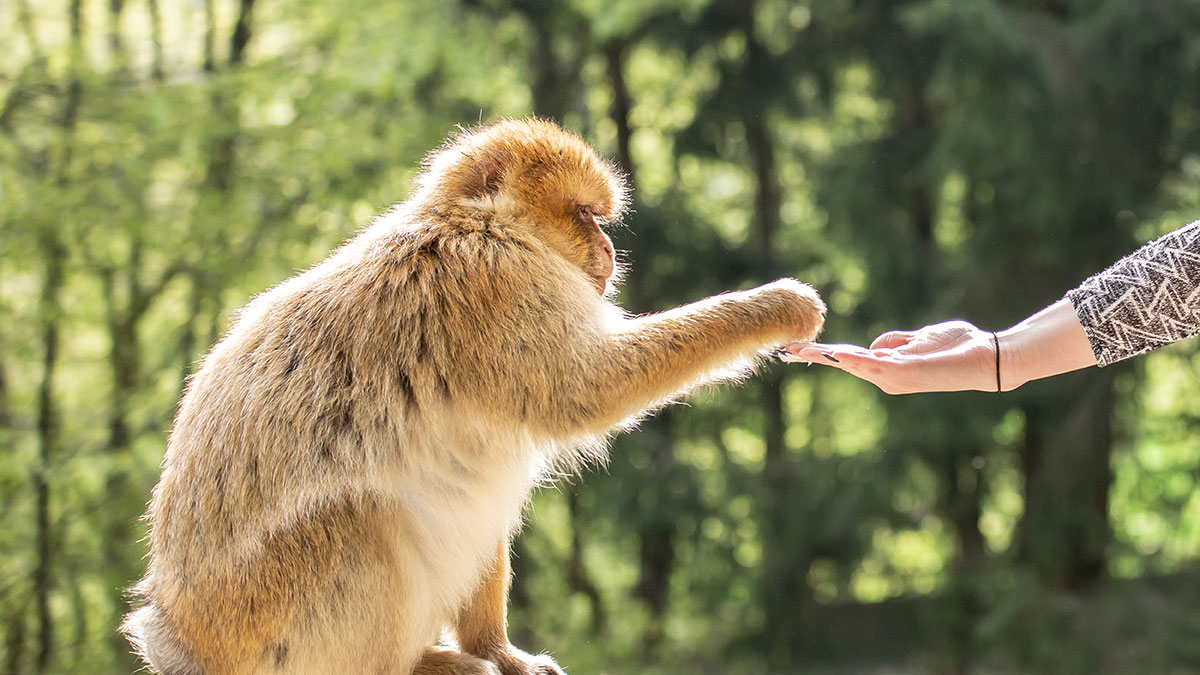
Photo by Silas Stein/picture alliance via Getty Images
Source link