Recent stories of note:
“Met Museum to Acquire Rediscovered Renaissance Painting Admired by Vasari”
Maximilíano Durón, ARTnews
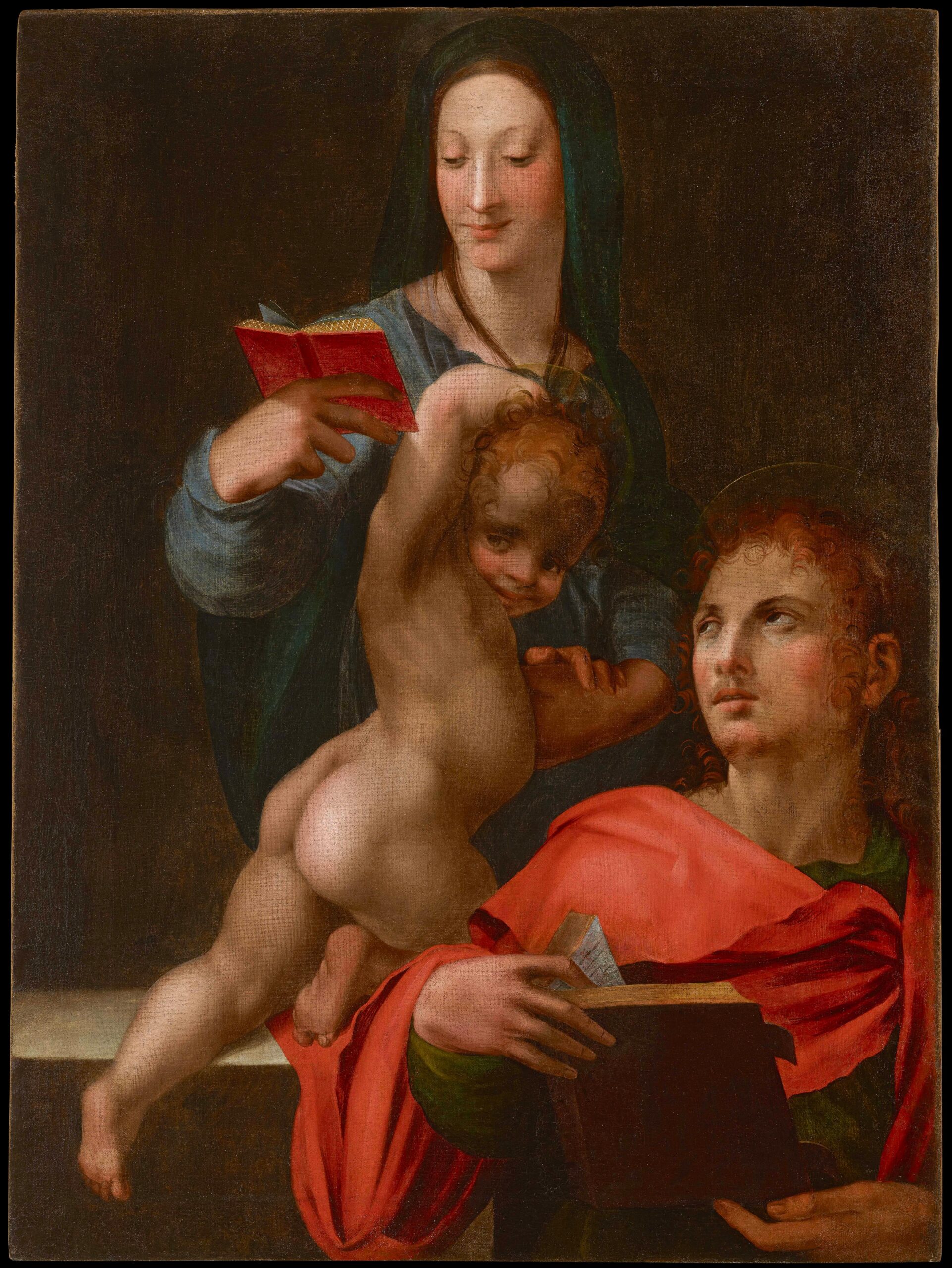
In 1513, the eighteen-year-old painter Giovanni Battista di Jacopo (1494–1540), later nicknamed Rosso Fiorentino, caught his first big break: upon seeing Rosso’s Madonna and Child with Saint John the Evangelist, Friar Jacopo of the Servite Order was so impressed that he hired the “Florentine Redhead” to paint the Assumption of the Virgin (1513) in the cloister of Florence’s Basilica della Santissima Annunziata, the fresco that made his name as a rising star of Florentine painting. Long thought lost, Madonna and Child with Saint John, the painting that in Vasari’s telling launched the artist’s career, has now been conclusively identified after undergoing conservation treatment, which revealed the half-length Saint John that Vasari mentions in the foreground. Christ, who looks more like a miniature professional bodybuilder than a baby, is shown in an impossibly convoluted pose, twisting in every possible direction, in quintessential Mannerist fashion. This early masterpiece, one of only two dozen works attributed to il Rosso, will be acquired by the Metropolitan Museum of Art, where it is already on view.
“‘A Spy Amongst Us’ Review: An Agent of Union”
Crawford Gribben, The Wall Street Journal
Today Daniel Defoe is known primarily as the author of Robinson Crusoe (1719), but as Marc Mierowsky argues in A Spy Amongst Us, his political legacy is as great as his literary gifts: Defoe played a key role in securing the passage of the Acts of Union of 1707, which joined England and Scotland and created Great Britain. As Crawford Gribben writes in his review, uniting with England was a highly contentious issue in Scotland, and so in 1706 the English government dispatched Defoe, who had significant experience in covert operations, to drum up support for a united Britain in Edinburgh. There he deployed his talents as a pamphleteer—only a few years prior, he had spent time in the pillory for a satirical tract in which he sarcastically called for the extermination of all Dissenters—to show the advantages of union, all while sending detailed reports of Scottish sentiment to Westminster. It is quite fitting that the man who invented the adventure novel led a life that reads like one uninterrupted picaresque romp.
“Life lessons from George Orwell”
D. J. Taylor, The Spectator World
While Defoe’s novels can be separated from his politics, the same cannot be said of George Orwell. Western politics have become so oversaturated with Orwell that he has the rare distinction of being cited as a prophet by both the Left and the Right: conservatives attacked Fauci’s COVID policies as Orwellian government overreach, even as left-leaning media outlets routinely wheel out Nineteen Eighty-Four to denounce the Trump administration’s totalitarian policy coup du jour. One side effect, however, of the rise of the Orwell–industrial complex is that “you start to turn up evidence for the prosecution,” as D. J. Taylor writes. Taylor, who is himself a noted Orwellian—his biography of the novelist was reviewed in these pages—makes short work of popular lines of attack against Orwell. It turns out, for instance, that Orwell’s much-discussed list of suspected Communists that he gave to the Foreign Office was no denunciation letter, but merely ensured that British pro-democracy pamphlets distributed in Soviet-dominated Eastern Europe would be written by actual democrats, and not by Soviet stooges. While Orwell’s status as secular saint seems secure for the time being, one wonders if the constant invocation of his name will not blind us to genuine Orwellian developments.