Artificial intelligence is currently the white-hot center of America’s economy. Big Tech is investing more than $750 billion in data centers this year, mostly domestically. Unsurprisingly, wages for construction workers and the skilled trades are skyrocketing. Communities like Virginia’s Loudoun County are almost covering their entire operating budgets through data-center taxes.
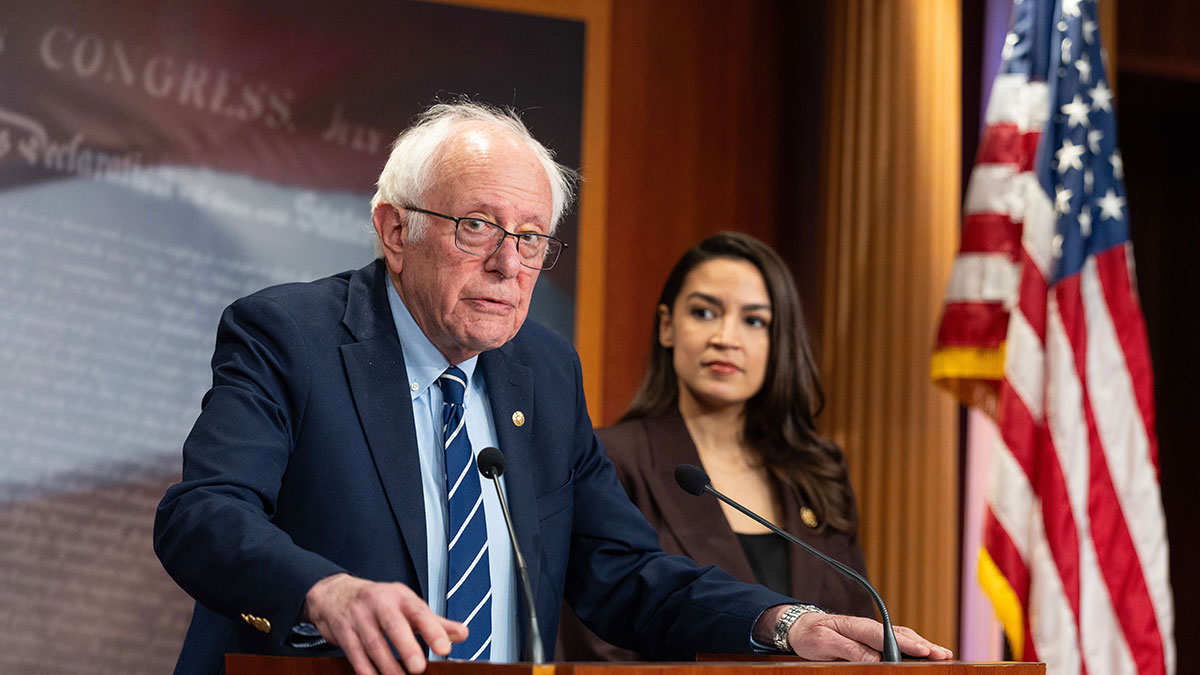
Representative Alexandria Ocasio-Cortez and Senator Bernie Sanders want to put a stop to all of that. On Wednesday, the pair jointly proposed a universal halt to America’s AI economy. Their bill would enact a moratorium on new and existing data-center growth as well as a ban on exporting AI chips. The pause would last until Congress passes a “framework” to regulate the industry.
Finally, a reason to check your email.
Sign up for our free newsletter today.
In other words, the degrowth duo want to tie up America’s most innovative and globally competitive industry using the same bureaucratic process that has recently resulted in TSA airport security lines snaking through terminals and parking garages. And they want to take advantage of Americans’ understandable fears about new technology to impose their radical beliefs on the nation’s economy.
It’s a far cry from how we used to think about growth. Back in 1996, as the World Wide Web was spreading but before the dot-com boom took off, a bipartisan group of legislators passed the Telecommunications Act, which opened up the nascent internet economy to bountiful innovation with a carefully crafted regulatory framework. That bill passed 414–16 in the House and 91–5 in the Senate. It’s unimaginable that a law with such a singular focus on openness and American growth could win such broad support today.
What Ocasio-Cortez and Sanders imagine goes hard in the opposite direction. They want to take Ezra Klein’s “everything-bagel liberalism” and add in even more “everything,” while toasting the American economy to boot.
Their wish list starts with wealth distribution. A regulatory framework that meets the law’s standards to end the moratorium would put “policies in place to prevent job displacement due to artificial intelligence.”
Their word choice is sneaky: job displacement means job change, not job loss. Even if America’s economy had extensive net employment growth, that would not meet the standard to “prevent job displacement.” The simple moving around of workers would be enough to keep data center growth checked.
Ocasio-Cortez and Sanders also demand a framework “ensuring the wealth generated by those [AI] companies is shared with the people of the United States.” AI companies already do this: their employees pay income tax, the companies pay corporate tax, the data centers pay property taxes and utility fees. A moratorium until the gains are “shared” implies taking an even larger slice of the pie.
Next on their wish list is every degrowther’s dream, a NIMBY veto: “communities that would be affected by the artificial intelligence data center are empowered to approve or reject the construction or upgrading of that artificial intelligence data center.” This is a sop to the AI backlash, designed to hinder the industry’s growth even as the vast majority of Americans take advantage of the apps and platforms built on that infrastructure. Of course, local communities already control their own zoning, which is why local moratoriums on data centers have already passed in multiple cities. Again, what more do they want?
Note also that the community that hosts a data center isn’t the only one that could be affected. Given the bill’s focus on climate and environment, any city sharing the same power grid or water supply with a proposed data center would presumably also get a veto over construction. One shudders to think what would happen if even one city council surrendered the fight and became pro-prosperity.
Next up is Ocasio-Cortez and Sanders’s offering to organized labor. Their moratorium would be lifted when federal law requires that “the artificial intelligence data center creates union jobs with strong labor standards, including payment of prevailing wages and use of registered apprenticeship programs and project labor agreements.” “Prevailing wage” is the artful term that legally demands private industry pay the nonmarket wages offered by government. “Project labor agreements” are the mechanism that hamstrung Joe Biden’s infrastructure law, requiring union negotiations for every proposal.
Ocasio-Cortez and Sanders seem to understand that terminating America’s most important growth industry amid a competitive race with China is bad industrial policy. So they reinforce their degrowth agenda in the bill’s final section, mandating a sweeping export ban of AI hardware to countries that don’t enshrine equivalent legislation. Given that no country—not just China, but all of Europe, the Middle East, and the Global South—would pass such a progressive fever dream of a regulatory framework, their ban on exports as proposed is essentially absolute.
In fact, the European Union, which launched its own AI Act in 2024, has now started what liberal critics decry as a “massive rollback” of its strict privacy and governance provisions. That’s because of Europe’s declining competitive position in what is currently the twenty-first century’s most important industry. Maybe our own legislators can take a lesson from the regulatory vanguard’s missteps and avoid repeating them.
Sanders and Ocasio-Cortez’s bill opens with a litany of cherrypicked quotes from tech titans—Elon Musk, Anthropic’s Dario Amodei, DeepMind’s Demis Hassabis, and others—on the potential dangers of AI. In a final flourish, the bill specifically applies the export ban to these individuals.
It can’t be overstated enough: the AI backlash is real. Consumers are worried about rising utility prices, employees are waiting for pink slips, and parents are concerned about the safety of their children. All these fears are understandable and should be addressed with thoughtful legislation.
What political entrepreneurs like Ocasio-Cortez and Sanders recognize is that those fears can propel their dangerous agenda. By tying voters’ fears to tech and capitalism, they can undermine the principles that have enabled the United States to become the most powerful and wealthiest nation in the world.
Responding to the extraordinary growth underway in the AI economy, the Left has decided to replace Barack Obama’s “yes, we can” with the command-economy pessimism of “halt!” It amounts to a freeze on innovation, a moratorium on expansion, a stop to change. One struggles to understand how such ideas get labeled “progressive.”
Photo by Tasos Katopodis/Getty Images
City Journal is a publication of the Manhattan Institute for Policy Research (MI), a leading free-market think tank. Are you interested in supporting the magazine? As a 501(c)(3) nonprofit, donations in support of MI and City Journal are fully tax-deductible as provided by law (EIN #13-2912529).
Source link