After Iran launched several drones at Cyprus in early March, the United Kingdom deployed a Type 45 destroyer to the region—but stopped well short of a more muscular response.
President Donald Trump publicly scolded the United Kingdom earlier this month after the British government refused to send warships to support the ongoing war against Iran. The fact remains that the Royal Navy doesn’t exactly have the capabilities to support such operations.
The UK’s senior service is more like an aging pensioner well past his prime than a robust and agile fighting force—a point that some naval analysts noted in January when the Royal Navy retired its final warship in the Middle East, the Hunt-class minesweeper HMS Middleton (M34), which was based at the United Kingdom Naval Support Facility (UKNSF) in Bahrain.
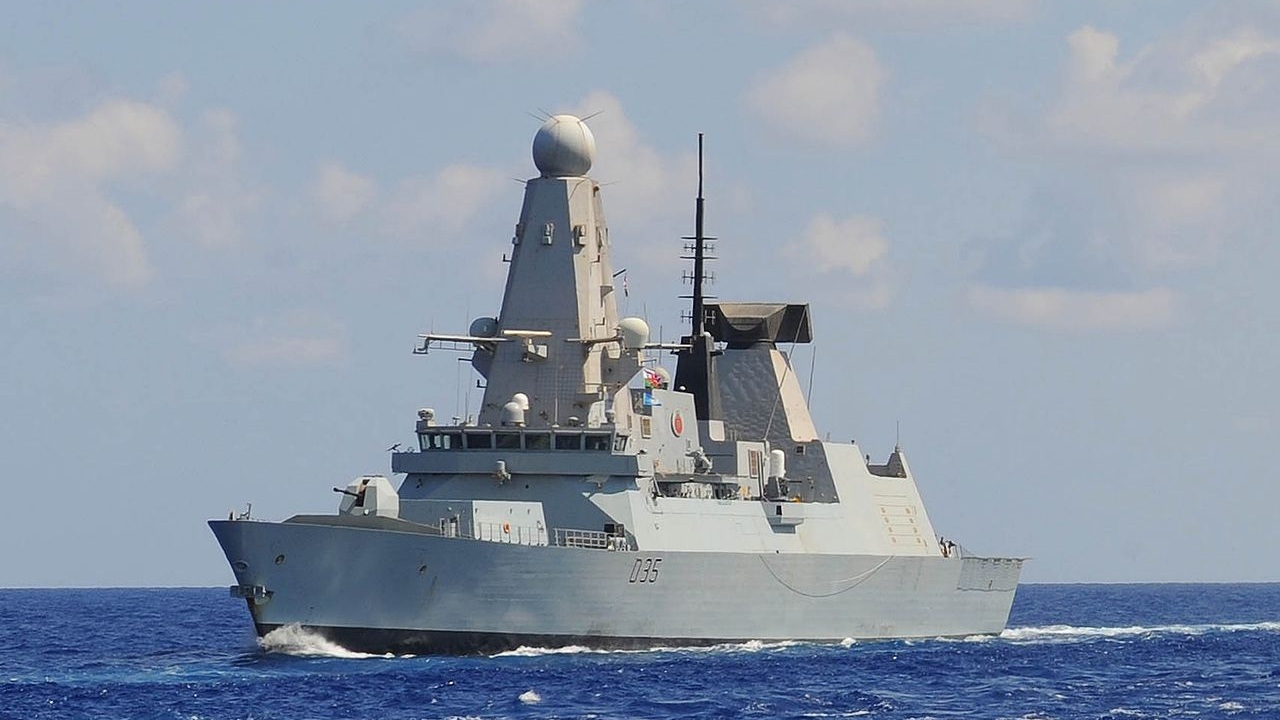
Neither of the two Royal Navy aircraft carriers are expected to be sent to the eastern Mediterranean to support the mission and protect British interests. Instead, London pledged to send the Type 45 Daring-class guided-missile destroyer HMS Dragon (D35) to Cyprus, after RAF Akrotiri, the main base on the island, came under attack by Iranian drones more than three weeks ago. It had been expected that it would take several days for the warship to reach the region, but that was clearly overly optimistic.
HMS Dragon finally arrived in the eastern Mediterranean on Monday. The destroyer required two weeks of “critical training and assessment to ensure her 230 sailors, advanced systems and weaponry [were] ready for the potentially intensive pace of operations,” the Royal Navy explained.
The Type 45 Destroyer’s Specifications
- Year Introduced: 2009 (HMS Daring commissioning)
- Number Built: 6
- Length: 152.4 m (500 feet)
- Beam (width): 21.2 m (69 ft 7 in)
- Displacement: 7,500 tonnes
- Propulsion: Two Rolls-Royce WR-21 gas turbines
- Speed: 32 knots (37 mph, 59 km/h)
- Range: 7,000 nautical miles (8,055 mi, 12,964 km)
- Armaments:
- “Sea Viper” Principal Anti-Air Missile System (PAAMS):
- One 48-cell Sylver A50 Vertical Launching System (VLS) for a combination of 48
- Aster 15 short-range missiles
- Aster 30 medium-range missiles
- Two Mk. 141 quad missile launcher for up to 8 x RGM-84 Harpoon SSM
- One BAE Mark 8 Mod.1 gun
- Two DS30B Mark 1 – 30mm machine guns
- Two M134 six-barreled machine guns (minigun)
- Two Mk 15 Phalanx CIWS
- Crew: 191, accommodating up to 285
British Destroyers in Cyprus: Better Late Than Never
The Type 45 destroyer is now operating off the coast of Cyprus and will integrate with the island’s defenses. The deployment comes after Greece and France already sent naval support to the region, including the Marine Nationale’s (French Navy’s) flagship nuclear-powered aircraft carrier Charles de Gaulle, which arrived last week.
The Royal Navy has sought to put a positive spin on its current state.
“HMS Dragon was rapidly brought to readiness and deployed from Portsmouth earlier this month and will now play her full part in defending Cyprus and the wider Eastern Mediterranean,” said General Sir Gwyn Jenkins, the First Sea Lord and chief of the Naval Staff.
“Equipped with the cutting-edge Sea Viper system, she can tackle a wide range of threats. On her way to the region, her crew has undertaken essential training to ready themselves for this mission, and I have every confidence that they will rise to the task before them,” Jenkins added. “In uncertain times, her presence is a visible demonstration of the Royal Navy’s commitment to protecting our people and our interests, at home and overseas.”
HMS Daring Is Stuck in Development Hell
One pressing issue for the Royal Navy is that all six of its Daring-class destroyers have received, or will receive, significant upgrades, notably the Power Improvement Project (PIP), intended to address several issues with their WR-21 gas turbine engines, which proved unreliable in warm climates. That has delayed the availability of the warships.
HMS Dauntless and HMS Dragon have already received the PIP modification, and the former vessel has returned to service, with HMS Dragon expected to have its refit completed later this year.
Work continues on HMS Daring with no end in sight. The lead vessel of the class has been undergoing a refit in Portsmouth since April 2017. The refit—originally scheduled to be completed around 2021—is not yet complete, and has altogether taken longer than the warship’s initial construction.
HMS Defender, HMS Diamond, and HMS Duncan are next scheduled to receive the upgrades. Current plans call for updating all Type 45 destroyers by 2028.
About the Author: Peter Suciu
Peter Suciu has contributed to dozens of newspapers, magazines and websites over a 30-year career in journalism. He regularly writes about military hardware, firearms history, cybersecurity, politics, and international affairs. Peter is also a contributing writer for Forbes and Clearance Jobs. He is based in Michigan. You can follow him on Twitter: @PeterSuciu. You can email the author: [email protected].