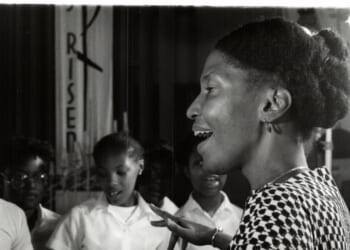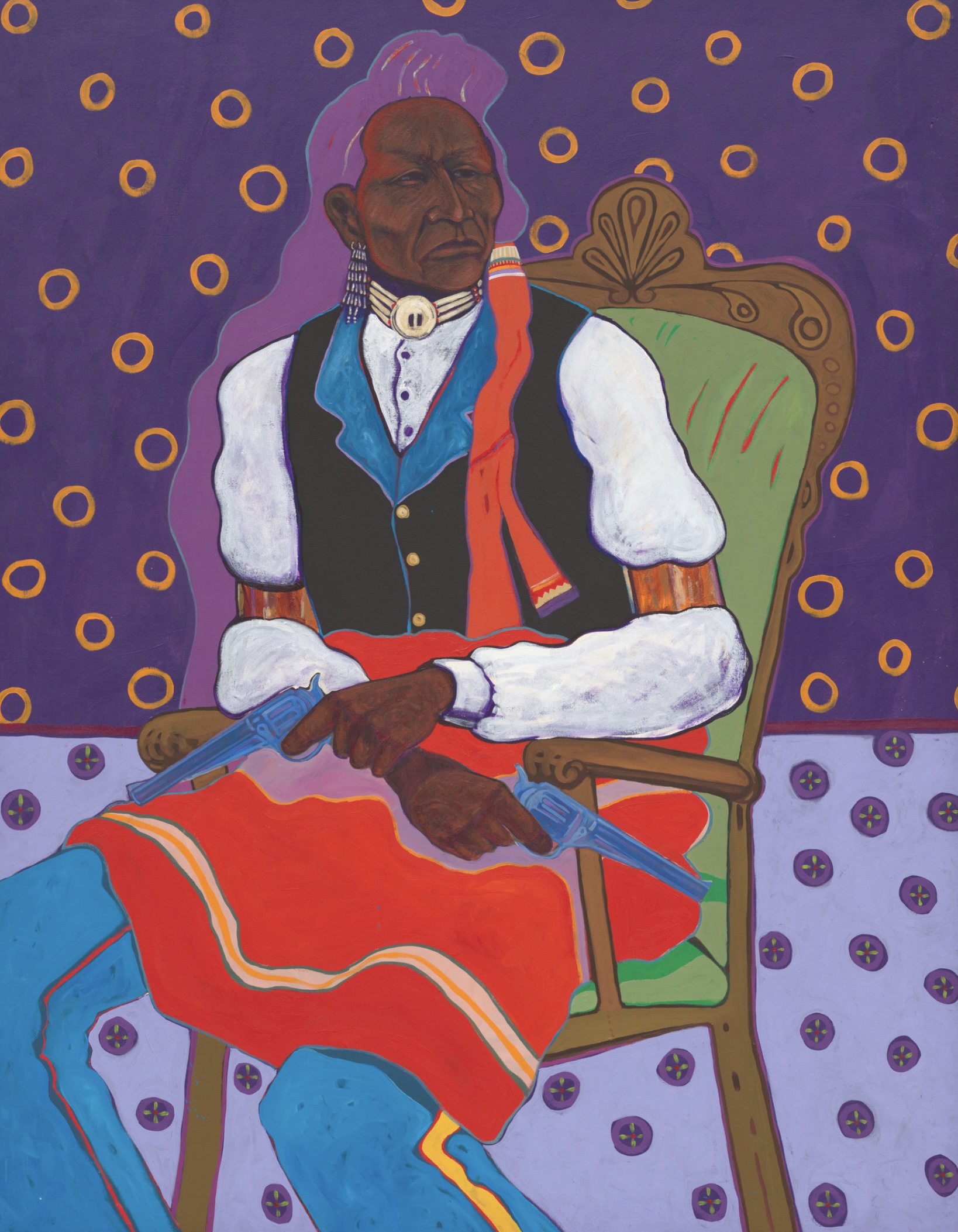
You may not associate the New York Historical (until recently, the New-York Historical Society) with Native American art, but perhaps now you should. In February, the chair of the New York Historical’s board of trustees, Agnes Hsu-Tang, and her husband Oscar Tang donated to the institution a collection of 150 artworks by contemporary Native American artists, including Fritz Scholder, Jaune Quick-to-See Smith, T. C. Cannon, Cara Romero, Nampeyo of Hano, Maria Martinez, Angel De Cora, and Zitkala-Ša. It is the largest gift of native art to a New York museum since the establishment of the Museum of the American Indian in 2004.
The artworks, which are going on view on April 22, are labeled meticulously, with each artist identified by his or her tribal connection. Jaune Quick-to-See Smith (1940–2025), for instance, is identified as a member of the Salish tribe of the Pacific Northwest, while T. C. Cannon (1946–78) is described as hailing from the Kiowa tribe of the Great Plains. One of the best-known artists in this group is Fritz Scholder (1937–2005), who descends from the Luiseño tribe, which dwells in southern California. Many of Scholder’s paintings, prints, and sculptures reference Native American figures and life, with titles that clarified the subject when the images themselves were ambiguous: Indian with Beer Can, Mad Indian, No. 3, Indian in Car, Dying Indian—you get the idea.
On numerous occasions, Scholder stated that he was not an Indian, although he did register himself with the Luiseño tribe for the simple reason that doing so kept him out of jail: the 1990 Indian Arts and Crafts Act, a federal truth-in-advertising law, mandated that creators and sellers of native art objects be registered members of one of the 567 federally recognized tribes. Scholder’s images of Native Americans are deemed authentic because he was registered.
The American Indian art market is big business west of the Mississippi, exceeding a billion dollars a year, according to the U.S. Department of the Interior’s Indian Arts and Crafts Board. Indian markets, a specialized type of arts-and-crafts festival, take place throughout the year in Western states, and many museums and gift shops sell these types of items as well. All that money and interest attract fraudsters who falsely claim to be Native Americans. In January of this year, Jose Farinango Muenala of Casselberry, Florida, pleaded guilty to misrepresenting goods as handmade by Pueblo Indians. He was sentenced to three years of probation and a $25,000 fine. Also in January, Robert Haack, a California resident, was sentenced to thirty-seven months in prison and ordered to pay $134,443 in restitution for running a counterfeit-jewelry operation that exploited the reputation of the famed Hopi artist Charles Loloma and siphoned roughly five hundred thousand dollars from collectors nationwide.
“On average, the number of submitted complaints of apparent and/or actual violations is thirty per month,” said Meredith Z. Stanton, the director of Indian Arts and Crafts Board, where these complaints are submitted. “This is an increase from the number in the past decade.”
No one is seriously opposed to ferreting out deceitful claims and counterfeit objects, but the current methods have their own detractors. While the Indian Arts and Crafts Act was primarily written to counter the flood of mass-produced imports, the statute divides the Native American community because of the varying standards by which different tribes can decide whom they will or will not register. Tribes rely on “blood quantum”—what percentage of an individual’s blood belongs to a particular tribe—which can be difficult to quantify, especially in the case of individuals who are the products of intermarriage or who have ancestors from several different tribes.
It may have been useful for the singer Buffy Sainte-Marie and the Massachusetts senator Elizabeth Warren to claim Native American ancestry, but many artists who have distant links to one tribe or another would be in violation of the federal law if they made those claims publicly while seeking to exhibit and sell their work.
When I interviewed her, Jaune Quick-to-See Smith had this to say about the Indian Arts and Crafts Act:
No other ethnic group in this country has to carry a cultural ID card in order to show and sell their art, to write, or to speak on a public podium. People never ask, and they should, why are Americans Indians subject to quantifying questions such as “How much Indian are you?” Would a black person or a Latino answer such a question? Not likely, because physical features often don’t reveal one’s culture. Culture can be defined by such things as religious preference, foods, language with its slang and humor, special holidays or celebrations, dress, and many other things including worldview. Defining someone’s cultural authenticity by degrees of race is not only a lunatic idea but is cultural hegemony right out of our colonial past. . . . This law violates First Amendment rights. I fear that censorship results from this law.
Jimmie Durham (1940–2021) was another artist whose career suffered from the law. He claimed to be Cherokee, but, since he was not an enrolled member, he was unable to show his work at a number of museums. He described blood quantum as “a bunch of racist nonsense”:
Saying you are Indian or not sounds good, but it also makes people choose one ancestry over another. I don’t see urban Indians as second class citizens, or reserve Indians as the epitome of all that is truly red.
Fortunately for the New York Historical, it need only concern itself with how best to display its new acquisitions and not with parsing the blood of each Native American artist that has entered the museum’s collection.