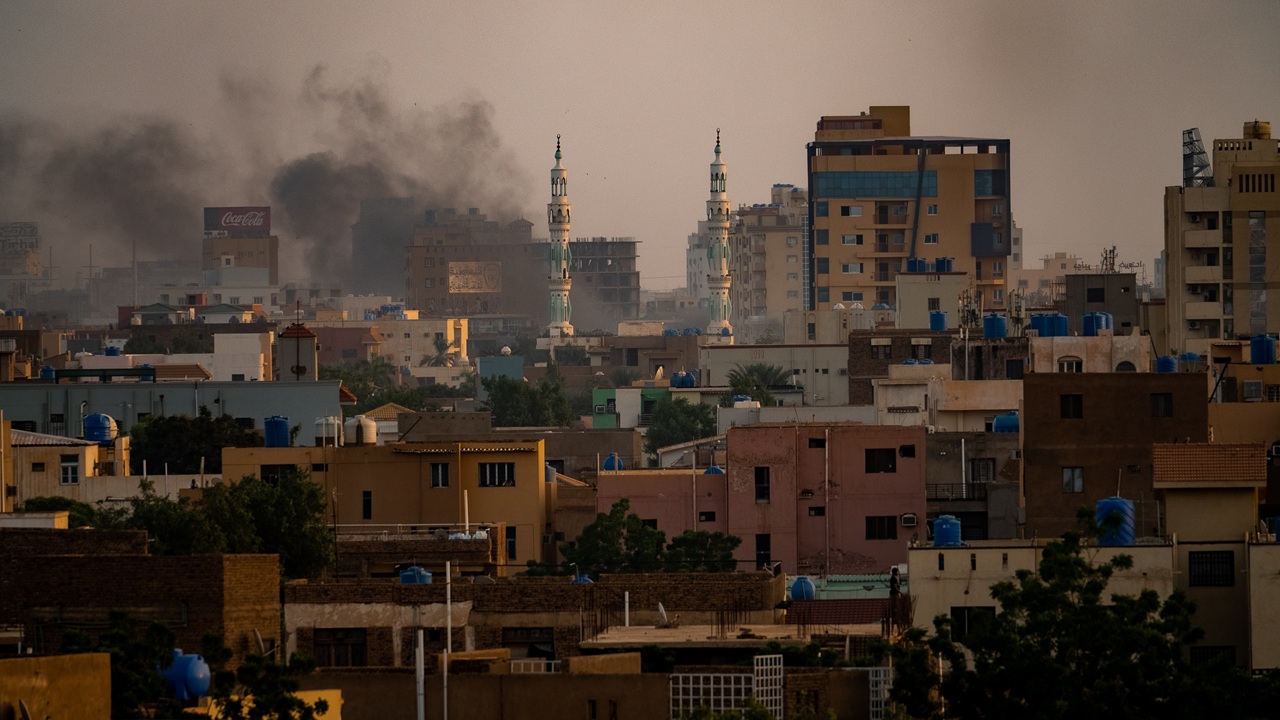
The Sudanese government has regularly used chemical weapons against its domestic opponents, believing that it can act with impunity. The United States should show otherwise.
In its ongoing civil war against the Rapid Support Forces (RSF) militia, the Sudanese Armed Forces (SAF) under dictator Abdel Fattah al-Burhan has repeatedly deployed chemical weapons. More alarmingly, it has done so with relatively little international concern.
Sudan now stands as the first post-colonial state to replicate the chemical warfare tactics pioneered during the colonial era. From longtime dictator Omar al-Bashir’s use of chemical weapons—alongside a litany of other crimes against humanity—to Burhan’s present-day deployments, Sudanese leaders have breached international humanitarian law without any meaningful accountability.
The world ought to be particularly concerned with the Sudanese case, given that Khartoum not only flouts international law but does so in the name of an extremist Islamic ideology. The United States recently designated the Sudanese Muslim Brotherhood as a Specially Designated Global Terrorist entity. The designation found the group promotes a violent Islamist ideology, with some fighters receiving training and assistance from Iran’s Islamic Revolutionary Guard Corps (IRGC).
The US designation illustrates the danger from the SAF, whose institutional culture has long mirrored Sudan’s Islamist movements. For decades, Muslim Brotherhood networks cultivated influence inside the SAF, embedding loyalists throughout the officer corps and security services. Although Sudan’s political leadership has changed significantly since Bashir’s fall from power in 2019, the Islamist Muslim Brotherhood underbelly that constitutes the SAF remains. This helps explain why a military so deeply shaped by ideological extremism has yet again turned to chemical warfare.
Chemical Weapons and the Colonial–Post-Colonial Continuum in Africa
The precedent for chemical warfare in Africa traces back to European colonial powers, which frequently resorted to toxic agents to overcome military setbacks. In the 1920s, battlefield losses against Moroccan fighters in the Rif War prompted both Spain and France to deploy poison gas to suppress local insurrections, in flagrant violation of international commitments. In December 1935, following setbacks in its second attempt to conquer Ethiopia, Italy deployed sulfur mustard gas against Ethiopian troops and civilians. As late as the 1970s, Portugal employed chemical weapons in its fight to keep its colony in Angola.
As formal European empires receded, post-colonial authoritarian regimes adopted the practice of chemical warfare. In Libya, the Gaddafi government repeatedly employed Iranian-supplied mustard gas against Chadian forces during the wars of the 1970s and 1980s. During the same era, apartheid-era South Africa established Project Coast, a clandestine state program dedicated to the research, production, and potential deployment of chemical and biological weapons against perceived internal and external adversaries.
Chemical Weapons as Tools of Domestic Rule in Sudan
What distinguishes Sudan’s use of chemical weapons is not only its brutality but its brazenness and willingness to attack its own people. Carried out at least 30 times over nine months in 2016, the Al-Bashir regime’s chemical strikes on Jebel Marra amounted to a systemic policy, not an aberration. Al-Bashir and his inner circle faced no immediate military or legal consequences for attacks that killed hundreds, mostly children, and left survivors with devastating injuries. That absence of accountability normalized the very tactics now reappearing on Sudan’s battlefield.
The outbreak of Sudan’s civil war in 2023 motivated the SAF to resort to old, unpunished tactics. By September 2024, the SAF had deployed chlorine gas barrel bombs against RSF forces surrounding the al-Jaili oil refinery and Garri military base, demonstrating that the threshold for chemical weapons use had not merely been crossed, it had been institutionalized. Even more egregiously, the SAF repurposed chlorine originally designated “exclusively for water treatment purposes” to manufacture these weapons. Investigations by C4ADS, an NGO focused on countering global security threats, showed that the SAF-linked Ports Engineering Co. Ltd. had a long history of importing chemical materials that could easily be diverted for military use.
Islamist Ideology and Chemical Warfare Undermine Negotiations
While most of the world turned a blind eye, in April 2025, the US Department of State announced sanctions on Sudan for its use of chemical weapons. The United Nations Human Rights Council likewise acknowledged America’s determination, issuing a circulated statement condemning the SAF’s use of chemical weapons and linking it to broader patterns of international humanitarian law violations. Evidence of “unrestrained violence against civilians” by Sudanese Islamist movements continued to accumulate, ultimately prompting the United States to designate the Sudanese Muslim Brotherhood as a terrorist entity.
While this designation provides a measure of accountability, it only partially addresses the problem, as the SAF and the Sudanese Muslim Brotherhood are so intertwined that they cannot be meaningfully disentangled. Rather than attempting to disentangle the two, the US must lead the international community in refusing to recognize the SAF as a legitimate partner. The international community should recognize that the fabric of SAF is the Brotherhood ideology—and the SAF is therefore not a legitimate party to negotiate with.
Sudan’s Islamist factions have already shown their contempt for diplomacy by rejecting peace overtures put forward by the Quartet (the United States, Saudi Arabia, Egypt, and the UAE). Continuing down the path of negotiation, even as mass atrocities persist on the ground, amounts to complicity in a broken cycle that has repeatedly failed the Sudanese people.
About the Author: Paul Mwirigi
Paul Mwirigi is a Kenya-based author specializing in African affairs. His contributions explore political, social, and economic dynamics across Africa. He holds a degree from the University of East Africa and has developed a strong foundation in building scalable and efficient digital solutions to issues around the continent.