Afghanistan’s ruling Taliban terrorist government is struggling with an influx of returning Afghan refugees fleeing the ongoing war in Iran and detentions in critical agricultural and raw material shipments in the Strait of Hormuz, reports this week indicate.
Afghanistan shares an extensive border with Iran. While both countries’ ruling governments are authoritarian, terrorist Islamist entities, Kabul and Tehran have struggled to get along since the return of the Taliban to power in 2021, in large part due to significant water shortages along their border. Both countries have regularly accused each other of hoarding water supplies during the dry winter months.
The Iranian Islamist regime and the Taliban share a common animosity against the United States, however, and support the violent imposition of Sharia, the Islamic law. Prior to the current war, Taliban officials suggested they would aid Iran in the face of any escalated hostilities with America.
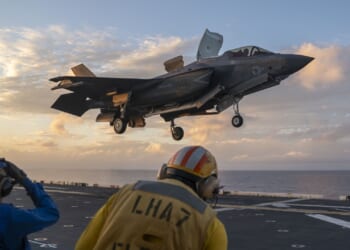
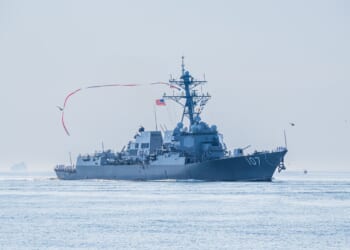
President Donald Trump announced on February 28 the launch of “Operation Epic Fury,” a military initiative to degrade the Iranian terror state’s ability to pose a threat to America and its allies. Trump also announced that day the elimination of the longtime “supreme leader” of the country, Ali Khamenei. Iran has since claimed to replace Khamenei with his son, Mojtaba Khamenei, but the new “supreme leader” has yet to make any public appearances or deliver statements live, raising questions as to his ability to run the country.
Iran also responded to the Pentagon’s operations by threatening global commercial shipping in the Strait of Hormuz, a critical route for Asian trade, particularly oil shipments from Gulf states to Asia. An anonymous report published by CBS News on Tuesday claimed that the U.S. government has reason to believe that Iran has laid sea mines in the Strait of Hormuz, bombs that could potentially destroy any ship attempting to navigate the waters. No on-the-record reports have confirmed this allegation at press time.
The Afghan news agency Khaama Press reported on Tuesday that Afghanistan, while refusing to take a side in the ongoing war, is nonetheless suffering negative economic consequences as its shipments are stuck in transit, unable to pass the Strait of Hormuz.
“Around 10,000 containers carrying Afghanistan transit goods have been stranded at Jebel Ali Port due to escalating tensions involving Iran, the United States, and Israel, traders said,” according to Khaama, citing the Afghan Chamber of Commerce and Investment. The containers are reportedly “stuck in limbo” with no reliable arrival date. Khaama added that the shipping containers reportedly contain “food, non-food items, and raw materials for factories, raising concerns about supply shortages and price increases in Afghanistan.”
Some economic analysts have suggested that the shipment restrictions by sea could become an opportunity for shippers using Central Asian land routes to increase traffic through their countries, as some estimates suggest that as many 70 percent of central Asian food imports travel through the Strait of Hormuz. Afghanistan is in a particularly poor position to take such advantage, however, as it boasts extremely difficult mountainous terrain to travel through and is one of the world’s most active hubs for jihadist terrorist activities. Complicating matters further is the ongoing war between the Taliban and the government of neighboring Pakistan that began shortly before “Operation Epic Fury.” While both parties are currently claiming to observe a ceasefire marking the end of the holy month of Ramadan, hostilities appear to have continued as of Tuesday.
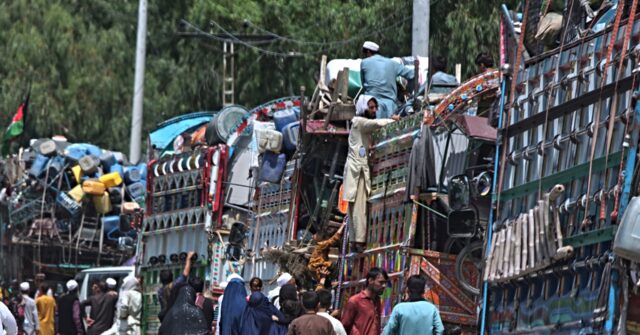
Also causing instability in Afghanistan – already suffering high levels of poverty and oppression since the Taliban return to power – is an influx of Afghan refugees forced to flee neighboring Iran in light of the current conflict. The Afghan outlet Tolo News reported on Monday that Taliban officials estimate that as many as 2,000 Afghan refugees are fleeing Iran and coming home on a daily basis, threatening to overwhelm the country’s ability to process returnees. Those returning complained that finding work in Iran during the conflict has become especially difficult for foreigners and demanded in remarks to Tolo that the Taliban improve the economic situation to allow for more jobs, particularly for young Afghan returnees.
“Since the war began in Iran, work opportunities have declined significantly. Prices have risen sharply, and the Iranian currency has lost much of its value,” one returnee identified only as Najibullah, told Tolo.
“Young people returning from neighboring countries should be provided with job opportunities so we are not forced to migrate again under such difficult conditions,” an Afghan citizen returning from Iran named Mohammad Bashir told Tolo.
The Taliban has offered minimal commentary on the conflict between America and Iran. Prior to the Pentagon launching Operation Epic Fury, top Taliban spokesman Zabihullah Mujahid claimed that the Taliban would offer “full support” to Iran in the event of an American attack.
“The people of Afghanistan will offer various forms of solidarity and support to their Iranian brothers,” he alleged.
At press time, the Taliban has offered no overt support or solidarity to Iran. On the contrary, the Taliban announced on Tuesday that, in a gesture of goodwill to Washington, it had released an American citizen in its prisons, Dennis Coyle.