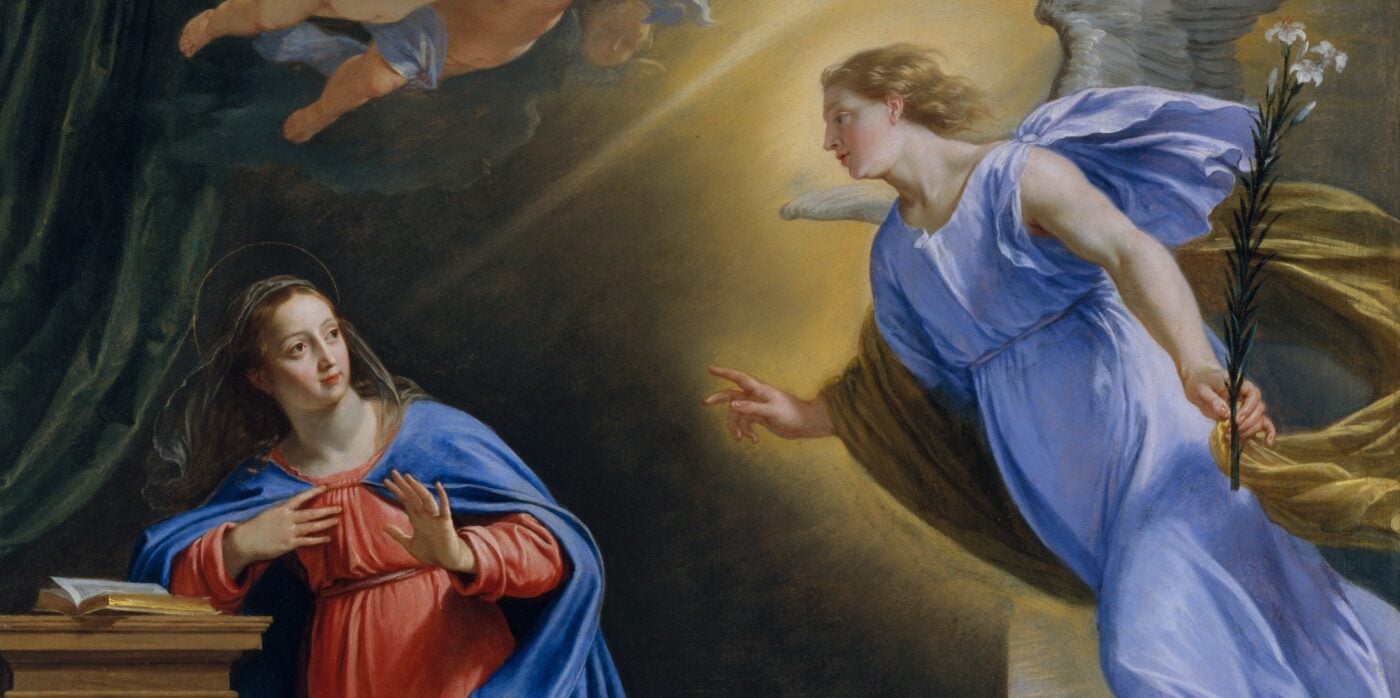
And coming to her, he said, “Hail, full of grace! The Lord is with you.” But she was greatly troubled at what was said and pondered what sort of greeting this might be. (Lk. 1:28-29)
One of the most striking things about the Angel Gabriel’s visit with Mary is that it causes Mary to become “greatly troubled.” Of course, who wouldn’t be troubled by the shock of a celestial being popping into the middle of one’s kitchen out of nowhere? But Mary is not greatly troubled by the “shock” of suddenly being visited by an angel, as the rest of us would be. How do we know this? Because Scripture tells us that Mary’s greatly troubled heart is over “what was said.” So we learn a few things here.
First, if Mary is not rattled over the appearance of an angel, this may suggest that for her, there is nothing unusual about his sudden apparition. In fact, as one totally pure and undefiled, it is possible that this is not the first time Mary has had face-to-face communications with the angel! It is even possible that Mary has been in regular communication with Gabriel—or other angels as well, for that matter—from the time she was a small child (as was the case for other saints such as Padre Pio and St. Catherine of Siena).
Secondly, if Mary is greatly troubled by “what was said,” then we can easily point to the words that have troubled her: “Hail, full of grace!” and “The Lord is with you.” The word “hail,” when used as a greeting, is understood as an enthusiastic salute of approval. So this is unlikely to have “troubled” Mary. But then the angel says, “full of grace.” In actuality, he calls Mary “full of grace”—referring to her with this title, as a name.
Herein lies the reason for Mary’s greatly troubled heart. In her equally great humility, Mary cannot imagine “what sort of greeting this might be.” She certainly doesn’t feel “full of grace.” For the twelve short years of her life, Mary has been doing nothing but contemplating the grandeur and glory of God and is therefore thoroughly cognizant of her smallness in comparison to the Lord’s splendor. How can the angel possibly announce that she is “full” of that? It is uncomfortable and bordering on scandalous for Mary to hear such words spoken about herself.
And yet, she knows this is a messenger of God, so the words must be true. How to reconcile the two apparently dichotomous realities is something Mary would have to ponder in her heart.
Then the angel said to her, “Do not be afraid, Mary, for you have found favor with God.” (Lk. 1:30)
The Angel Gabriel, in his “perfectly illuminated light of intelligence” (St. Aloysius Gonzaga), can read Mary’s countenance and understands well that her greatly troubled heart is at risk of turning into a greatly fearful one if he does not respond to the questions that are brewing in her heart. And so he explains the plan about the virginal birth…and leaves Mary more confused than ever!
But Mary said to the angel, “How can this be…?” (Lk. 1:34)
The plan that the angel has revealed makes no sense to Mary, and so her “greatly troubled” feelings have not yet left her. So the angel answers her question:
The Holy Spirit will come upon you, and the power of the Most High will overshadow you. (Lk. 1:35)
At this point, Mary would have gained no greater understanding of the situation than before she asked the question! The Spirit of God will “come upon” her? He will “overshadow” her? What could this possibly mean? Mary would not have had a clue. But then, the angel speaks words that finally, finally settle her troubled heart in peace:
And behold, Elizabeth, your relative, has also conceived a son in her old age, and this is the sixth month for her who was called barren; for nothing will be impossible for God. (Lk. 1:36-37)
Mary’s aged cousin Elizabeth is with child, after suffering decades of infertility. The impossible has come to fruition; Elizabeth’s ceaseless prayers have miraculously been answered! And for the first time since the angel appeared in her home, the light of understanding has turned on in Mary’s heart: Nothing is impossible for God.
Now, Mary no longer concerns herself with “how can this be” or with what the phrases “come upon you” or “overshadow you” might mean. In the words of Corrie ten Boom (The Hiding Place), for Mary, “It’s enough…to know that [God] knows.”
The Annunciation story teaches us a lesson in how to accept the answers to the questions which we don’t understand. In those times when our own hearts are greatly troubled, we can and should ponder our questions in the silence of our hearts before reacting in panic. We must not let our imagination or the rumination in our minds turn our greatly troubled hearts into greatly fearful ones!
But we must also realize that when we ask the Lord to explain to us the circumstances of our lives, He is not always going to answer us with a direct and explicit rationale that enlightens us as to His reasons for all things.
In our humanity, there are some things which our minds are not capable of understanding—such as what the words “come upon” or “overshadow” could possibly mean. And there are other things which are simply veiled from our view because the Lord wills us to grow in humility and trust, more than He wills us to “understand.” Our faith must precede our understanding (St. Augustine).
In the meantime, to settle our souls in peace, the Lord will remind us of how He has worked all things in our lives for good before, and He will point out to us His hand in our circumstances now—a hand which operates unceasingly to work all things for good again (Rom. 8:28).
Mary said, “Behold, I am the handmaid of the Lord. May it be done to me according to your word.” (Lk. 1:38)
Image from Wikimedia Commons