I want you to think about your death for a moment. Not your judgment, not heaven, hell, or purgatory, but the actual final moment of your life on this earth. Like all sorrows, our closing scene is shrouded in mystery: Will it come swiftly or must we endure long suffering? Will we be alone or surrounded by loved ones? Will we die heroically, peacefully, tragically…?
Memento mori—remember your death.
From noon onward, darkness came over the whole land until three in the afternoon. And about three o’clock Jesus cried out in a loud voice, “Eli, Eli, lema sabachthani?” which means, “My God, my God, why have you forsaken me?” Some of the bystanders who heard it said, “This one is calling for Elijah.” Immediately one of them ran to get a sponge; he soaked it in wine, and putting it on a reed, gave it to him to drink. But the rest said, “Wait, let us see if Elijah comes to save him.” But Jesus cried out again in a loud voice, and gave up his spirit. (Mt. 27:45-50)
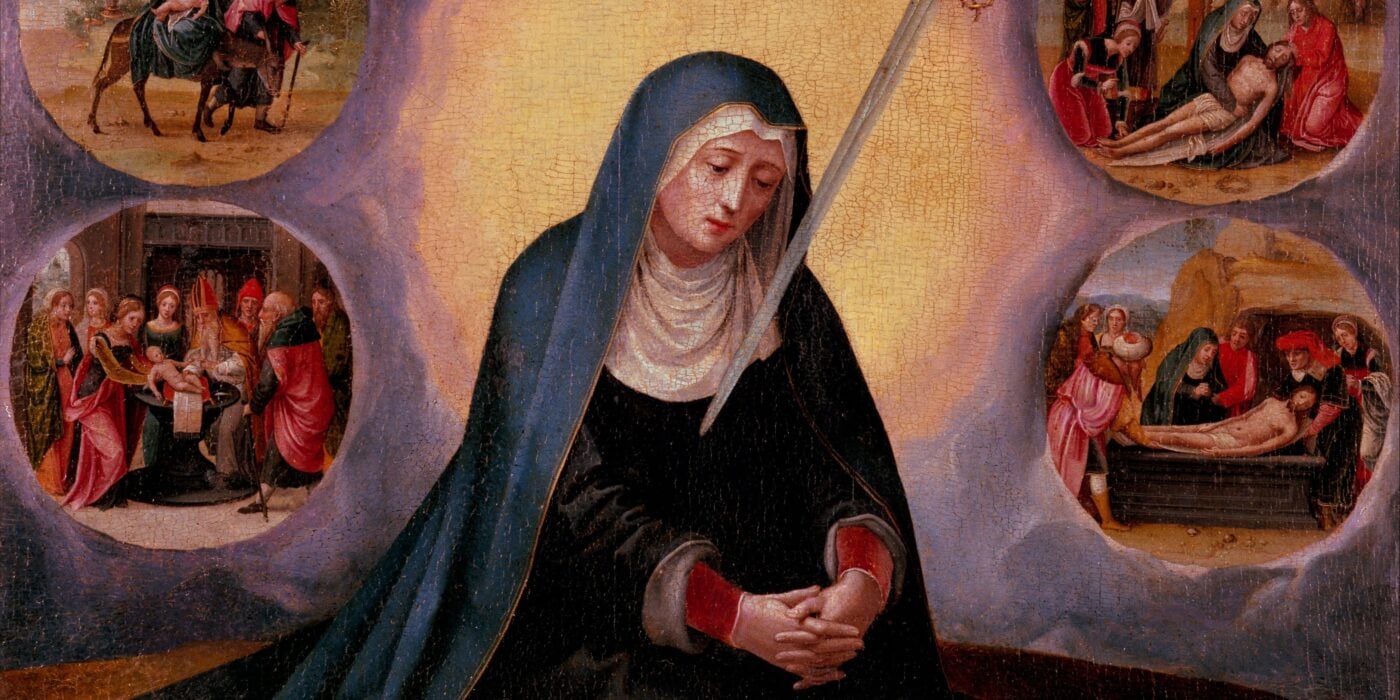
Our Lady stood at the foot of the cross while her Son breathed His last breath. She listened as He forgave the ones who nailed Him to the tree. When the centurion stabbed His ribs, the sword that Simeon prophesied slid through her heart. She was left with an agony that only she could endure. Rage made an attempt to overtake her soul.
But mercy won out.
There is a very sweet (and powerful) moment in the film The Passion of Christ when Jesus is carrying the cross and falls before Mary. The scene draws Mary back to when Jesus was a child and fell on a rocky slope. Both scenes play over one another as if happening at the same time, only their endings differ—in her flashback, Mary coddles the boy Jesus and a sense of joy surrounds the two, but when she tries to embrace Christ and His burdensome beams, He tells her, “See mother, I make all things new!” and embraces the cross instead of her.
We can make things new, too.
Sinners won’t feel sorrow for their transgressions until they realize that their eternity is at stake. The portal by which we come to understand this truth is the cross—through suffering we come to know Christ’s deepest form of love. And it is through our suffering that we become Christ’s love most perfectly. As St. Pope John Paul II wrote:
This discovery caused St. Paul to write particularly strong words in the Letter to the Galatians: “I have been crucified with Christ, it is no longer I who live, but Christ who lives in me: and the life I now live in the flesh I live by faith in the Son of God, who loved me and gave himself for me” (Gal. 2:19-20). Faith enables the author of these words to know that love which led Christ to the Cross. And if he loved us in this way, suffering and dying, then with this suffering and death of his he lives in the one whom he loved in this way; he lives in the man: in Paul. And living in him—to the degree that Paul, conscious of this through faith, responds to his love with love—Christ also becomes in a particular way united to the man, to Paul, through the Cross (S.D. 20).
In other words, suffering for love makes us new—it turns us into Christ.
Jesus knew how to die simply because he knew how to live. The final death of a Catholic is a passage that is paved by many “mini-deaths” that come before it, keeping the hills and valleys of sorrow and joy in balance. For Jesus, it was the many nights of intense prayer, the days of fasting, the ridicule from his countrymen, and the lack of faith of those He came to proclaim the Good News to.
But there’s another side to His ministry that sometimes gets overshadowed by the doom and gloom of His Passion—His joy. For Christ, it was the many times he spent in His mother’s arms or St. Joseph’s workshop. It was the wedding feast at Cana, the feeding the 5,000, the blind man seeing, the joy of healing the woman with hemorrhages or raising Jarius’ daughter from her sleep. It was Mary’s bathing of His feet in perfumed oil, Lazarus coming out of the cave to have lunch with Him, and His last supper with His friends.
But his greatest joy was, and still is, the gift He gave to all—mercy.
Yes, Christ taught us how to die, to sacrifice our desires so as to attain holiness, but He also taught us how to live, to cherish the joys of life so intensely that we might experience glimpses of heaven here, and death becomes simply a portal through which we experience those joys (and many others!) for eternity.
The ticket for entry, however, requires mercy.
Christ could die because He held no grudges. Mary could endure Her son’s death because she, too, longed for the forgiveness of His persecutor’s sins. Both have the same hope for us—that we might repent from our sinful lives and come to God for mercy so that we can leave this valley of tears and thrive in the everlasting joy of heaven. This means that we must not only seek forgiveness from God, but from our family, friends, and most especially our enemies. To live a life so full that, when we die, we have no grudges, is to follow Our Lord’s and Our Lady’s examples.
All spiritual sorrow is destroyed by mercy. Whether someone wronged you or you wronged them, forgiveness erases the spiritual pain. This is why we pray in the Lord’s Prayer “forgive us our sins as we forgive those who trespass against us,” because without forgiveness, there is no true joy. Without mercy, we stand condemned.
Mercy is not only a gift you can give to others; it’s also a gift to be received. Too often we plague ourselves with the burden of guilt for our own sins. Our Lord tells us to not let this sense overpower our souls—it’s simply not worth the trouble. Burdening yourself with guilt is pain that is self-afflicted. At first, it is a good thing because it reminds you of your need for mercy. But after you receive forgiveness in the confessional, let it go. Forgive yourself. Move on.
Crosses come with their share of spiritual and physical pain. While Jesus experienced the full force of both, Mary sustained her share of the spiritual torture that the death of her Son implied. Therefore, when you experience pain, know that there are two cures:
For spiritual pain—forgiveness heals the soul.
For physical pain—there are medicines and treatments sure, but to truly defeat physical pain one must give it purpose—you have to make it redemptive.
We’ll learn about how to do that in the next chapter of my series Finding Joy in Our Crosses, which you can read by clicking here.
The tribulations of the just are many, but mercy will encompass those who hope in the Lord. (Ps. 32:10)
Editor’s Note: Catch up on previous installments of this CE series here!
Image from Wikimedia Commons