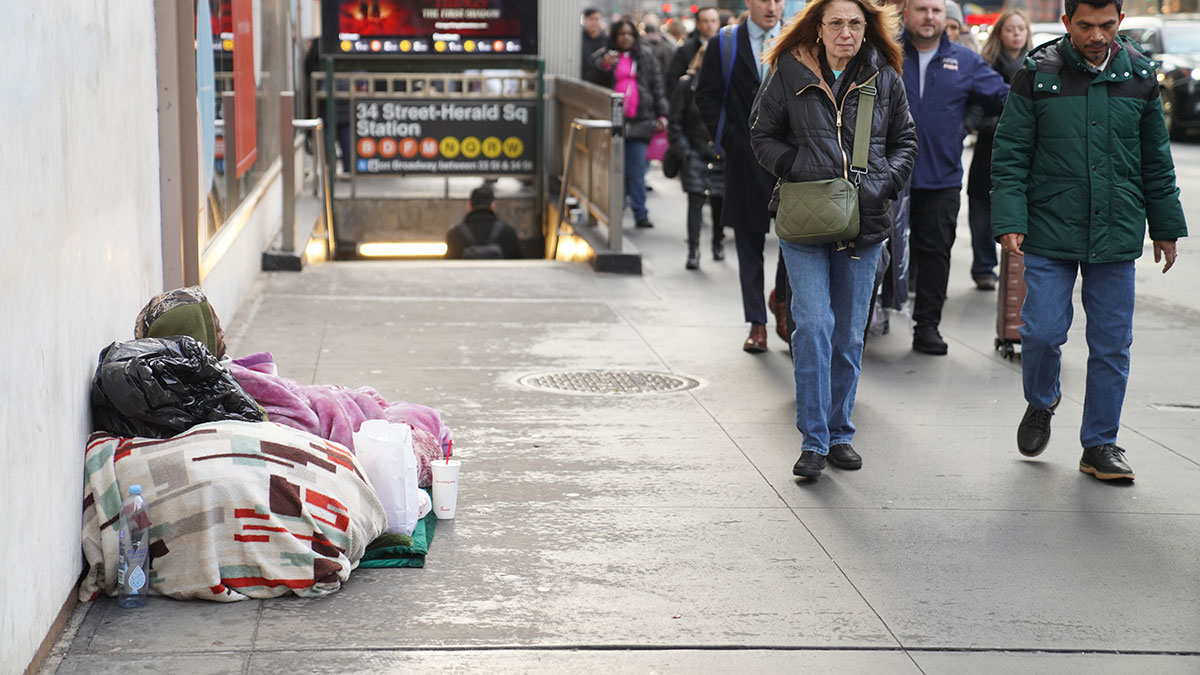
The abomination that is urban “homelessness” policy rests on the reinforcement of certain unspoken fictions. A recent article on New York’s latest “homeless” outreach program demonstrates how that process works.
Before recycling the usual “homelessness” myths, New York Times reporter Emma Goldberg lets loose with a fabrication of her own making. It is a whopper.
Finally, a reason to check your email.
Sign up for our free newsletter today.
Spotting vagrants in the urban landscape, she suggests, is a specialized skill possessed only by trained professionals. “It’s something you can’t exactly teach: how to spot the homeless New Yorkers trying to blend into the night—people resting on bus stop benches, curled up on doorsteps, tucked into the shadows of scaffolding. Fortunately for Goldberg, the outreach team she shadows on this March night proves uncannily adept at detecting these “subtle signs of hidden life on city streets,” darting, almost miraculously, from one vagrant to the next.
To which an ordinary New Yorker can only ask: in what world does Goldberg live? Street vagrancy is among the most visible features of the city’s public spaces; the disheveled bodies, surrounded by filthy bedding, uneaten food, and cardboard, are unmistakable at any hour. New Yorkers can only wish they were camouflaged.
Having grounded her article in an alternative reality, Goldberg then turns to the more familiar fictions.
Fiction #1: Every homeless outreach program is a novel breakthrough.
The thesis of Goldberg’s March 3 article, “Offering Warmth and Care to Homeless People, as Cold Deaths Mount,” is that New York policymakers just had a brainstorm: “On Jan. 29, with New York City plunging into a stretch of persistent, piercing, and ultimately fatal cold, NYC Health + Hospitals proposed a new outreach program: Why not send out vans to find people sleeping on the street who were sick, instead of expecting those people to find their way to a hospital on their own?” An architect of this “new” program—dubbed Winter Access, Relief and Medical, or WARM—tells Goldberg that the initiative is distinctive for not telling “people what we want them to do,” but instead asking “what we can do in the moment to build trust.”
Fiction #1 requires a complete suspension of disbelief. There is nothing new about the WARM program or the philosophy behind it. Feckless outreach has been the government’s default response to street vagrancy for decades. Its founding premise—not telling people what to do—virtually guarantees that it will have no effect on street conditions.
Each reiteration of this concept is nonetheless rolled out with fanfare and billed as the newly discovered key to the supposedly baffling problem of “homelessness.” Government funders, along with the “homeless” activists who draw taxpayer dollars, rely on the public’s ignorance of the identical efforts that came before. The press plays along, presenting the latest version as news.
The Times itself, on January 26, wrote about the at-least 400 outreach workers already employed during the winter cold snap. Yet it casts the WARM outreach workers as a pioneering breed of urban problem-solver, untethered from conventional assumptions about authority and who should control the streets.
Fictions # 2 and 3 are closely related: Homelessness is an involuntary condition caused by a lack of housing, and “shelter resistance” is a myth invented by conservative critics of compassionate policy.
The premise of nearly all homeless programs is that the homeless are helpless victims of economic circumstances. Invisible forces—capitalism, inequality, poverty, racism—have pushed them onto the streets; government’s failure to help them get off the streets keeps them there. When a journalist does report facts that cut against this narrative, he often fails to grasp their significance.
So it is with Goldberg. The WARM team encounters its first “client” of the evening, a “fast talker,” as Goldberg calls her, named Kristina Uspenskai, standing on Second Avenue in Lower Manhattan. The workers leap from their van, “arms piled with blankets and jackets and food,” and race toward her, painfully eager to please. She quickly dispels the notion that WARM represents anything new: she has had frequent contact with other outreach teams, she says. True to form, she declines an appointment for free medical and psychiatric care: “I’m bad at keeping time. I’m bad at adulting.”
That was one of the more productive interactions of the night. The encounter with Vinny Torres is more typical. Torres is occupying a stretch of sidewalk on St. Mark’s Place, once a countercultural redoubt, now trying to preserve its anarchic vibe in the face of gentrification. He is as familiar with the outreach charade as Uspenskai, and more entitled. “What’s for dinner?” he asks, as the ever-eager WARM team hurries over. They hand him sandwiches, bananas, cereal, and milk, no doubt grateful for the chance to display their compassion. Somehow, the transfer is completed while Torres keeps his head buried in his sleeping bag, according to Goldberg.
The social workers meekly ask whether he will let them drive him somewhere warm. No sale.
Torres does, however, have some consumer complaints. The city should be doing more to help people like him, he says. The WARM team receives the critique with humility. “What are your frustrations?” an outreach specialist asks. “We need more people like you coming by and seeing how we’re doing,” Torres replies. These visits, of course, accomplish nothing beyond enabling continued street encampment.
A third encounter yields the same result. Three occupants of an encampment in a downtown park rebuff offers of shelter and assistance, though one vagrant magnanimously accepts a white blanket.
Fiction #4: Vagrancy is not a function of addiction or mental illness.
Mainstream coverage of “homelessness” is largely silent about drugs. One might think these street colonists were an adult version of a Scout troop, simply preferring life outdoors to being inside. There is no hint in Goldberg’s reporting or in the Times’s broader coverage that vagrants are, in most cases, struggling with addiction, and that the ready availability of drugs is a major reason many remain on the street. Whenever an encampment is cleared, the primary residue is drug paraphernalia.
Mainstream coverage is only slightly more honest about mental illness. The double whammy of drug addiction and mental illness severs the social ties that would ordinarily keep someone housed after an unexpected setback. (Social workers Alice Baum and Douglas Burnes explained this mechanism in the early 1990s; they have been ignored ever since.) And allowing mentally ill chemical abusers (known as MICAs) to stay on the streets guarantees that neither their addiction nor their mental illness will be treated. This is not an accident.
Fiction #5: Street vagrants are vulnerable lambs.
Goldberg casts the vagrants encountered by the WARM team in almost maternal terms. They are “tucked” into sleeping bags, as outreach workers gently drape blankets over them for an “added layer of warmth.” She closes with a sentimental image: after briefly poking his head out like a turtle from its shell, Torres retreats into his bedding, “nestle[s]” against a building on Third Avenue, and “settle[s] down to sleep.” A child sleeps peacefully; all seems right with the world.
Torres tells the WARM outreach workers that he avoids shelters because they’re violent. New York’s advocacy groups—from the Legal Aid Society to the Coalition for the Homeless—have spent decades resisting any requirement that street vagrants use the shelters that taxpayers are obligated to provide, on the same grounds: the shelters are dangerous. The question rarely asked is why.
After natural disasters, shelters run by the Red Cross or the Federal Emergency Management Agency (FEMA) are not plagued by violence. Yet vagrant shelters are, apparently for reasons no one cares to examine.
Violence, however, is not an attribute of a shelter; it is an attribute of the people in it. City policy shields vagrants from one another but not the public from vagrants. The same population that claims to avoid shelters because of violence one moment may assault a perceived antagonist the next moment. Nearly every week, an innocent civilian in New York or elsewhere is attacked by a MICA vagrant whose prior offenses and evident psychosis have had no bearing on his freedom to roam the streets. A few of these cases—such as in Charlotte, where Iryna Zarutska was stabbed to death in a subway car in August 2025, or in Chicago, where Bethany MaGee was nearly burned to death last November—draw national attention. Most do not.
In the Times’s telling, it is not just shelters that are violent; subway cars are, too. A full-page article in the paper’s March 20, 2026, print edition is headlined, “Artist Works to Reclaim Life Changed in Instant by a Subway Car.” The digital version reads, “She Was Paralyzed by a Subway Train.”
In reality, a vagrant grabbed the woman from behind as she stood on a Manhattan platform and slammed her head into an oncoming train. She was left paralyzed for life—because of the subway, if you believe the Times.
Fiction #6: The hardworking taxpayers who fund homeless programs do not exist.
Eyewitness accounts of outreach efforts feature three groups: vagrants, social workers, and advocates. They interact against an otherwise emptied cityscape. The activists reliably complain that the city asks too much of the homeless and too little of itself.
The New York Times appears to have Dave Giffen, executive director of New York’s Coalition for the Homeless, on speed dial; his responses arrive on autopilot. “When these individuals have gone years, and have had every one of these systems failing them again and again and again, and not giving them what they actually need, you end up with people still outside in this cold,” he told the paper on January 27.
Giffen’s Times quote two weeks later had a familiar ring: “Unless you’re actually offering people what it is they want and need, it’s not going to do anything other than make it harder for people to survive day to day.” What they “want and need,” of course, are fully subsidized private apartments at taxpayer expense, with nothing, such as sobriety, expected in return.
The vagrants have their own complaints, as we’ve seen. “I think it’s atrocious they’re going to move encampments that aren’t in front of businesses,” a female “resident” of an encampment on Sixth Ave. and W. 18th St. told the Times on February 18. Did the actual residents of Sixth Ave. and W. 18th St. think that the encampment was atrocious? One can only guess.
The shopkeepers whose storefronts are ringed with boxes and tents, the employees who step over bodies and needles on their way to work, the children who pass addicts searching for a vein on their way to school, the commuters who weave around encampments to reach the subway—all are invisible and unheard in coverage of vagrancy.
Fiction #7: Government programs should be evaluated based on inputs. Outputs don’t matter.
Goldberg reports that 16 WARM vans have logged nearly 10,000 “conversations” with homeless New Yorkers since the program began in February. Ninety percent of those approached accepted handouts. The city estimates that at least 4,500 people sleep on the streets, suggesting that each has, on average, been contacted twice by a WARM team, not counting interactions with other outreach teams.
In its first weeks, WARM cost $3.6 million. Generously assuming that the average “conversation” lasts five minutes, that amounts to roughly $4,300 an hour. In reality, most interactions are far shorter, consisting of a brusque refusal to engage. By comparison, top partners at elite law firms may occasionally bill $3,000 an hour for highly specialized work; rates above $4,000 are virtually unheard of.
What, then, did taxpayers receive for these costly exchanges? Has visible homelessness declined? Have encampments disappeared? How many individuals kept the appointments arranged for them, and how many continued with treatment? Have their mental or physical conditions improved?
Those questions do not matter. They are outcome measures and it would be churlish, apparently, to judge government by outcomes. The WARM program’s real function is to demonstrate that the “city” cares; it’s enough that vagrants will sometimes accept food and extra bedding.
Public discourse about homelessness rests on a category mistake as well as on empirical fictions. The error goes beyond the advocates’ successful rebranding of drug addiction, mental illness, and social disaffiliation as “homelessness.” We speak of “the homeless” as if it were an ontological category, one population set apart from everyone else. The term is not merely shorthand for individuals making persistently bad decisions. We do not hold “the homeless” to the same expectations as anyone else. They are treated as a different species. Of course they live on the streets; that is their essence.
Meantime, the roughly $80,000 the city spends annually on each street vagrant serves largely to preserve that status quo. The only policy that would restore public spaces to their rightful users is to prohibit their colonization by vagrants. Until about 60 years ago, it was simply understood that police would move transients along. Photographs of the New York subway system in the 1940s and 1950s show orderly spaces; commuters did not fear being pushed onto the tracks. Is poverty greater now than it was then? Hardly. Today’s poor receive levels of government support unimaginable in earlier eras. The fact that commuters must now contend with potentially lethal disorder is not a civilizational advance in the name of liberal autonomy; it is a step backward toward anarchy.
Restoring public order will require a counterrevolution in how government understands its role. Since the civil rights era, government has increasingly embraced a social-justice mission, defining its purpose as the redistribution of resources from the wealthy and middle class to the “poor,” and as advocacy on behalf of allegedly marginalized groups against an allegedly oppressive majority. Those groups, in turn, grow ever more numerous, as their self-appointed advocates press for their inclusion in the expanding pantheon of the disadvantaged. Preserving public safety, keeping streets clean and passable, building and maintaining transportation infrastructure, safeguarding property—those functions are embarrassingly bourgeois and repressive in the eyes of every nonconservative politician and bureaucrat. Today, progressive governance prioritizes the antisocial, the deviant, and the alienated over the law-abiding majority, which is increasingly cast in the role of a revenue source rather than a constituency to be served.
New York Mayor Zohran Mamdani seemed surprised when vagrants died during a late January Arctic freeze, even though his left-wing ideology guaranteed that there would be people camped out on the streets and trained not to come indoors. After those deaths triggered the first public relations crisis of his mayoralty, Mamdani appeared to walk back a campaign promise to stop clearing encampments. There is little chance that this change in policy will take root; the mayor’s corporation counsel, Steven Banks, is the city’s most veteran homeless advocate and the one who has done the most damage to sane urban policy. Far from diminishing, the lean-tos around the entrances to the Second Avenue subway line, for example, are appearing with more regularity.
New Yorkers did not face as clear-cut a choice in the 2025 mayoral election as they did in 1993, when they elected Rudolph Giuliani to restore order. But it was clear enough that Mamdani, an unreformed proponent of homelessness dogma, represented the worst option. That he won anyway suggests how diminished expectations for civilized public space have become. One would like to believe that reality eventually prevails over fiction. For now, however, residents of New York and other American cities must live within a world shaped by a counterfactual ideology.
Photo by Zhang Fengguo/Xinhua via Getty Images
Source link