The latest Israeli foray into Lebanon is an attempt to impose the “Gaza model” on the country.
As the American and Israeli war on Iran expands across the Middle East, Lebanon faces its nightmare scenario. Israel has invaded the country once again, supposedly to disarm Lebanese Hezbollah, its non-state rival to the north. This specific component of the broader war is ultimately critical, as it could become the primary focus of the warring parties in the coming weeks, especially if direct confrontation with Iran yields diminishing returns.
It is no secret that Israeli officials have long wanted to apply more pressure on Lebanon to solve the Hezbollah problem. After a year of exchanging fire, Israel opted to invade Lebanon in 2024 to directly combat the group, severely hampering Hezbollah’s ability to conduct serious military operations while killing most of its senior leadership. Following the November 2024 truce that was supposed to constitute a true ceasefire but rather fostered near-daily Israeli strikes on Lebanon, Beirut began the effort of disarming Hezbollah.
Different understandings of the now-dead, so-called ceasefire’s details have hampered that process, with both Israel and Hezbollah looking to take advantage of any possible vector to increase their relative power. Indeed, this dynamic is exactly why many feared a new war was coming. Hezbollah rejected disarmament wholesale at first, eventually agreeing to disarm south of the Litani River.
Even as the Lebanese government proclaimed that it had removed Hezbollah’s military presence south of the Litani—roughly 10 percent of sovereign Lebanese territory that spans its contested border with Israel—its southern neighbor cried foul. It promised a new invasion at the turn of 2026 without full, nationwide Hezbollah disarmament, even as it directly and openly violated multiple terms of the ceasefire from day one.
That operation ultimately never occurred, reportedly due to planning for the broader war with Iran. Thus, Israel’s operation in Lebanon can only be understood within the broader context of the regional conflict. Israeli officials may have assessed that any renewed fighting with Hezbollah on a large scale would welcome an Iranian response. Yet while Hezbollah attacked Israel after the killing of Iranian Supreme Leader Ali Khamenei, the reality is that Israel was very likely planning an assault on the group regardless.
In this context, Israel welcomed conflict with both Hezbollah and Iran. Since the Hamas attacks of October 7, 2023, it has employed a new security strategy, externalizing its security in all instances. It has coupled this approach with a strong willingness to use massive force against its enemies, occupying neighboring territory to create additional “buffer” zones along its contested borders. Thus, the defining shift in Israeli security strategy is clear: deterrence has been replaced by dominance. For Israeli officials, instability in neighboring countries is welcome if it weakens real or perceived capacities to harm the state of Israel.
In Lebanon’s case, as with Iran, that approach is presented in its starkest form: a willingness to welcome civil conflict and total state dissolution if its demands are not met. In doing so, it retains the ability to operate at will in these countries, regardless of the legal or moral implications, to ensure its security at the expense of any would-be challengers. In Lebanon’s case, that even means potential civil conflict. For Israeli leaders, this dynamic is a win-win because it provides Israel with security, one way or another.
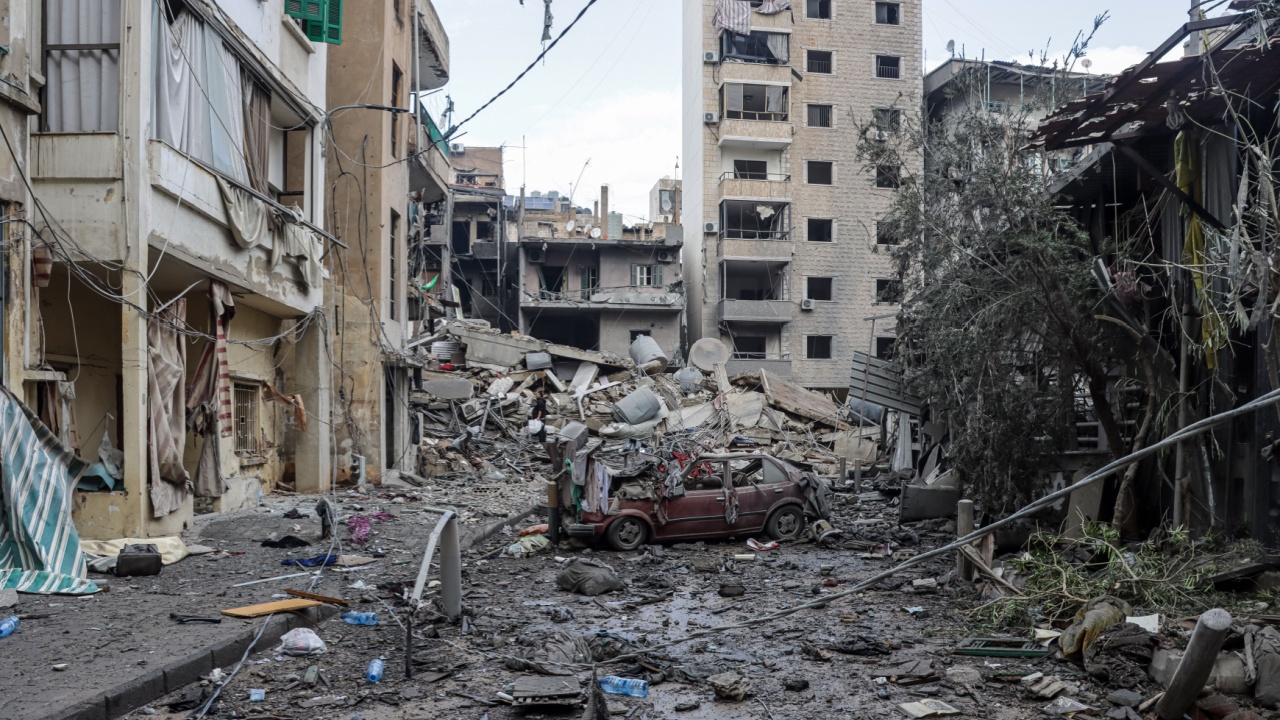
This strategy incorporates the Dahiya Doctrine—a military strategy of total war that aims to inflict maximum damage on civilian and non-civilian sites alike—to realize Israeli security aims. In Lebanon, where the doctrine was first developed in the 2000s, that effort means mass forced displacement from supposedly Hezbollah-friendly communities. It involves the widespread razing of infrastructure in those evacuated zones, including the use of chemicals to destroy the area’s soil. Civilian infrastructure does not receive the protections outlined in international law, leaving homes and apartments, schools, hospitals, and ambulances, banks, roads and bridges, and water and power sites as targets. Indeed, what is occurring in Lebanon today—per Israeli officials—is the extension of the Gaza model.
For Lebanon, two scenarios appear most likely in the medium and long term should the war continue. Israeli leaders, including Israeli Prime Minister Benjamin Netanyahu, have said as much. Netanyahu is particularly incentivized to prolong the war due to his corruption trials at home and strong public support for the fight against Hezbollah across Israeli society.
In the first scenario, Israel pushes the envelope through its ground invasion but eventually hits real resistance from Hezbollah. Exporting the Gaza model becomes a nightmare for the country internationally, but it does not stop Israel’s military operations or occupation of Lebanese territory. A stalemate, but not a quagmire, persists in the short-to-medium term as the Lebanese government fails to rein in Hezbollah.
As such, the risk of a long-term occupation of territory south of the Litani and the equally long-term displacement of this area’s residents increases. Widespread frustration with Hezbollah peaks but gradually shifts back toward Israel due to its military operations and occupation, which ultimately work to justify Hezbollah’s raison d’être of resistance.
In the second scenario, popular support for Hezbollah crumbles, forcing it to shift its stance on its weapons, but not fully surrender its arms. The Lebanese government pushes the issue of normalization talks with Israel and its crackdown on Hezbollah military activities, following its recent decision to ban those activities. These efforts are presented in eventual quiet talks as a concession. Whether Israel would be compelled to stop bombing the country is unclear, but with such moves, Washington could already be pushing Israel to talk in good faith for the bigger prize—one that US President Donald Trump openly desires.
The question here is one of focus. Washington would likely need to end its assault on Iran to shift any focus back to Lebanon. Should it do so, Israel would still likely occupy some Lebanese territory long-term, as the countries work out their disputed border in a format that likely benefits Israel, just like the 2022 maritime border deal.
At present, the first scenario seems to be the most likely outcome. The broader war in the region has no clear endgame—an issue no amount of public relations work in Washington can fix. The seeds of mission creep have been planted as Iran refuses to capitulate and both it and elements of its so-called Axis of Resistance prove unwilling to yield on when and how the war ends.
Still, Trump has shown a penchant for cutting deals when the trends of war do not appear to be favoring him and is more than willing to do so on a moment’s notice. Ultimately, how Washington approaches Iran will have a massive impact on developments in Lebanon, highlighting how fighting in the small eastern Mediterranean country could come to define the broader regional conflict.
About the Author: Alexander Langlois
Alexander Langlois is a foreign policy analyst, the senior editor at DAWN, and a contributing fellow at Defense Priorities. He is focused on the geopolitics of the Levant and the broader dynamics of West Asia. Langlois holds a Master of Arts degree in International Affairs from American University. He has written for various outlets, including The Carnegie Endowment for International Peace’s Sada, the Atlantic Council’s MENASource, the Lowy Institute, the Gulf International Forum, The New Arab, The Nation, and Inkstick. Follow him on X:@langloisajl.