Whatever Hezbollah’s objectives for entering the Iran War, the Lebanese people will bear the costs of the conflict.
In the aftermath of US-Israeli strikes that crippled Iran’s senior leadership, Tehran did not retreat—it adapted. Projecting power along its periphery, it turned to a familiar instrument in its neighborhood: Hezbollah in Lebanon.
Yet as the conflict grinds on beyond Iran’s borders, a more difficult question emerges—one that cuts to the heart of the war’s trajectory: what is Hezbollah’s definition of victory?
For some analysts, the answer is straightforward. Hezbollah cannot win.
Joshua Landis, a professor of Middle East studies at the University of Oklahoma, argues that the conditions that once allowed the group to claim success no longer exist: “Hezbollah cannot win this conflict this time. This is not 2006. Preserving a handful of missiles does not constitute a victory. Lebanese society is overwhelmingly opposed to further conflict.”
Landis’ assessment reflects a broader shift in how Hezbollah’s role is understood. Unlike in 2006, when survival alone could be framed as a strategic triumph, today’s battlefield is defined by deeper constraints. Iran—Hezbollah’s primary patron—faces mounting economic pressure, limiting its ability to finance reconstruction or sustain prolonged conflict. At the same time, domestic fatigue in Lebanon has eroded the political space that Hezbollah once relied on to justify escalation.
In this context, the traditional narrative of “divine victory” appears increasingly difficult to sustain. But this view assumes that Hezbollah is fighting its own war.
Michael Young, a senior editor at the Malcolm H. Kerr Carnegie Middle East Center in Beirut, offers a different interpretation: “Hezbollah’s involvement must be understood within a broader Iranian strategy. This is not solely a Hezbollah decision—it is fundamentally an Iranian one. The primary objective is to open an additional front against Israel in order to relieve pressure on Iran.”
This interpretation reframes the conflict entirely. If Hezbollah’s role is to serve as an extension of Iran’s regional strategy, then victory is not measured in Lebanese terms—territorial gains, battlefield outcomes, or reconstruction capacity—but in whether it can alter Israel’s strategic calculus vis-à-vis Tehran. Under this logic, even limited engagement could be considered effective if it forces Israel to divert attention, resources, or military bandwidth away from Iran itself.
There is another explanation. Ali Rizk, a Beirut-based security analyst and translator, explains that Hezbollah’s objectives may be far more immediate and tactical.
“One element of victory is to demonstrate that Hezbollah still retains the capability to impose real costs on Israel. Another would be to force Israel to comply with the terms of the November 2024 ceasefire. If Hezbollah can reverse Israel’s gains and return the situation to something resembling the pre-October 7 reality, that would constitute a major victory.”
Here, success is neither symbolic nor strategic in the grand sense—it is measured in deterrence. The ability to impose costs, constrain Israeli operations, and reestablish a previous balance along the border becomes the benchmark.
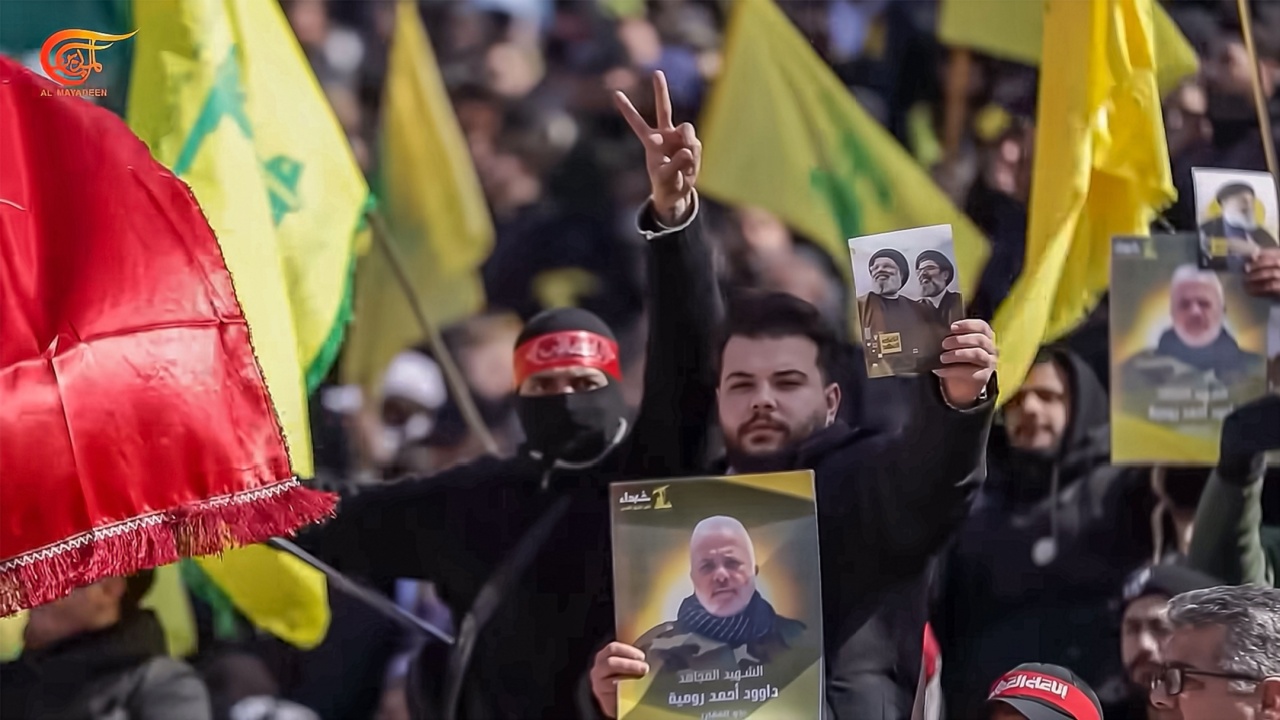
Taken together, these perspectives reveal a deeper truth about the current conflict: victory for Hezbollah is not a fixed concept. In practice, Hezbollah has never treated victory as a fixed concept. Rather, it has consistently adapted its definition of success to fit evolving political and military realities—reinforcing its claim to be Lebanon’s primary line of defense against Israel. The group has rarely, if ever, acknowledged setbacks publicly. Even in 2024, after sustaining significant blows—including the assassination of longtime leader Hassan Nasrallah—his successor, Naim Qassem, declared victory following the ceasefire.
Whether Hezbollah succeeds in relieving pressure on Iran, demonstrating residual strength, or attempting to restore deterrence, the consequences will be borne locally. Infrastructure damage, economic strain, and political fragmentation will not be evenly distributed across the region—they will be concentrated in Lebanon itself.
In that sense, the question of victory may be less relevant than it appears. Hezbollah may not be able to claim victory in the traditional sense. If a ceasefire in the war is implemented that allows the Iranian regime to remain intact, the Shia party and paramilitary will see this as a way to reclaim its military prestige. Even so, in the end, Hezbollah’s constituency, the people of southern Lebanon, are the ones paying the ultimate price.
About the Author: Adnan Nasser
Adnan Nasser is an independent foreign policy specialist and journalist based in Beirut and Washington DC. In addition to The National Interest, his work has also appeared in Al-Monitor and Diplomatic Courier. He holds a bachelor’s degree in international relations from Florida International University. Follow him on X: @Adnansoutlook29.