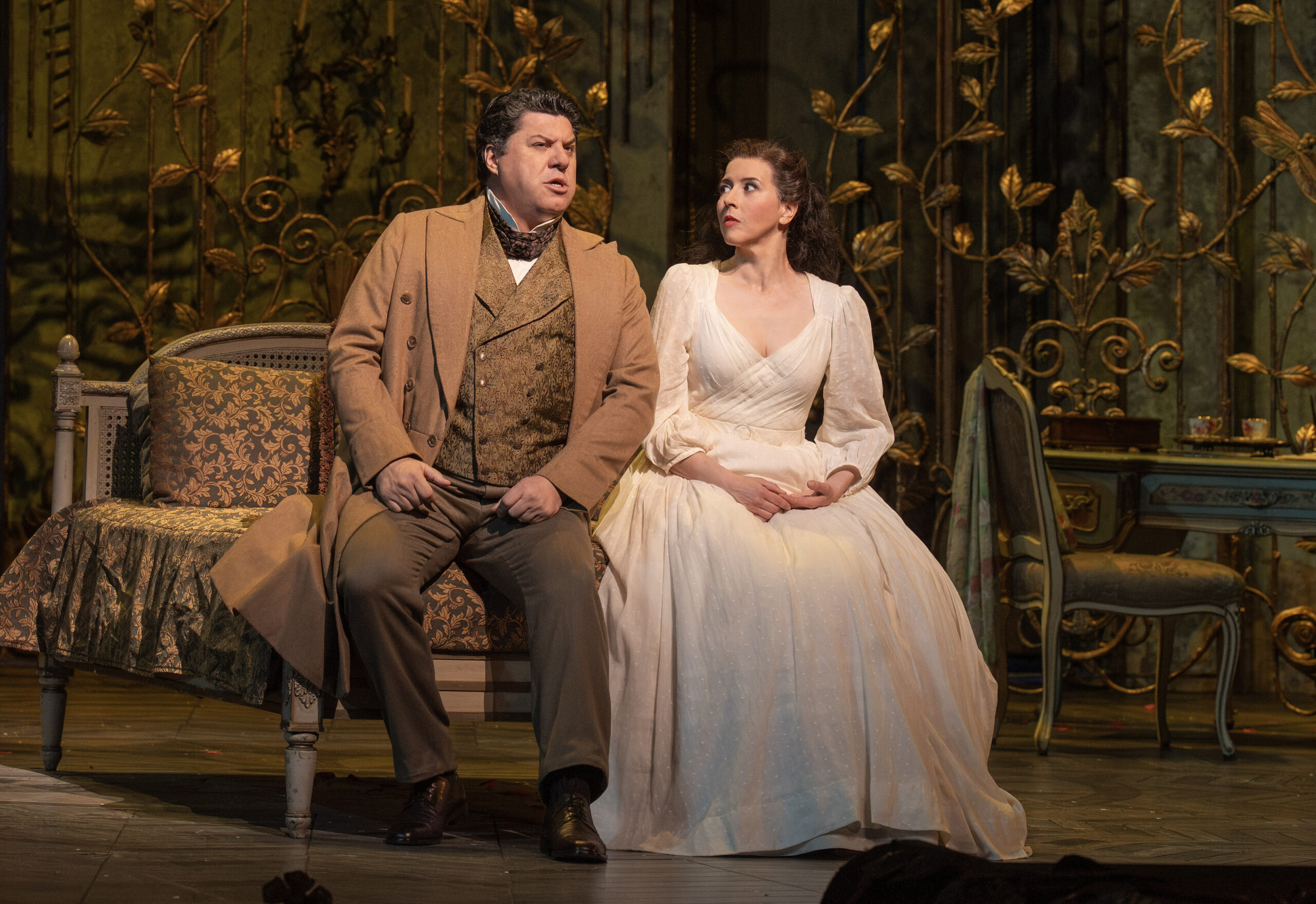
Lisette Oropesa, the soprano from Louisiana, has become a big, big singer. She is rail thin (a runner and a vegan). But she is a prima donna in New York, Salzburg, and elsewhere.
I remember a time when she was singing small roles, such as Lisette in La rondine (Puccini). A Lisette playing a Lisette? Yes, it happened.
On Friday night, Oropesa sang the title role of La traviata (Verdi) at the Metropolitan Opera. This role, Violetta, the “traviata,” or “woman who has gone astray,” requires a lot. It requires almost three singers instead of one: a coloratura soprano, a lyric soprano, and a dramatic soprano.
Oropesa has no trouble handling the coloratura or the lyric. The dramatic? She conveys drama in her own way, not necessarily with volume.
The phrase “Amami, Alfredo” can be overwhelming: “Love me, Alfredo!” Ideally, a Violetta will pour out sound. From Oropesa, this line was lyric and inward—and affecting.
She began “Dite alla giovine” very, very small—pianissimo. Yet the voice carried. And this line, too, was affecting.
About Lisette Oropesa, there is a brightness and a quickness. She is hard to take your eyes or ears off of. I believe she is a native Spanish speaker, the daughter of Cuban immigrants. Some of her single r’s sounded Spanish to me, instead of flipped in the Italian manner. But this is a simple detail, a curiosity.
“Addio, del passato” was a moving experience. Oropesa spun out the melody expertly. Her final note, a high A, was a little low (a euphemism for “flat”), but, smart woman, she adjusted upward as she held the note.
I have mentioned what it takes to sing Violetta. Well, it helps to be an actress too. And Oropesa is one. From my seat, she looked a bit like Audrey Hepburn.
The Met was reviving Michael Mayer’s production from 2018. In the pit was Antonello Manacorda, a conductor from Turin. In former times, he was a concertmaster for Claudio Abbado. Last summer, he conducted Maria Stuarda (Donizetti) at the Salzburg Festival. In the title role was Lisette Oropesa.
(For my review of that one, go here.)
Friday night? Manacorda began La traviata very, very quietly. Yet the sound carried, at least to my seat. In general, Manacorda was understated in his conducting. He let the music speak for itself. He did not force drama on it. The score, and the story, contain enough drama. Frankly, La traviata sometimes sounded like a chamber opera.
Would you like to know a “fun fact”? Of all of Verdi’s operas, La traviata is the only one set entirely indoors. (Try that out at your next cocktail party.)
I noticed just one eccentricity on Friday night. Briefly, in “Di Provenza il mar,” the tempo turned very slow. I’m sure that Manacorda has a reason (unknown and unguessable to me).
In concerts, principal players in the orchestra get to take solo bows at the end. But not in the opera house. Maestro Manacorda did something that made me smile. From the stage, he pointed to players in the pit and, with his hands, mimicked how they play their respective instruments.
The chorus does not have a big part in La traviata, but it does have a part. (Can’t have a party without a chorus—not in La traviata, at least.) The Met’s chorus performed with verve, nuance, and cohesion.
Alfredo was a Polish tenor named Piotr. Beczała? No, a tenor from the next generation: Buszewski. His voice is probably a size too small for the role, in the Metropolitan Opera House. But it is a good voice, which he handles ably.
In the early going, his intonation was iffy. And I feel sure that he can sing Alfredo’s aria, “De’ miei bollenti spiriti,” better—with spirits more ebullient. But he was superb in the Act III duet, “Parigi, o cara.” Buszewski was “hooked up” and making a beautiful, glowing sound.
“Grand opera walked in,” I scribbled in my notes. That was when Luca Salsi began to sing. This baritone from Parma portrayed Alfredo’s father, Giorgio Germont. He is a well-known Scarpia (in Puccini’s Tosca), and he brought some of the same heft and power to Père Germont.
Yet he sang “Pura siccome un angelo” with tender lyricism. “Di Provenza il mar,” I thought, should have had more evenness. The sea was a little choppy. But he is a canny performer, Salsi.
Annina, Violetta’s maid, was portrayed by a soprano from Colorado who owns one of the coolest names in opera—in show business: Tessa McQueen. She has a substantial voice, and I look forward to hearing her in more prominent roles.
In a minor role, that of Baron Douphol, was Dwayne Croft. The Dwayne Croft, the famous American baritone? Yes. I recall reviewing him as Père Germont in the early 2000s. He made his Met debut in 1990. He is part of the furniture, for many of us.
It was a good night at the opera—very satisfying. And La traviata, it must be said, is perfect. That does not mean it is Verdi’s best opera, though one may consider it so. But it is, in my judgment and others’, his perfect opera.