The populist National Rally claimed a historic “breakthrough” for the party on Sunday’s French municipal elections, which saw major establishment figures fall by the wayside and the craven political partnerships made with the far-left prove toxic to voters.
Rassemblement National (RN) and its allies secured mayoral victories in at least 50 towns and cities across France during the two-round elections, which concluded on Sunday evening.
Although the populist party fell short in some contests, including the mayoralty in Marseilles, it successfully expanded its power base in regions such as Alsace, Carcassonne, Montargis, Orange, the Pyrénées, and Pas-de-Calais. The RN also notably flipped the municipality of La Flèche in Sarthe, which has been under socialist control for nearly four decades, Le Figaro reported.
Meanwhile, Éric Ciotti, the head of the Union of the Right for the Republic (UDR), which has aligned itself with the National Rally, won a key mayoral race in Nice, the fifth largest city in the country. Additionally, fellow UDR candidate Didier Lallemand won the race in Montauban.
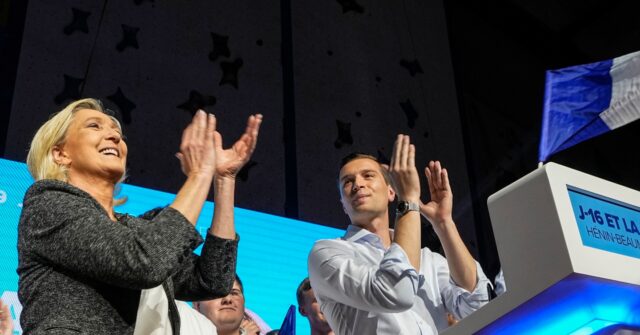
National Rally President Jordan Bardella proclaimed Sunday saw “the biggest breakthrough in the entire history” of his party, while claiming that it represented a “turning point” against the “old world and disconnected politicians”.
“Never before have the RN and its allies had so many elected officials across France. In dozens of municipalities. We are called upon to prove ourselves,” Bardella said. However, he noted that “these successes are not an end, but a beginning,” as the National Rally looks towards next year’s presidential election.
Former RN presidential candidate Marine Le Pen added: “Bravo to all our candidates, whatever the outcome in each municipality: they can be proud of the work accomplished, and tonight, dozens of RN mayors and thousands of RN municipal councillors are elected!”
Yet, the big takeaway from the second round of voting on Sunday may be the emerging divide on the political left in the country, as it also eyes potential strategies to challenge in the 2027 race to replace President Emmanuel Macron.
While First Secretary of the Socialist Party, Olivier Faure, had supposedly ruled out joining forces with the radical La France Insoumise (France in Rebellion/LFI) party of former presidential candidate Jean-Luc Mélenchon, Faure sparked uproar last week after announcing that local branches of the Socialist Party were free to partner with the LFI in municipal elections.
This came despite the Socialist leader personally accusing the Mélenchonist camp of being antisemitic and the radical party facing a storm of controversy following the mob killing of a conservative student in Lyon, allegedly at the hands of Antifa militants who worked in the National Assembly for LFI lawmaker Raphaël Arnault, the founder of a banned Antifa cell in the city.
The transparent political gamesmanship and the discarding of supposed principles apparently failed to achieve their aim, however. Socialist candidates who partnered with the LFI in Sunday’s second round of voting fell to centrists or right-wing candidates in previous left-wing strongholds such as Clermont-Ferrand and Brest. In contrast, where Socialist Party candidates refused to partner with the LFI, they came out on top, including in Marseille and Paris.
The LFI did manage to win several municipalities on its own; the far-left party only formed successful partnerships with the Socialists or Greens in two races, Nantes and Lyon, suggesting that the Mélenchonist brand remains popular among extreme leftists (and likely Muslim voters) while increasingly becoming toxic to average left-wing voters.
Socialist Party secretary-general Pierre Jouvet said, per the BBC: “My conclusion from tonight is that the LFI wins nothing – and what is worse, it is the LFI that brings about defeat.”
Already on manoeuvres for next year’s presidential race, rumoured left-wing candidates, including former Socialist President François Hollande and Place Publique party leader Raphaël Glucksmann, both condemned the partnerships with the LFI.
Hollande specifically criticised the Socialist Party “leadership”, a likely reference to Faure, who has long been an advocate of building left-wing coalitions, including the far-left. The former president said that “the time for clarification has come,” and said that the position of “unity for the sake of unity” has reached a “dead end”.
Apparently undeterred, Mélenchon hailed his party’s performance as a “clear and resounding success” and claimed that it was the Socialist Party that “dragged us down”.
“We are a useful force where others are simply opportunists without a compass,” he added.
Perhaps overshadowed by the drama and infighting on the left, the centrist French political establishment, aligned with President Emmanuel Macron, continued to suffer at the ballot box.
In a major blow to the supposed centre-right Les Républicains — who have in recent years consistently partnered with the Macronist and Socialist camps over the National Rally — former Culture Minister and once frontrunner Rachida Dati suffered a stinging loss to Socialist Emmanuel Grégoire, despite him refusing to partner with LFI candidate and top Mélenchon confidant (and widely rumoured lover) Sophia Chikirou, who peeled off 8 per cent of the left-wing vote.
Dati also had the benefit of populist Reconquête (Reconquest) party candidate Sarah Knafo stepping aside after the first round in a bid to help the right win, yet Dati refused to accept a partnership, as is typical of the alleged centre-right party.
Potentially even more embarrassing for the establishment, however, was the loss of former Prime Minsiter François Bayrou, who just six months after being unceremoniously kicked out of the Hôtel Matignon with a no-confidence vote, was defeated in the mayoral race in Pau, where he has held office since 2014. Bayrou fell to his Socialist opponent Jérôme Marbot by a margin of 42.45 per cent to 41.14 per cent, or just 344 votes.
The continued decline of the Macron establishment and the deep fissures breaking out on the left will likely be welcome news in Le Pavillon de l’Écuyer. However, it remains to be seen if the National Rally can overcome its struggles in major urban centres as it eyes taking control of another Paris landmark, the Elysée Palace.