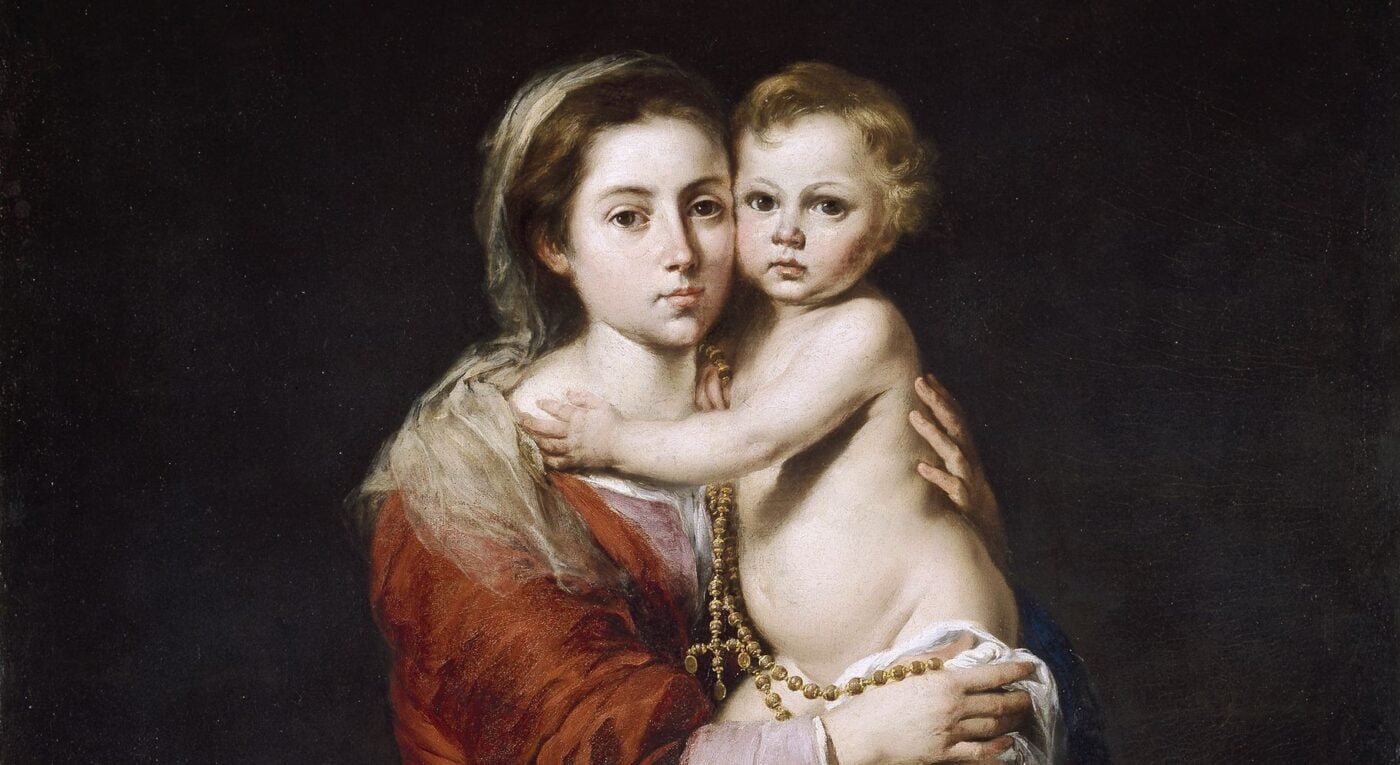
The Church’s devotion to Our Blessed Mother is simply the will of God, as we saw in the fourth article of this Magnificat series (“All Generations Will Call Me Blessed”). Pope Benedict XVI called it “a command of the Holy Spirit” (Homily, August 15, 2006).
And so it is that “the Church rightly honors [the Mother of God] with special devotion,” as the Catechism says (971), and par excellence in the prayer of the Holy Rosary. In the Hail Mary, “all generations” call Our Blessed Mother “blessed,” a fulfillment of Luke 1:48, and in the Mysteries of the Rosary we come to know the “great things” God has done for Her (Lk. 1:49). Thus, this fifth article of the Magnificat series will focus on the Mysteries of the Rosary, through which we will know the “great things” God has done for the Blessed Mother.
The Magnificat and the Mysteries
The Holy Rosary is “an epitome of the whole Gospel” (CCC 971), a summary of God’s merciful plan for the Redemption of man after the original sin of Adam and Eve, after they ate the fruit of the tree God forbade them to eat (cf. Gen. 3). The Mysteries of the Rosary are a summary of the life of Jesus Christ, which is inseparably intertwined with the life of His Blessed Mother, His intimate associate in the Redemption. As we pray the “Our Father,” “Hail Mary,” and “Glory Be,” the vocal prayers, we meditate upon these Mysteries.
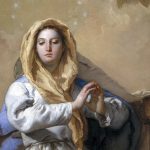
God’s plan for our Redemption begins in time with His creation of the Blessed Virgin Mary, the Immaculate Conception, as She said to St. Bernadette. She is the dawn of our salvation. God creates the woman truly worthy to be His Mother, immaculately conceived—preserved, from the first moment of Her conception from any stain of original sin. And She is preserved from actual sin all Her life. (For more on the Immaculate Conception, please read the second article of this series, “Our Lady’s Savior: On the Immaculate Conception”).
Mother of the Church
In the Mystery of the Annunciation (First Joyful Mystery), God announces His plan of Redemption to Our Blessed Mother through the angel Gabriel. She is to be the Mother of God; this is Her greatest privilege, from which all Her other privileges flow. Our Blessed Mother assents to God’s plan, saying fiat: “let it be to me according to your word” (Lk. 1:38). At that moment the Incarnation takes place—God, the Second Person of the Blessed Trinity, the Word, becomes flesh in Her Immaculate womb: “And the word became flesh and dwelt among us” (Jn. 1:14). The will of Our Blessed Mother is one with the will of Jesus and is united to His, in obedience to the Father’s plan of Redemption.
When She says fiat, the Blessed Virgin Mary becomes the Mother of God and the Mother of the Church. She becomes the Mother of Jesus’ Mystical Body, a vocation which culminates at the foot of the Cross when Jesus says to Her: “Woman behold your son!” (Jn. 19:26). Pope Benedict XVI says:
We have listened to a passage from St. John’s Gospel which invites us to contemplate the moment of the Redemption when Mary, united to her Son in the offering of his sacrifice, extended her motherhood to all men and women, and in particular to the disciples of Jesus…Mary’s motherhood, which began with her fiat in Nazareth, is fulfilled at the foot of the Cross. Although it is true—as Saint Anselm says—that “from the moment of her fiat Mary began to carry us all in her womb,” the maternal vocation and mission of the Virgin towards those who believe in Christ actually began when Jesus said to her: “Woman, behold your son!” (Jn. 19:26). (Homily, November 29, 2006)
Our Blessed Mother stands at the foot of the Cross suffering with Jesus (Fifth Sorrowful Mystery). “And a sword will pierce through your own soul also” (Lk. 2:35) was Simeon’s prophecy to Her at the Presentation of Jesus in the Temple (Fourth Joyful Mystery). The sword, the lance, piercing the Heart of Jesus physically on the Cross (cf. Jn.. 19:34) pierces Her Heart mystically. From the pierced Sacred Heart of Jesus, blood and water gush forth (ibid), “the wellspring of the Church’s Sacraments” (Preface of the Mass of the Sacred Heart of Jesus).
Through the Sacraments ordinarily, Jesus gives the Church life and salvation, thus the Church is born from Jesus’s side on the Cross (cf. CCC, 766). There, at the foot of the Cross, the Blessed Mother’s mission begins as our Mother, the Mother of the Church.
Mother of Mercy
On the Day of Pentecost, the “newborn” Church, gathered in prayer with Our Blessed Mother, the Mother of the Church, in the Upper Room, receives the life-giving Spirit (cf. Acts 2: 1-4) (Third Glorious Mystery). The Holy Spirit comes, through the prayers of Our Blessed Mother, upon all present in the Upper Room, the Cenacle. This is the fulfillment of Jesus’ Paschal Mystery—His Passion, Death, and Resurrection (cf. CCC 731). “I came to cast fire upon the earth…” (Lk. 12:49). The Mystery of Pentecost is both the Baptism (cf. Acts 1: 4-5) and the birthday of the Church, since the Church born from the side of Jesus on the Cross receives life on this day—receives the life-giving Spirit.
Our Blessed Mother remains on earth for a while, then, at the appointed time, is assumed body and soul into Heaven (Fourth Glorious Mystery). “A great sign appeared in heaven: A woman clothed with the sun, and the moon under her feet, and on her head a crown of twelve stars” (Rev. 12:1). In Heaven She continues to pray for us as our Mother, that we may go to Heaven when we die, to be with Her and Jesus for all eternity.
God’s plan for our salvation is a plan of mercy; His mercy is revealed in Jesus (cf. CCC 1846)—and Mary is the Mother of Mercy—of Jesus. As we pray the “Hail Holy Queen” at the close of the Rosary, we turn to Our Blessed Mother and contemplate Her as our “Mother of Mercy,” Who brings Jesus—Mercy—to us and us to Him. “Turn then most gracious Advocate Thine eyes of mercy toward us, and after this our exile show unto us the blessed fruit of Thy womb, Jesus.” She is all mercy, all love. God, Who is Love, Merciful Love, is perfectly reflected in Her—His Masterwork of creation—His Mother.
We return to this quote of Pope Benedict XVI from our fourth article of this Magnificat series (“All Generations Will Call Me Blessed”): “…it is precisely by looking at Mary’s face that we see more clearly than in any other way the beauty, goodness and mercy of God…” (Homily, August 15, 2006). Mother most tender, Mother most compassionate, Mother of Mercy, pray for us!
Author’s Note: The first article of this Magnificat Series (“My Soul Proclaims the Greatness of the Lord”) reflects on the Second Joyful Mystery, the Visitation, and the fourth article (“All Generations will Call Me Blessed”) reflects briefly on the Second Luminous Mystery, the Wedding at Cana.
Image from WikiArt