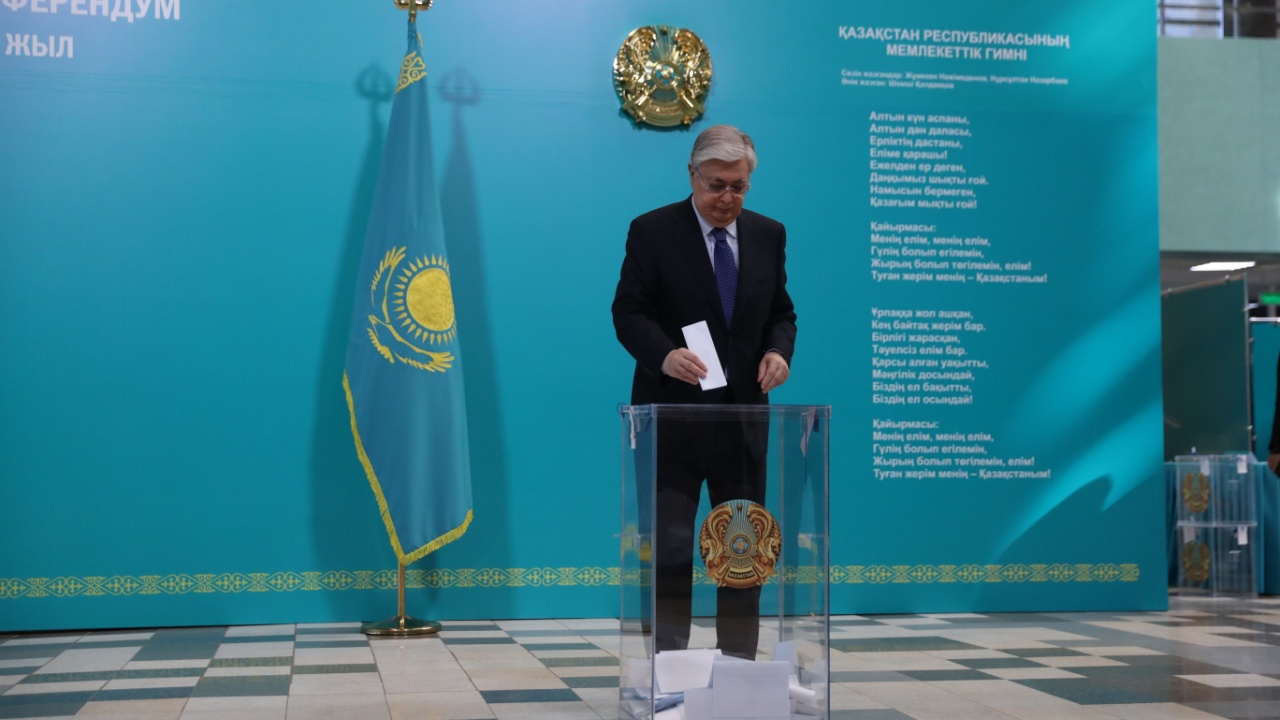
Kazakhstan’s constitutional changes are intended to streamline decision-making and reduce uncertainty over presidential succession.
Kazakhstan’s recent constitutional referendum has attracted attention primarily for what it changes domestically. But for Washington, the more relevant question is what the reform reveals about Kazakhstan’s political trajectory, and what that means for US strategy in Central Asia.
Approved by around 87 percent of voters on a turnout exceeding 70 percent, the referendum is best understood as an effort to strengthen state capacity, streamline governance, and reduce internal friction ahead of the next political cycle. In a region facing external pressures—from the consequences of Russia’s war in Ukraine to volatility in global energy markets and shifting transport routes—this emphasis on institutional coherence is strategically significant. For external partners, including the United States, the key issue is the state’s ability to act predictably and execute policy over time.
That question matters because US-Kazakhstan relations have deepened in ways that depend directly on long-term reliability. Kazakhstan is the world’s largest uranium producer, a major oil exporter, a growing node in critical minerals supply chains, and a central player in the development of the Trans-Caspian transport corridor linking Asia to Europe. The United States has invested heavily in this relationship, with more than $40 billion in cumulative investment and sustained engagement through mechanisms such as the C5+1 platform.
These areas of cooperation—energy, critical minerals, and transport—share a common requirement: they depend on continuity. Investments in extraction, infrastructure, and supply chains operate on timelines measured in decades, not electoral cycles. From this perspective, the constitutional reset is significant for its impact on Kazakhstan’s ability to sustain consistent policy over time.
One of the changes is the move to a unicameral parliament. Its practical effect is to reduce the number of veto points in the legislative process. For external partners, this matters because it increases the likelihood that agreements reached at the executive level can be translated into law and implemented without prolonged internal delays.
The creation of a new People’s Council, with the authority to initiate legislation, reinforces this shift toward centralized policy coordination. For Washington and US investors, this can reduce uncertainty about Kazakhstan’s strategic priorities. In practice, it becomes easier to identify which sectors are being prioritized—whether critical minerals, transport corridors, or energy diversification—and to align engagement accordingly.
Kazakhstan is also restoring the vice presidency. In many emerging markets, the greatest source of uncertainty is political succession. Periods of leadership transition can generate elite competition, policy reversals, or delays in decision-making. By formalizing a succession pathway, Kazakhstan’s revised system appears designed to reduce these risks.
Taken together, these changes point to a broader shift toward greater institutional alignment. The expansion of executive coordination capacity allows for more coherent implementation across ministries, regulators, and state-owned enterprises. This matters in practice because many of the sectors central to US-Kazakhstan cooperation, particularly energy and infrastructure, require complex, cross-agency coordination.
This has implications beyond individual projects. It affects the overall credibility of Kazakhstan as a partner. By reducing institutional fragmentation, the constitutional reset may strengthen the perception that agreements will be upheld and enforced. In a competitive global environment, where capital and supply chains are increasingly mobile, that perception carries real weight.
The timing of the referendum also matters. Kazakhstan is approaching the latter part of the decade in a highly uncertain geopolitical environment. The Ukraine War has reshaped regional dynamics. The global energy market is volatile due to the war in the Middle East. The Middle Corridor is emerging as a strategic alternative to traditional transport routes, but its development requires sustained political and economic coordination. At the same time, competition over critical minerals is intensifying, with the United States seeking to diversify supply chains away from concentrated sources.
In this context, the question for Washington is whether Kazakhstan can act as a stable, capable, and strategically autonomous partner in a region where such partners are limited. The constitutional reforms suggest an attempt to reinforce precisely those attributes: continuity, predictability, and coordinated state action.
This is particularly relevant for Kazakhstan’s multi-vector foreign policy. The country has long sought to balance its relationships with Russia, China, and Western partners. Maintaining that balance requires not only diplomatic skill but also internal stability. A political system that reduces the risk of internal fragmentation is better positioned to sustain an independent foreign policy. For the United States, this is a critical consideration.
None of this suggests that institutional design is irrelevant. But it does suggest that, from a strategic perspective, the more important question is how institutional changes affect state capacity. Interests rather than institutional preferences will ultimately shape US policy.
In Central Asia, those interests are expanding. Energy security, critical minerals, transport connectivity, and regional balance all point in the same direction. Kazakhstan’s constitutional reset indicates a move toward a more consolidated and coordinated model of governance, one that prioritizes stability and continuity in a complex regional environment.
About the Author: Michael Rossi
Michael Rossi is a lecturer in Political Science at Rutgers University of New Jersey, United States, and a visiting professor at Webster University, Tashkent. He has also served as the program director in International Relations at Long Island University, Brooklyn, and as a visiting instructor in the Department of Political Science at Fordham University, Rose Hill.