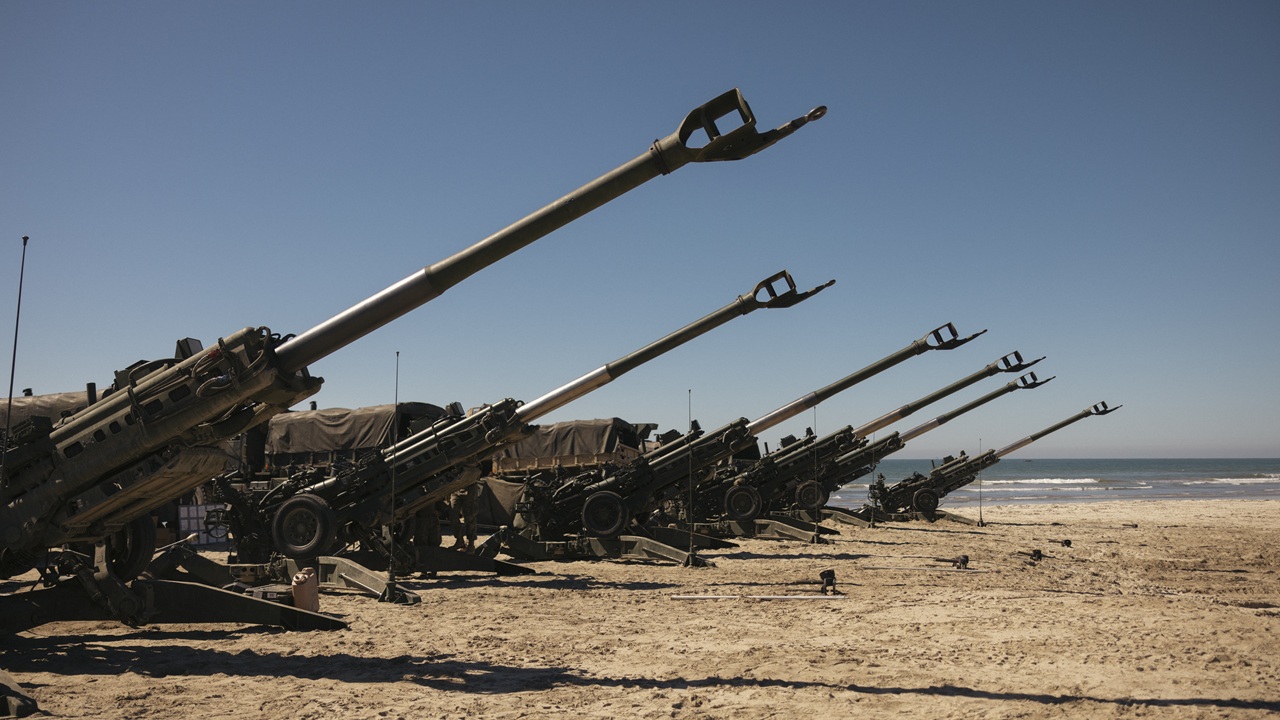
The Marines’ decision to fire live artillery over a major California highway as part of its 250th birthday celebrations in 2025 came under harsh criticism from Governor Gavin Newsom.
As the United States Marine Corps celebrated its 250th anniversary last October, shrapnel fired by a cannon struck a California Highway Patrol (CHP) vehicle near Camp Pendleton. At the time, it was reported that the artillery shell “prematurely detonated” over California’s Interstate 5, striking a patrol car and at least one other vehicle that were part of Vice President JD Vance’s protection detail.
As previously reported, CHP officers reported seeing an artillery piece failing to clear the southbound lanes of the highway. Multiple pieces of shrapnel were found after the celebration, including one large enough that it dented the hood of a patrol car assigned to the protection duties.
Following Road Closures, No One Was Hurt in the I-5 Accident
This week, a United States Marine Corps investigation determined that the misfire was a “one in a million” malfunction. The investigation had already ruled out any negligence or wrongdoing, yet the findings aren’t good enough for the Golden State’s governor, who had warned against the live fire demonstration before it took place.
“Democratic Gov. Gavin Newsom called the planned demonstration with live artillery dangerous and unnecessary, and he ordered I-5 to be closed during it,” the Associated Press reported.
“Firing live rounds over a busy highway isn’t just wrong—it’s dangerous,” Newsom said in a statement in advance of the celebrations.
Newsom had ordered the closure of Interstate 5, citing risks from the USMC event. The governor’s office expressed concerns about driver safety, including distractions from “sudden unexpected and loud explosions.” Such actions could lead to accidents, injuries, or even fatalities, underscoring the need for a thorough safety review.
The California Highway Patrol also condemned the decision to carry out a live fire over a public highway, even one that was closed at the time to civilian traffic.
Those decisions drew ire from the White House and the Marine Corps, which said that the celebrations and the live fire of cannons “wouldn’t endanger motorists.” But in the aftermath of the incident, Newsom took a victory lap, stressing that his caution could have prevented disaster on the ground.
The Marines Have No Definitive Explanation for the Shrapnel Incident
The USMC released its 666-page report on the incident in December, but it was made public only this week. AP, citing the findings, noted that the USMC concluded there was “no definitive answer” to why one of the M795 high explosive rounds detonated early, and further stated that such a premature detonation was “beyond reasonable expectations and should not have happened, but it did.”
The shell exploded at approximately 1,480 feet (450 meters) over the highway, resulting in the shrapnel that struck the vehicles.
The report further stated that the rounds are “manufactured to a tolerance of one defect in a million.” As the AP further reported, the original plan called for 60 rounds of live shells to be fired over the highway via six 155mm howitzers, over the course of five minutes. After the round in the first volley misfired and prematurely detonated, the demonstration was subsequently canceled.
The USMC report considered what may have contributed to the misfire, stating that the howitzers were placed too tightly, but seemed to dismiss the severity of the incident.
“What was different from the thousands of times before this event employing the same shell-fuze combination, weapons system, and highly trained Marines? There is no definitive answer,” the report stated.
No one was hurt in the incident. But, as every law-abiding gun owner knows, one should always treat every firearm as if it is loaded, and never point a weapon at anything except what they want to hit. Why artillery was ever meant to fire over a highway just seems to miss those points entirely.
About the Author: Peter Suciu
Peter Suciu has contributed to dozens of newspapers, magazines and websites over a 30-year career in journalism. He regularly writes about military hardware, firearms history, cybersecurity, politics, and international affairs. Peter is also a contributing writer for Forbes and Clearance Jobs. He is based in Michigan. You can follow him on Twitter: @PeterSuciu. You can email the author: [email protected].