Mojtaba Khamenei’s accession to the post of Supreme Leader was a virtual certainty—following decades of careful political maneuvering by him and his father.
After the United States and Israel killed longtime Iranian Supreme Leader Ali Khamenei on the first day of the ongoing war, the Islamic Republic’s Assembly of Experts quickly named his most prominent son, Mojtaba Khamenei, as the country’s new supreme leader. The younger Khamenei, aged 56, has not been seen since the beginning of the conflict, although Tehran has released several written statements attributed to him.
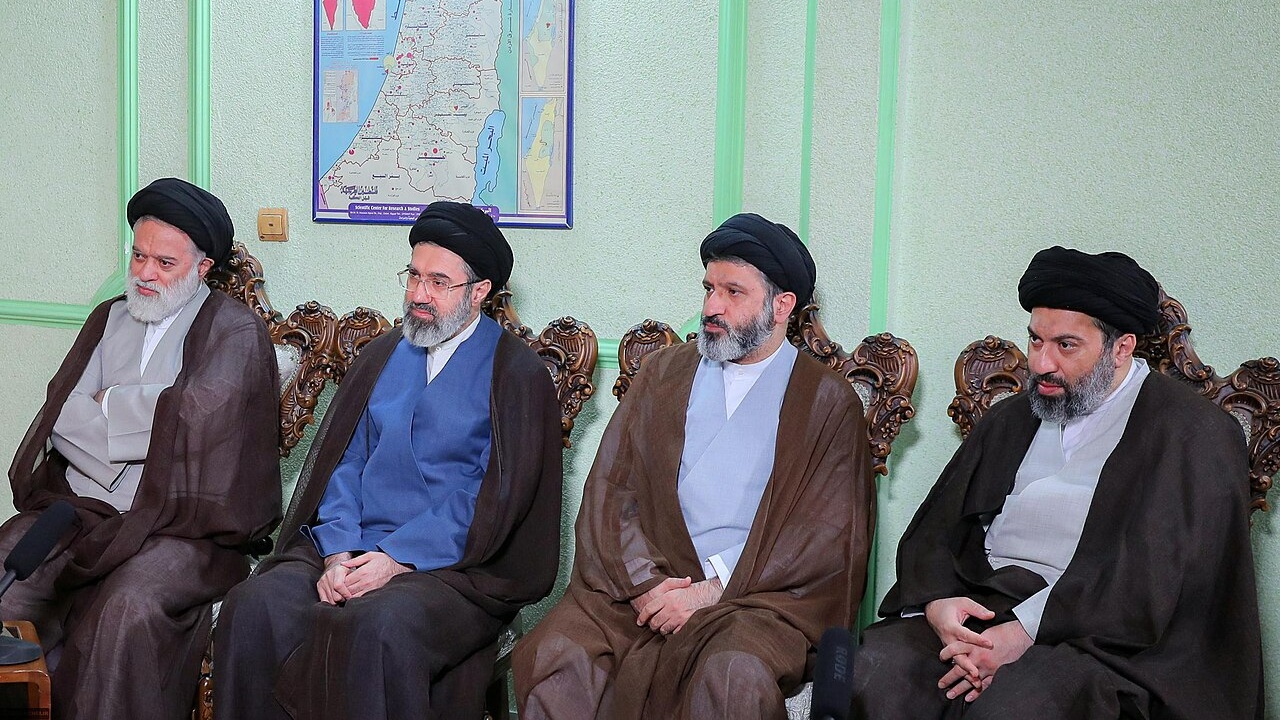
Before his death, Ali Khamenei had four sons—Mostafa, Mojtaba, Masoud, and Meysam—all of whom were mainly involved in the Khamenei household. However, the most prominent of them was Mojtaba, who was born on September 8, 1969, in the city of Mashhad, under the rule of the Shah. Mojtaba Khamenei grew up as a cleric, studying religious sciences at the Qom Seminary under Mahmoud Hashemi Shahroudi, Mohammad-Taqi Mesbah-Yazdi, and Lotfollah Safi Golpaygani.
Mojtaba Khamenei’s Succession Was Years in the Making
Mojtaba Khamenei’s competition to succeed his father began long before the current outbreak of war. It was a campaign long in the making—one that even resulted in disputes within the Iranian elite class, as some regime insiders questioned whether Iran had reverted to a monarchical system. Eagle-eyed observers noted that as the elder Khamenei’s health declined and his public appearances became fewer, the Qom seminary’s news agency began to use the title “Ayatollah”—denoting a high-ranking Shi’a religious official—for his son for the first time. As Mojtaba waited in the wings, many of Ali Khamanei’s close associates, including influential clerics like Mehdi Tajzadeh, the Friday Prayer Leader of Baharestan in Isfahan Province, praised Mojtaba and compared him to the second Imam of the Shiites, defending his succession after his father.
To understand how Mojtaba reached the heights of Iranian leadership, one must go back to the mid-1980s, when he enlisted in the Islamic Revolutionary Guard Corps (IRGC), then on the front lines of the Iran-Iraq War. The younger Khamenei joined the “Habib ibn Muzahir” battalion, one of the main battalions of the IRGC’s 27th Mohammad Rasulullah Division. At that time, the elder Khamenei was serving as the Iranian president, but was not particularly popular among many commanders and soldiers. The balance of sympathy inside the system leaned more toward Mir-Hossein Mousavi, then prime minister, who enjoyed the backing of then-Supreme Leader Ruhollah Khomeini. But it was in this environment that Mojtaba began building the ties that would later turn into one of the most important informal networks in the Islamic Republic.
The “Habib Battalion Circle” was a product of that war and the postwar period. Over time, members of Mojtaba’s circle gained influence across intelligence, the IRGC, political security, and the institutions closest to the office of the Supreme Leader. Men such as Hossein Taeb, Mehdi Taeb, Hassan Mohaqeq, Mohammad Esmail Kowsari, Ali Fazli, Ebrahim Jabari, Hossein Nejat, and Alireza Panahian became part of the hardcore of Mojtaba’s network, transforming it from a group of old war comrades to a political security machine and a core pillar of his personal power. In the years that followed, Habib Battalion veterans managed Iran’s intelligence apparatus, oversaw security in Tehran, and were involved in ideological and propaganda work.
Mojtaba’s name first came up in Iranian political discourse during the 2005 presidential elections after Mehdi Karroubi, a two-term speaker of the Iranian Parliament and a presidential candidate, criticized him for intervening in the elections in a letter to Khamenei. It was widely believed that Mojtaba was behind Mahmoud Ahmadinejad’s success in the election and in becoming president. But the influence of Mojtaba’s hidden network became widely visible to the broader public in the 2009 presidential election, when The Guardian, citing a senior official, reported that Mojtaba had played an essential role in securing Ahmadinejad’s reelection, with the help of the Basij and security organs.
Mojtaba Khamenei Built Religious Legitimacy—and Cut Down His Rivals
Mojtaba’s role deepened after he began teaching dars-e kharij, the highest level of study in Shi’a seminaries, in Qom. On paper, this was merely a clerical step, with no connection to Iranian politics. In reality, it amounted to much more than that.
One of the central criticisms of Ali Khamenei’s elevation in 1989 had been his insufficient clerical standing. Although he was a cleric, he was not regarded as a mujtahid—a high religious rank in Shia Islamic seminary education, one that was initially expected of a Supreme Leader under the constitution. For Mojtaba, the effort to establish religious credentials was part of succession building, making himself more palatable to the clerics who had greeted his father’s rise with suspicion. Of course, a handful of Iranian clerics still objected to Mojtaba’s rise, accusing him of exploiting his father’s position and insinuating that he was not qualified to teach at the highest level. But their opposition was drowned out by the ideological machinery around him, which had already begun to describe him in hagiographic terms reserved for a future leader.
As Mojtaba burnished his clerical credentials, his father simultaneously worked to cut down his potential rivals when the time came for the succession. The first and most important of those rivals was longtime Iranian kingmaker Ali Akbar Hashemi Rafsanjani. Hashemi had played a decisive role in Ali Khamenei’s rise in 1989, and succeeded him in the Iranian presidency. Over the years, however, the alliance between the Khamenei camp and Hashemi broke down. He was removed from the leadership of the Assembly of Experts, and disqualified from running in the 2013 presidential election. His death in January 2017, officially attributed to a heart attack while swimming alone in a pool at Saadabad, was seen by many as suspicious. Indeed, Rafsanjani’s daughter, Faezeh Hashemi, announced that the body of her father contained radioactivity levels 10 times higher than the typical human limit. Mohsen, Hashemi’s eldest son, said that the government did not allow them to see the footage from the cameras in the garden and pool where his father died.
Other serious contenders also fell out of the picture over time. Mahmoud Hashemi Shahroudi, the former head of the judiciary, who was highly regarded in jurisprudence and had executive experience, died after severe illness. Sadeq Amoli Larijani, one of Mojtaba’s teachers in Qom and another serious candidate for succession, became politically radioactive after several of his associates were charged with corruption. One of those individuals, Akbar Tabari, was apprehended in Larijani’s private villa, underscoring the deep connection between the two men in the eyes of regime insiders and the public. Tabari’s trial for bribery and corruption was extensively covered on television and in the media, eroding Larijani’s credibility among regime supporters.
Iranian State Institutions Supported the Khamenei Succession
By the late 2010s, Mojtaba and his circle had steadily consolidated hardline control over the state and narrowed the field for the real succession battle. At the center of that process stood the Assembly of Experts, the 88-member body formally responsible for choosing the next Supreme Leader. But over the years, the Assembly had been stripped of real independence by the smaller and more powerful Guardian Council, which Khamenei had already packed with his loyalists.
Under these conditions, the Assembly of Experts became little more than a rubber stamp. In 2023, Rahim Tavakol, a member of the group, revealed that he was part of a secret commission within the Assembly of Experts actively reviewing candidates for Khamenei’s succession. According to Tavakol, that commission consulted only with Khamenei himself—raising the question as to why the remainder of the Assembly of Experts, nominally tasked with the same responsibility, existed in the first place. Tavakol’s confession confirmed that the Supreme Leader’s succession process was not an open contest, but a carefully managed internal process intimately connected to Khamenei himself.
All this was accompanied by a nonstop public relations campaign projecting an image of austerity onto the second generation of the Khamenei family. Mohammad Mohammadi Golpayegani, the head of the Supreme Leader’s office, claimed that all four of Khamenei’s sons were tenants, paid rent, owned no homes, and even paid for using basic things in their father’s office so that no public money would be spent on them. Of course, this carefully-cultivated image stood in tension with common knowledge of the Khamenei family’s extreme wealth. According to documents published on WikiLeaks, Mostafa and Mojtaba Khamenei invested roughly $10 billion in heavy industries in South Africa in 2009—hardly the actions of a pious clerical family.
Mojtaba Khamenei’s worldview also mattered in making him acceptable to the hardest layers of the state, particularly within the all-important IRGC. He was not seen merely as the son of the Leader, but as someone deeply aligned with the security and regional posture of the Islamic Republic. Reports have linked him to the IRGC’s dealings with the Taliban. He was also described as a strong supporter of aid to Iraqi Shi’a militias under Qassem Soleimani—burnishing his bona fides as the ultimate regime insider, and a man that Iran’s ideological hardliners could trust with the country’s future.
The Second Khamenei Will Be Much Like the First
In that sense, what kind of rule is likely to follow now that Mojtaba has reached the highest office? Most probably, it will be more security centered, more suspicious, and in many ways even more severe than that of his father.
Mojtaba’s current whereabouts are unknown, but he is thought to be seriously injured. The airstrike that killed his father—and in so doing catapulted him to the supreme leadership—also reportedly killed his mother, his wife, and one of his children. This is hardly likely to have softened his attitudes toward the United States and Israel. Indeed, if the Iranian regime survives the ongoing war, Mojtaba will likely conclude that survival depends not on flexibility but on steadily tighter control of Iranian society. That means more reliance on intelligence, more intervention by security organs, and less tolerance for dissent at any level.
At the same time, if Mojtaba is politically smart, he will have the sense not to simply imitate his father. Ali Khamenei rose in a different Iran, at a time when the system still had revolutionary energy and greater institutional flexibility. Mojtaba inherits a state that is more militarized, more brittle, more penetrated by foreign intelligence, and distrusted by the vast majority of Iranian society than at any point in its history. If he understands this, he may try to rule not as a copy of Ali Khamenei, but as a colder, more disciplined manager of factional balance and repression. That would not make him less authoritarian, but it would make him a different kind of authoritarian.
Ultimately, much remains in doubt about Iran’s future. But it appears clear that the chances of internal reform under the second Khamenei are laughable. In all likelihood, his regime will grow more insular, more suspicious, and more hostile to the outside world than ever before—if it survives the weeks and months ahead.
About the Author: Natiq Malikzada
Natiq Malikzada is a journalist and human rights advocate. He holds an MA in International Relations and an LLM in International Human Rights Law from the University of Essex, which he attended as a Chevening Scholar. Since 2013, he has focused on countering religious extremism and promoting democracy and pluralism. In 2020, he co-founded Better Afghanistan, an organization dedicated to fighting extremism, supporting education, documenting human rights violations, and empowering civil society. The organization also provides a platform for Afghan women’s rights activists to mobilize, engage in dialogue, and advocate for freedom and justice under increasingly repressive conditions.