After a tumultuous decade marked by civic unrest, violent crime, and economic decline, St. Louis may be eyeing a resurgence.
Accelerated partly by last year’s deadly tornado, the city is trying to rebuild its way out of a self-inflicted urban doom loop. Business leaders are speaking openly about execution and standards, and public officials appear increasingly aligned on economic competitiveness. “We’re having to build relationships where they didn’t exist before and come to the table again and again,” said Mayor Cara Spencer, elected last year. She described a region “coming together in ways” she hasn’t seen before. Spencer’s emphasis on redevelopment and reducing red tape for business owners marks a sharp contrast with the approach of her progressive predecessor, Tishaura Jones, who sought to punish business owners for crimes committed on or near their properties.
Finally, a reason to check your email.
Sign up for our free newsletter today.
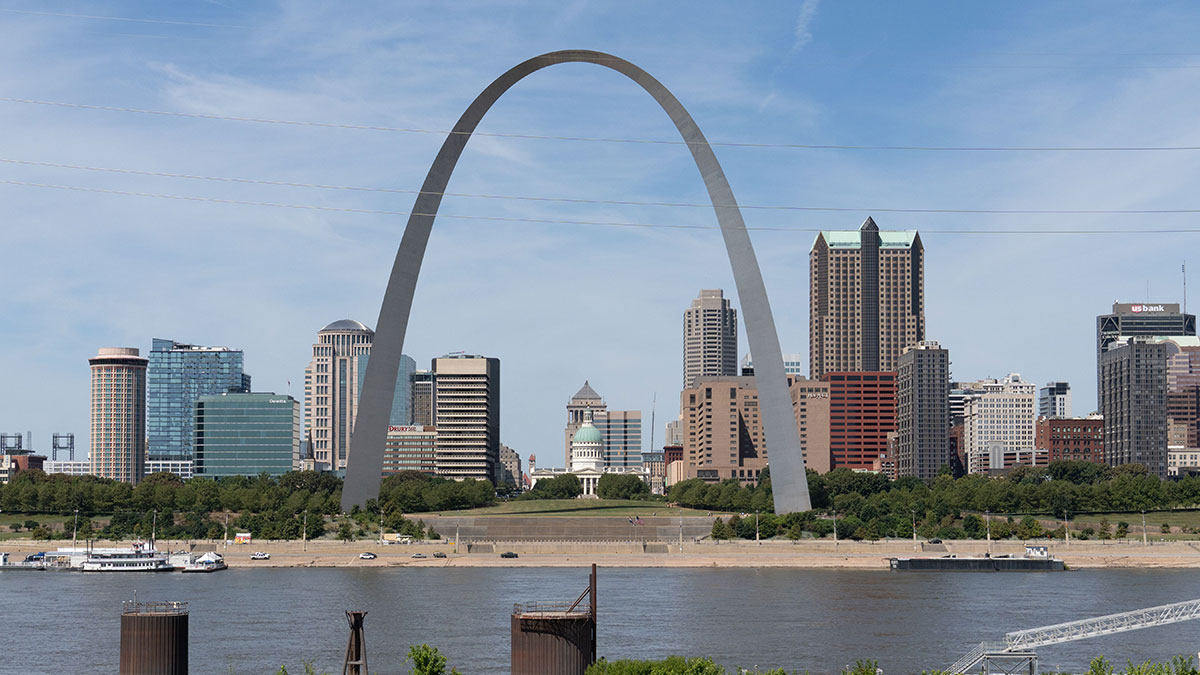
The riverfront illustrates the shift. For decades, land north and south of the Gateway Arch had hardened into industrial blight, with vacant factories, abandoned warehouses, and weed-choked lots visible to anyone flying into the airport.
Now a private redevelopment effort south of the Arch—dubbed “Gateway South”—aims to transform 100 acres of desolate land at the crossroads of river, rail, and interstate into an industrial, residential, and cultural hub. At one of the Midwest’s most strategic transportation junctions, 15 miles south of the Missouri–Mississippi confluence, developers envision the area becoming America’s “construction capital,” with a cluster of contractors, suppliers, and logistics firms.
To the north, parcels long trapped in questionable tax-credit schemes have become the subject of serious cultural investment. Former Guggenheim director Thomas Krens, who resides part-time in St. Louis, is exploring the possibility of a contemporary model railroad museum, potentially anchored by a monumental locomotive works from artist Jeff Koons. (Krens famously transformed Bilbao, Spain—another declining industrial riverfront city—into a global cultural destination.)
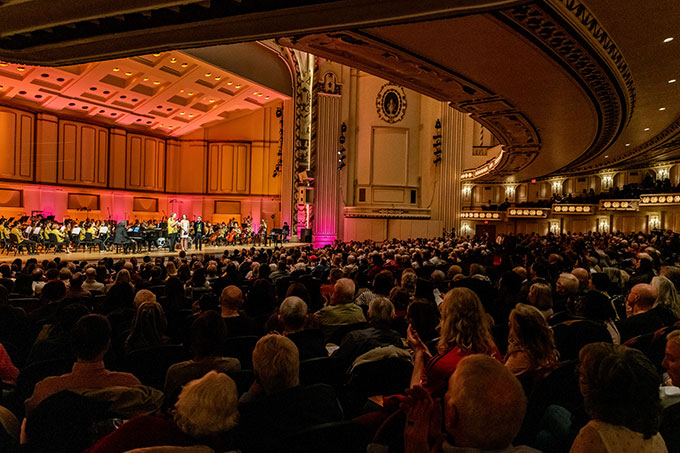
Cultural institutions are moving in parallel. The St. Louis Symphony Orchestra recently reopened after a $140 million renovation and expansion, while the art museum’s exhibition of three-story-tall Anselm Kiefer paintings—inspired by the Mississippi and Rhine rivers—drew international attention. Olympic soccer will return to the city in 2028 for the first time since 1904, following the arrival of a Major League Soccer franchise and stadium in 2023. Index-fund pioneer Rex Sinquefield has successfully turned St. Louis into the nation’s “chess capital” with a 30,000-square-foot campus that hosts elite international tournaments.
The most visible economic signal, however, is the overhaul of St. Louis Lambert International Airport, with the first terminal scheduled to be completed by about 2032. The firm leading the project also redesigned New York’s LaGuardia Airport. Designed by Minoru Yamasaki, architect of the original World Trade Center, the St. Louis airport was once a major Midwestern gateway to Europe before TWA dismantled its hub. International service has returned with direct flights to Germany; service to London’s Heathrow Airport will commence this spring.
Structural reforms at the state level are advancing, as well. Last year, Missouri lawmakers eliminated capital-gains taxes and are now working to abolish the state income tax—a move that would reshape the state’s competitive position in the Midwest. Efforts are underway to rationalize one of the nation’s most fragmented municipal maps by merging the city with the county’s 91 municipalities (federal corruption scandals derailed earlier attempts). The Show-Me Institute, Missouri’s free-market think tank, is calling on state lawmakers to replace St. Louis’s archaic earnings tax with a land-value tax similar to one Pittsburgh adopted in the 1970s to encourage redevelopment of vacant land.
Yet serious obstacles remain, such as crime, which has declined but remains volatile. In 2025 homicides and sexual assaults reached their lowest levels in more than a decade amid record federal resources and coordination with local law enforcement. After the disastrous tenure of progressive prosecutor Kim Gardner, the city has resumed prosecuting violent crime. Still, aggravated assaults and vehicle theft remain stubbornly high. Just last month, a career criminal fatally shot a former Team USA skater during a daytime robbery at a Starbucks drive-thru.
Public disorder reinforces the perception that parts of St. Louis remain unsafe. The central library—an ornate Cass Gilbert structure—functions largely as a daytime homeless shelter. Roadside litter remains pervasive despite millions of dollars spent on cleanup. Bob Clark, founder of construction giant Clayco, recently said that he had seen less public litter during recent travels in Africa than in parts of St. Louis. “It’s not even a maintenance issue,” Clark said. “It’s an issue of trash in the brain. When you don’t have pride in your community, you throw trash out the window.”
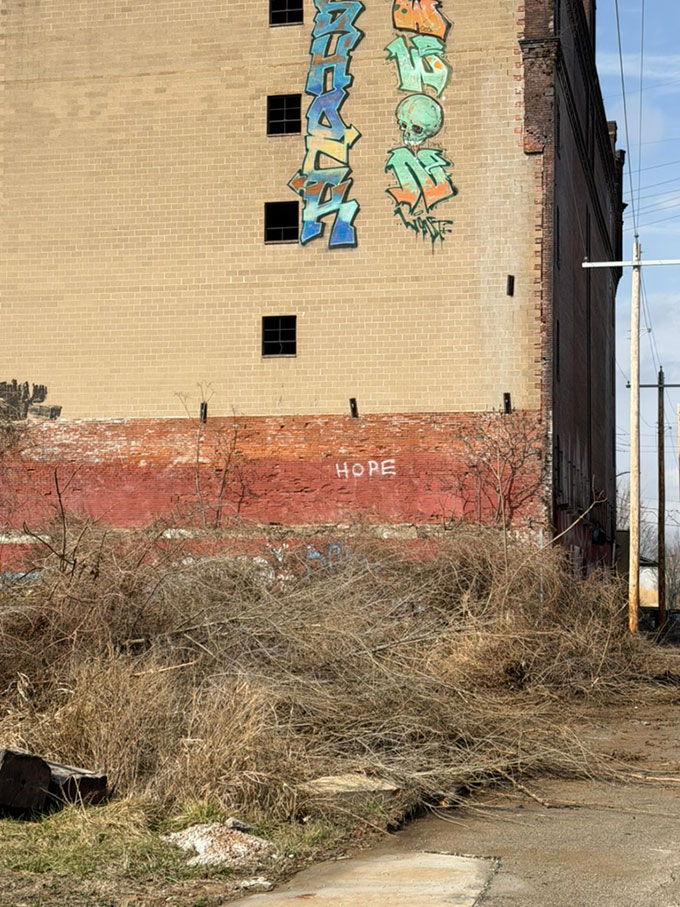
In my conversations with current and former elected officials, a theme emerges: St. Louis possesses first-class commercial and cultural amenities but lacks political maturity and civic discipline. Even as downtown office vacancies reach record levels, the city continues to impose costly climate mandates on large buildings. The city finally launched an online building permit portal after decades of dysfunction and corruption in its building department. Meantime, more than one-third of the city’s $498 million federal pandemic relief funds remain unspent as the 2026 deadline approaches, and the St. Louis City Board of Aldermen continues to argue over how to define “funds” from a $790 million NFL settlement concluded nearly five years ago and involving the departure of the formerly St. Louis Rams.
The clearest test ahead for St. Louis is the attempted political comeback of former Missouri Representative Cori Bush, nationally known for calling to defund police while maintaining private security and sympathizing with Hamas. Bush’s candidacy will serve as a referendum on whether the city’s political center of gravity has shifted decisively away from progressive self-destructiveness and toward public order and competitiveness.
History suggests that the city has a genuine opportunity now. A 25-year building boom followed the 1904 World’s Fair because St. Louis believed in itself and built accordingly. The present moment feels closer to that spirit than any other time in recent memory. After a long stretch of drift, St. Louis has decided to start building again.
Top Photo by Marli Miller/UCG/Universal Images Group via Getty Images
City Journal is a publication of the Manhattan Institute for Policy Research (MI), a leading free-market think tank. Are you interested in supporting the magazine? As a 501(c)(3) nonprofit, donations in support of MI and City Journal are fully tax-deductible as provided by law (EIN #13-2912529).
Source link