A niece of mine once complained to her mother during Mass that her knees hurt from all the kneeling. My sister told her to offer it up and to look at the crucifix to see how Christ suffered for her. My niece looked at the crucifix, then turned to her mother and said, “Yeah, but that was only for one day. I have to do this, every Sunday.”
We can find a bit of humor in the childish logic, and of course we understand that Christ did not just suffer on one day; the cross shadowed Him His whole life. And that shadow grew darker and darker as Good Friday approached. “Night is coming,” Christ warned at the feast of Tabernacles, a harvest festival filled with great rejoicing.
Rejoicing Amid Vitriol
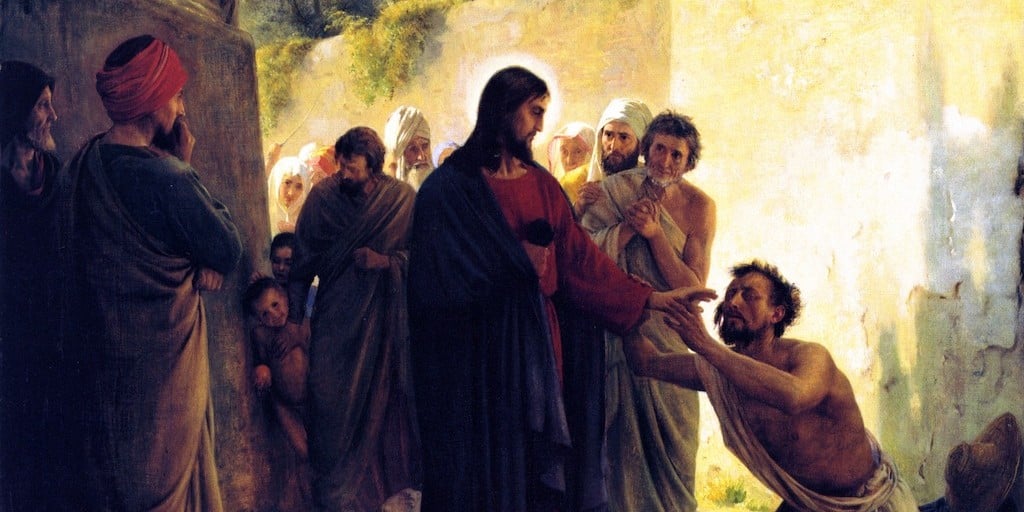
This Sunday was Laetare Sunday. Laetare is Latin for “rejoice.” It gets its name from the first word of the Entrance Chant: “Rejoice, O Jerusalem: and come together all you that love her: rejoice with joy, you that have been in sorrow.” Sunday’s gospel passage details the healing of a man born blind, a beggar at the temple—a cause for great rejoicing for sure.
The astonished crowd asked, “Isn’t this the one who used to sit and beg?” And others cried, “No it just looks like him!” The Jews who interrogated the healed man claimed it was a hoax. Even after interrogating the former blind man’s parents, they still refused to believe the miracle. To do so, they would have had to acknowledge that the man from Nazareth was divine, and they could not do that. They could not do so because they were blind. They could not see, but refused to have the Doctor examine them, because they denied being blind.
After the cured man was hauled in for a second round of questioning, the Gospel writer John gives us a bit of comedy in the form of sarcasm. After repeating his story once again, the man, no doubt fed up with the process, cracked wise:
I told you already and you did not listen.
Why do you want to hear it again?
Do you want to become his disciples, too?
Now, consider: the man had been blind his whole life…and now he could see. Why would he have wanted to waste any more time with these hateful people? They had no logical arguments, only vitriol and venom. The man no doubt wanted to get back outside and go sightseeing around the temple. Maybe he wanted to go back and look at the spot where he sat and begged for all those years. That would have been quite a new perspective. Can you imagine him staring at that spot with his new eyes?
And so, after being ridiculed and called names, the man was canceled by the elites at the temple. The man was excommunicated by people who claimed Christ’s miracle was no good because He worked it on the Sabbath. A man blind from birth was healed—something only God could do. But God spat on the ground and made clay on a Saturday, so, according to the Pharisees, the miracle didn’t count. Christ broke the rules. Charity and right reason had to take a back seat to a law that enslaved people and kept them in darkness.
Seeing the Light in the Darkness
But a light shines in the darkness (Jn. 1:5). When Christ, the light of the world, heard the blind man was kicked out of the synagogue, He went looking for him. And as a reward for his faith and obedience, he got to look at the face of God with his brand-new eyes.
The Pharisees looked at the face of God. But they did so with old and blinded eyes. Earlier at the feast, they had called Christ a devil-possessed Samaritan (Jn. 8:48). The next spring they wouldn’t just look at His face, they would spit on it, before crucifying Him.
Now, let’s understand: Christ healed the blind man on the Sabbath on purpose. He did so to reiterate the fact that the new, eternal law of faith and grace had arrived to fulfill the old, temporary law of slavery. The old law ended on Calvary when Christ, the true temple said, “It is finished.” That fact was reiterated when, a generation later, the temple in Jerusalem was leveled to the ground, ending Jewish sacrifice and the Mosaic Law.
We rejoice in this refreshing little victory in chapter 9. A couple months later, as recounted in chapter 10, Christ would go back to Jerusalem for the feast of Hanukah. And, as they tried to do in chapter 8, the Jews once again tried to stone Him.
Christ would return to Jerusalem one last time a few months later, in the spring, around the end of March, for the Feast of Passover. Christ had to go to Jerusalem because night was coming. Night came on Good Friday, during the day. It was the darkest day in the history of the world, because on that day the worst crime in all of history was committed: deicide. God, thanks to the collusion of the Jewish and Roman elites, was killed.
Spiritually, though, we all kill Him. “Nor did demons crucify him; it is you who have crucified him and crucify him still, when you delight in your vices and sins,” wrote St. Francis of Assisi, quoted in the Catechism of the Catholic Church (598). That is a pretty dark thought from St. Francis, until eyes are opened to the fact that Christ’s death brings life. The Psalm states:
He led them forth from darkness and gloom
And broke their chains to pieces. (Ps. 107)
St. Paul, citing Isaiah, wrote:
Arise, shine, for your light has come, and the glory of the LORD rises upon you. (Is. 60:1)
Follow the Way, the Truth, and the Life
So, what do we do now? Living in a world that offers up few logical arguments, we are now ridiculed for our belief that Christ is the Way, the Truth, and the Life. We are being canceled for stating Christ is King. What else then is there to do in a world blinded to the truth, but to crack wise and ask it: “Do you want to be His disciple too?”
What else do we do? We rejoice because the cross is shadowing us. But instead of cursing it and running away from it, we find rest and refreshment under its shade. We rejoice when they tell us we shall go into God’s house, where, though we are still crucifying Christ with our sins, we can draw water from the springs of salvation that flow from His pierced side.
“Rejoice all Jerusalem, rejoice with joy, you that have been in sorrow.” We are still sinning, but the blood and water are still flowing from the altar. And so, Laetare! Rejoice! With joy in our hearts, we get down on our knees—and we do this every Sunday.
Image from Wikimedia Commons