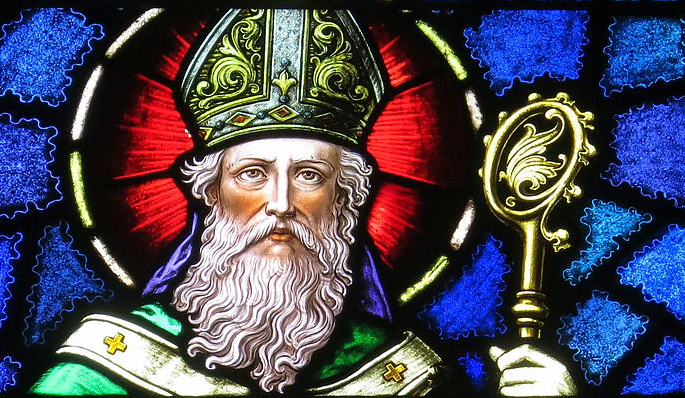
Editor’s note: The following homily was preached on the Solemnity of St. Patrick, March 17, 2026, at the Church of the Holy Innocents, New York City.
What is today, in the Universal Church, an optional memorial honoring Saint Patrick, is in Ireland and the Archdiocese of New York a solemnity, as he is the patron saint of these places.
Not much is known about the early life of this fifth-century “Apostle of Ireland”. What has come down to us is shrouded in the myths and mists of history. While Patrick is often presented as the evangelist of Ireland, that is not entirely accurate, as historical records reveal at least some presence of Christianity in the Emerald Isle before his arrival, as even his own admonition suggests: “Church of the Scots, nay of the Romans, as ye are Christians so also be Romans.”
In other words, Patrick’s unique contribution to the Faith in Ireland was bringing it into communion with the See of Rome. In short order, the nation earned for itself the title of “Isle of Saints and Scholars.”
In the modern era, Ireland sent missionaries around the world. Whole dioceses of the United States were populated by what were dubbed “FBI clergy,” that is, “foreign born Irish” priests. On my first visit to Ireland in 1983, the country was still spared the ravages of divorce and abortion.
When I expressed admiration for that reality, a curate at the Pro-Cathedral of Dublin chastened me with a reality check, ”Come back in ten years,” he prophesied, “and you won’t find a stone upon a stone.” How right he was. Indeed, in a bit more than ten years, Ireland would earn the shameful distinction of not only having legalized divorce and abortion but of being the first country in the world where those plagues were not visited on the people by judicial or legislative fiat, but by the direct vote of the people–the result of a prosperity-fueled and virulent secularization.
What do the hardcore data tell us?
Forty years ago, 93% of the Irish self-identified as Catholic; today, that is 69%. In the 1970s, the Church in Ireland could boast of a 90% Sunday Mass attendance, which has today dwindled to about 27%. Eleven seminaries have been reduced to one, with just a single ordination in the entire country last year.
Truth be told, were it not for Polish, Brazilian, and Nigerian immigrants, the majority of churches there would have to be shuttered. Interestingly and ironically, by a twist of not Fate but Providence, Nigeria, which was almost single-handedly evangelized by Irish missionaries, now has the highest Mass attendance in the world at 92%!
Now, lest this homily devolve into raining on the St. Patrick’s Day Parade, it is good and important to note that there are signs of hope of renewal. Some of the newer Irish bishops clearly realize that “institutional maintenance” is deadly; what is needed is a clear, strong, bold, orthodox proclamation of the Gospel. And that approach seems to be finding a welcome hearing among many of the younger generation, just as we are experiencing in this country and in places like France and England as well.
Ireland stands as an object lesson for the Church Universal. A cushy and even arrogant comfortable Church cannot withstand the winds of a hostile and arrogant secularism. As the European Union was aborning, St. John Paul II repeatedly pleaded with the secular elite to include but a single paragraph acknowledging the Christian roots of the continent. But to no avail.
John Paul knew and believed what Hilaire Belloc knew and believed and declared sixty years earlier in Europe and the Faith. On the very first page of that book, he wrote: “Europe is the Church, and the Church is Europe.” And the last two lines of his book read: “Europe will return to the Faith, or she will perish. The Faith is Europe. And Europe is the Faith.”
Severing Europe from the Catholic Faith–a project begun by Martin Luther in 1517 and carried on with gusto by heirs of his in the Enlightenment, the French Revolution, the Kulturkamp, and the Spanish Civil War–has brought her to a demographic winter and a listlessness and hopelessness which can only be pitied.
It took a Catholic revert U.S. Secretary of State, Marco Rubio, to remind his audience at the Munich Security Conference on February 14 that Europe and the U.S. are part of “one civilization — Western civilization” and are “bound to one another by the deepest bonds that nations could share,” including shared “Christian faith, culture, heritage, language, ancestry, and the sacrifices our forefathers made together for the common civilization to which we have fallen heir.”
He went on: “It was here in Europe where the ideas that planted the seeds of liberty that changed the world were born. It was here in Europe … which gave the world the rule of law, the universities, and the scientific revolution.” And that Europe was Christian and Catholic.
What has happened in Ireland and Western Europe in general is a cautionary tale for the United States. It requires every serious believer to be a witness to the Gospel in the circumstances of their own lives. Most of Europe and the Americas are lands where the Gospel once flowered so beautifully; today, that is no longer the case, unfortunately. Pope John Paul said this in Tertio Millennio Adveniente, no doubt with a great degree of sadness: “The more the West is becoming estranged from its Christian roots, the more it is becoming missionary territory” [n. 57].
The Pope called this type of preaching “re-evangelization” or “the new evangelization.” And God has placed us in a time and place where that is the work most urgent to perform, and we cannot exempt ourselves from it. So, get involved in the Legion of Mary or an apologetics group committed to explaining and defending our holy Faith.
That also means creating a climate of faith, so that you can impart the saving message of Christ and His Church at home with relatives who have lost their way, at work, at school, in the neighborhood, in the marketplace–wherever the Gospel light no longer shines, or does so only dimly. In the contemporary darkness, you and I are to be bearers of the light of Christ, “whether convenient or inconvenient” [2 Tm 4:2]. St. Francis of Assisi is often credited with counseling his brethren: “Always preach; sometimes use words.”
Or as Pope Paul VI put it so well, “Modern man listens more willingly to witnesses than to teachers, and if he does listen to teachers, it is because they are witnesses” (Evangelii Nuntiandi, n. 41).
If we take these invitations to heart, it would surely gladden the heart of our holy patron.
May we also make our own the concluding lines of his famous “Breastplate”:
Christ be with me, Christ within me,
Christ behind me, Christ before me,
Christ beside me, Christ to win me,
Christ to comfort and restore me.
Christ beneath me, Christ above me,
Christ in quiet, Christ in danger,
Christ in hearts of all that love me,
Christ in mouth of friend and stranger.I bind unto myself the name,
The strong name of the Trinity,
By invocation of the same,
The Three in One and One in Three.
By whom all nature hath creation,
Eternal Father, Spirit, Word:
Praise to the Lord of my salvation,
Salvation is of Christ the Lord.
St. Patrick, pray for us, that we may be worthy of the promises of Christ.
If you value the news and views Catholic World Report provides, please consider donating to support our efforts. Your contribution will help us continue to make CWR available to all readers worldwide for free, without a subscription. Thank you for your generosity!
Click here for more information on donating to CWR. Click here to sign up for our newsletter.