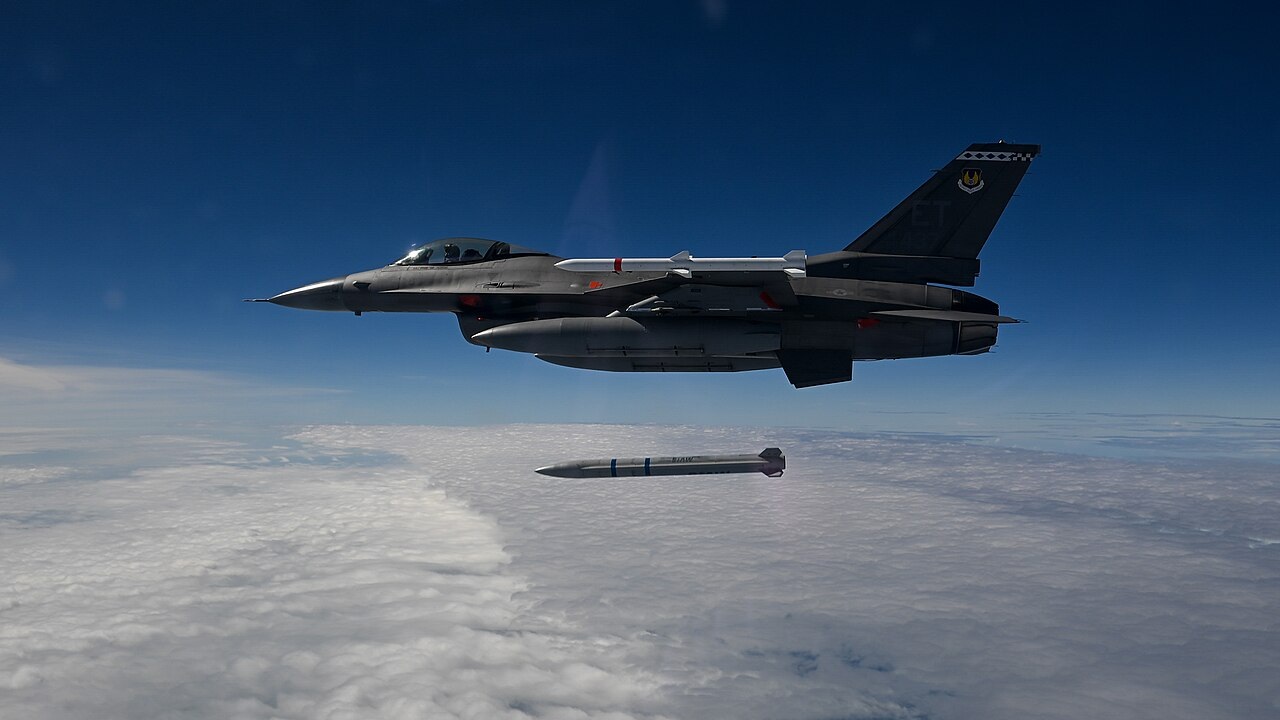
Though the SiAW missile is not slated to enter serial production until the end of the decade, the Air Force has made clear that it sees it as the future of aerial warfare.
The US Air Force is exploring additional industry partners capable of producing the Stand-in Attack Weapon (SiAW) air-to-ground missile, or a comparable system, for the next generation of combat aircraft, including the F-47 NGAD and B-21 Raider.
A “sources sought” notice posted on SAM.gov by the Air Force Life Cycle Management Center at Eglin AFB, Florida, suggests that the service is conducting market research to identify companies capable of producing weapons with similar (or improved) capabilities. Granted, the notice is not a formal solicitation—but it reflects the Pentagon’s interest in expanding the United States’ industrial capacity to build next-generation precision strike weapons.
What Is the “Stand-in Attack Weapon”?
The SiAW is a supersonic air-to-ground missile designed to operate inside contested air defense environments. Unlike traditional standoff weapons that launch from long distances, such as the Tomahawk cruise missile and the Precision Strike Missile (PrSM), the SiAW is intended to be carried by stealth aircraft, which can penetrate defended airspace before firing. The primary mission targets for the SiAW include integrated air defense systems, mobile missile launchers, GPS jamming systems, and related infrastructure. The SiAW is designed to rapidly strike time-sensitive and mobile targets.
The Air Force’s notice asks for compatibility with several aircraft, including the F-35 Lightning II, F-16 Fighting Falcon, F-47 NGAD, and B-21 Raider. The inclusion of the F-47 is especially notable—marking the first time the jet has appeared in an acquisition document relating to a specific weapon. The F-35, which recently scored its first air-to-air kill during Operation Epic Fury (albeit against an obsolete Yak-130), is expected to be the initial SiAW operator.
The notice also outlined key performance requirements. For example, it requested extended standoff range, which would allow the aircraft to launch strikes without entering the most dangerous and heavily guarded zones of an enemy’s airspace. It also requested that the new missile include an advanced anti-radiation seeker, in order to track and target frequency-agile radar systems and radars that use low-probability-of-intercept techniques. The Air Force has asked for precision navigation, using GPS/INS guidance with anti-jamming capabilities, and electronic resilience, to survive in dense EW environments. Lastly, the SiAW is expected to feature “re-attack” capabilities, or the ability to reacquire and strike targets if the initial attempt fails. Together, these variety of performance features make the SiAW well suited for destroying modern IADS.
The Air Force Wants Multiple SiAW Suppliers
The SiAW program is currently being developed by Northrop Grumman, which received a $705 million contract in September 2023 to build and test the weapon. The program is already underway, with early testing milestones achieved, including a first missile test in November 2024 and a successful separation test from an F-16 in December 2025.
The Air Force hopes full-scale SiAW production will begin later in the decade. But the Air Force’s outreach to additional vendors likely reflects broader concerns about the capacity of the US defense industrial base. Recent operations, most notably Operation Epic Fury, have highlighted just how quickly conflicts can consume large quantities of precision munitions—particularly the Tomahawk missile, which has been used liberally against targets inside Iran, depleting an estimated 10 percent of America’s stockpiles in the first 72 hours of the conflict. At the Tomahawk’s current production rate, it will take roughly 4 to 5 years to replenish the missiles expended, giving a window of opportunity to America’s adversaries elsewhere if the conflict drags on.
The SiAW program, and the Air Force’s search for additional suppliers, highlights the growing relevance of next-generation suppression and destruction of enemy air defenses (SEAD/DEAD) capabilities—a need that Epic Fury demonstrated concretely.
About the Author: Harrison Kass
Harrison Kass is a senior defense and national security writer at The National Interest. Kass is an attorney and former political candidate who joined the US Air Force as a pilot trainee before being medically discharged. He focuses on military strategy, aerospace, and global security affairs. He holds a JD from the University of Oregon and a master’s in Global Journalism and International Relations from NYU.