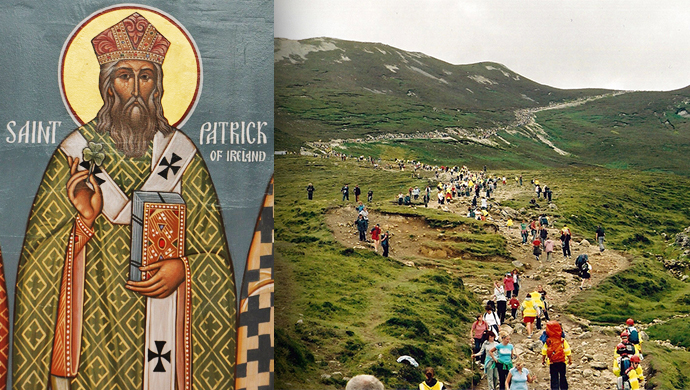
As Catholics, we celebrate the saints for their heroic witness to our Christian Faith. Each saint has a day on the Church calendar, which typically falls on the date of death, known as their dies natalis, “heavenly birthday.” These are days for merriment, meant for taking a break from the austerities typical to the Christian life, which is why they are known as “feasts.”
St. Patrick’s Day has an outsized influence in popular culture because of the large Irish diaspora spread across the globe. As the saying goes: “Everyone’s Irish on St. Patrick’s Day.” Celebrations in honor of Ireland’s patron saint are characterized by great festivity with parades, the playing of bagpipes, traditional dance, the wearing of green, and time in the pub.
There is a problem, however. This feast on March 17th always falls during the fast of Lent.
While breaking the fast for a saint’s feast is certainly in keeping with Catholic culture and even piety, it is important for the revelers enjoying the celebrations of the “Apostle of Ireland” to return to the fast at day’s end. The best way to honor the saints is by imitating their virtues.
It is worth recalling, then, Patrick’s own intense devotion to the Lenten fast and the fruit it bore for the conversion of the Irish, so we might embrace something of his spirit.
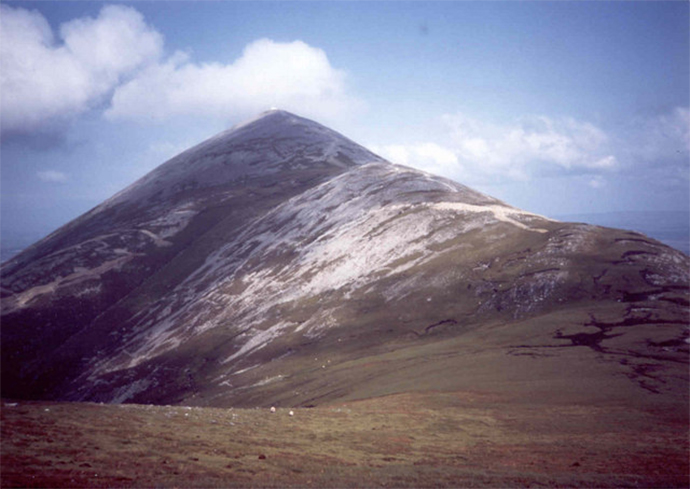
To best do this, we follow in the footsteps of the one hundred thousand pilgrims a year who make their way to Ireland’s holy mountain, known as Cruach Phádraig, “Croagh Patrick.” It was there that Ireland’s patron spent the forty days of Lent in the year 441, praying and fasting on its summit.
The anglicized word “croagh” refers to a hill or mountain that is shaped like a cone or stack. The Irish refer affectionately to the mountain as the “Reek” which comes from the old English word hrēac, meaning a “haystack” or “pile.”
Archaeological evidence suggests the mountain was considered sacred long before Patrick’s time. On the summit, likely dating from the Bronze Age, are the collapsed walls of a prehistoric hill fort and three large cairns, which are man-made stacks of stone commonly used as burial chambers, ritual monuments, or navigation aids. It is believed these were used for the ancient Celtic festival of Lughnasa, which celebrated the start of the harvest season on August 1st.
Patrick christened the mountain by his Lenten fast, making it one of Ireland’s chief centers of Christian pilgrimage through the generations.
The earliest surviving written source for the tradition that Patrick fasted for forty days on the summit of the Reek comes from the bishop Tírechán’s Collectanea, a biography of Ireland’s patron written in the mid-seventh century. Tírechán writes that the motivation for Patrick’s fast was the example of Moses (Ex. 34:28), Elijah (1 Kg. 19:8), and the Lord Jesus (Mt. 4:1-11; Lk. 4:1-13) in their own forty-day fasts.
Tírechán includes a curious detail about how Patrick was harassed during his fast by troublesome birds, which has been interpreted to mean the oppression of demons just as Satan himself tested the Lord during his fast in the wilderness of the desert.
Later hagiographical works, including the Bethu Phátraic from the ninth century and the Tripartite Life of Saint Patrick from the late ninth or early tenth century, add dramatic elements to the story.
Patrick’s fast is depicted as a kind of wrestle with God, much like the patriarch Jacob (Gen. 32:22-32). Patrick’s wrestle came in the form of a refusal to eat until God granted his prayers. By his perseverance in the fast until the end of Lent, Patrick won a special privilege for his beloved flock. When Christ returns in glory at the end of the age, Patrick will be allowed to stand between the Just Judge and the Irish people, advocating that they be visited by the Lord not with avenging judgment but tender mercy.
Fasting as a demand for justice in the Irish legal tradition is known as troscud, where a person, usually from a lower social standing, would fast on the doorstep of a superior to compel justice or redress a grievance. Perhaps the most famous episode of this practice is the deadly episode in 1981 during the Troubles, when ten Irish prisoners led by Bobby Sands starved themselves to death in a British prison in a demand to be recognized as political prisoners rather than criminals.
The legends surrounding Patrick’s fast go on to say that he was tormented by a demonic serpent but was able to cast it away by ringing a consecrated bell. From this comes the widely known tradition that Patrick banished all the snakes from Ireland, symbolic of his defeat of the pagan deities that once held sway over the Emerald Isle.
Cloc ind Édachta, “St. Patrick’s Bell” is a treasured relic kept to this day in the National Museum of Ireland in Dublin.
Pilgrims have been drawn to Croagh Patrick’s sacredness since the time of Patrick.
A stone oratory was discovered by archaeologists on the summit in 1994 that dates to between 430 and 890.
Treks up the mountain became especially popular in the medieval period when indulgences were attached to the practice. The earliest record of a papal indulgence in 1432 was granted to those who performed the penitential exercises known as “stations” while climbing the Reek.
What surely also draws pilgrims to Ireland’s holy mountain is the breathtaking landscapes.
The silhouette of Croagh Patrick dominates the horizon. It looms over the largest nearby town of Westport, which sits five miles to the east of where most pilgrims arrive by train after a three-hour ride from Dublin. The area can be described as arcadia, a pristine oasis of natural beauty. The rolling green fields are filled with rugged stone walls and grazing sheep, with the expanse of the Atlantic Ocean as a backdrop.
When William Makepeace Thackeray, who is most famous for penning the novel Vanity Fair, visited Westport in 1842, he had this to say:
The most beautiful view I ever saw in the world. It forms an event in one’s life to have seen that place so beautiful that is it, and so unlike other beauties that I know of. Were such beauties lying on English shores it would be a world’s wonder perhaps, if it were on the Mediterranean or Baltic, English travellers would flock to it by hundreds, why not come and see it in Ireland!
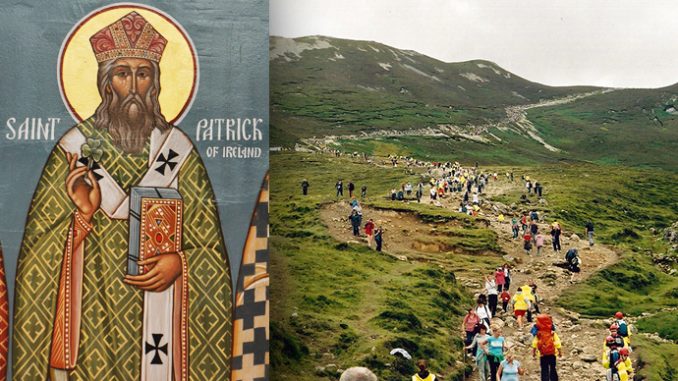
Pilgrims begin their trek to the summit from the small village of Murrisk, which lies at the mountain’s foot. Twenty to thirty thousand come on the last Sunday of July, known as “Reek Sunday” which falls close to the ancient Celtic harvest festival that first brought pre-Christian pilgrims to this holy mountain.
The stations of the Reek practiced today are generally considered to be three.
The first station is at Leacht Benáin, “Benan’s Grave,” an ancient stone cairn at the base of the mountain where pilgrims walk seven times around it reciting seven Our Fathers, seven Hail Marys, and one Creed.
The second station is on the summit, where pilgrims kneel before the modest stone and cement chapel erected in 1905. There, seven Our Fathers, seven Haily Marys, and one Creed must be prayed for the pope’s intentions before walking around the chapel 15 times while reciting 15 Our Fathers and 15 Hail Marys. Inside the chapel is an inscription above the high altar that speaks to the once fiercely loyal Catholic Faith of the Irish. It is taken from the Dicta Patricii, “Sayings of Patrick” preserved in the ninth-century manuscript known as the Book of Armagh, and reads: Ut Christiani ita et Romani sitis, as you are Christians, so also be Romans.”
The second station is only completed after the pilgrim then makes his way to the stone monument on the summit known as the Leaba Phádraig, “Patrick’s Bed,” and walk around it seven times reciting seven Our Fathers, seven Hail Marys, and one Creed.
The third station takes place at a cluster of three Bronze Age burial cairns on the western shoulder of the mountain known as Reilig Mhuire, “Mary’s Cemetery.” The pilgrim walks seven times around each cairn of stones, reciting seven Our Fathers, seven Hail Marys, and one Creed, and then walking another seven times around the whole enclosure, reciting the same.
Ascending and descending Croagh Patrick is about a four-mile round trip.
At this mountain made sacred by Patrick’s Lenten fast, we can see how much can be gained from this primordial Christian discipline.
Lent is a kind of “spring cleaning” for the temple of God within our souls to detach ourselves from the accumulated clutter of earthly pleasures. By resisting the urge for food and drink, we become trained to resist the urges to sin.
After his disciples failed to cast out a demon from a possessed man, Jesus came and said: “This kind can come out by nothing but prayer and fasting.” (Mk. 9:29). In the midst of his preaching campaigns against the druids, Patrick probably realized this truth firsthand. After his forty-day Lenten fast on Croagh Patrick, he cast the demonic deities of the druids who came in the form of snakes into the sea.
All who celebrate the memory of Ireland’s patron by feasting on this St. Patrick’s Day can honor the man even more by returning to the fast tomorrow.
If you value the news and views Catholic World Report provides, please consider donating to support our efforts. Your contribution will help us continue to make CWR available to all readers worldwide for free, without a subscription. Thank you for your generosity!
Click here for more information on donating to CWR. Click here to sign up for our newsletter.