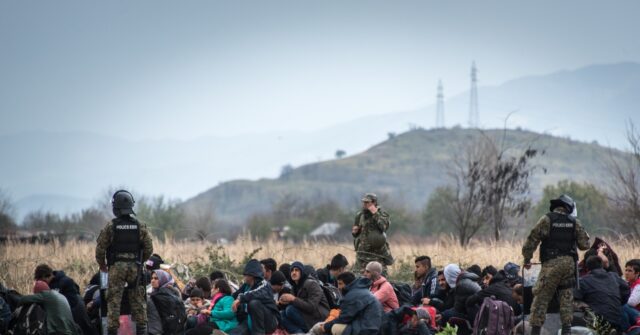
Still grappling with the civilizational transformations of the migrant crisis sparked over a decade ago by conflict in the Middle East, the European Union is facing the prospect of another large wave, with little more in the way of protection for its external borders.
In 2015, more than a million migrants poured into Europe as German Chancellor Angela Merkel unilaterally opened the gates of the bloc to mass migration from Africa and the Middle East, most notably from the Syrian Civil War, which in part was exacerbated by U.S. involvement, with the Obama administration funding rebel groups against the now-defunct regime of Bashar al-Assad.
The influx of the largest number of alleged asylum seekers since the Second World War upended European society and politics radically, sparking crime waves in once peaceful nations like Sweden, ingraining Islamist terrorist movements across the continent, straining national budgets, and entrenching sectarian politics.
Characteristic of the bureaucracy-obsessed European Union, it took a decade for the bloc to reach a form of migration agreement, dubbed the Migration and Asylum Pact, which is still only set to come into force by June. Even this agreement was struck over the objection of conservative nations such as Hungary and Poland, given that its primary aim is to share the burden of migration equally throughout the EU, meaning that countries which fail to police their borders can send illegals to countries that do, upon threat of financial penalties from Brussels.
It is unclear if the Migration Pact will be able to function regardless of outside pressure, with it already facing the prospect of Viktor Orbán’s Hungary refusing to abide by the terms of the deal and it being fundamentally undermined by the socialist government of Pedro Sánchez offering amnesty to illegal migrants, who in turn will be granted legal status throughout the internal open border Schengen Zone, a development likely untenable for many fellow member states.
Meanwhile, debate in the EU Parliament continues on the subject of so-called offshore “return hubs”, which would see illegals immediately removed to detention centres outside of the European Union rather than being allowed to remain within EU borders while their asylum claims are processed. Conservatives such as Italian Prime Minister Giorgia Meloni have argued that such sites are necessary to deter further illegal migration and to make deportation systems effective, given that only around one in five illegals are actually sent back to their homelands per year.
On top of the continued arrival of hundreds of thousands of illegals every year, the EU is now bracing for potential migrant crises to be sparked by the conflict in the Middle East, with both Iran and Lebanon currently under fire from the United States and Israel.
In a letter to member state leaders ahead of this week’s European Council summit, Commission Chief Ursula von der Leyen admitted that Brussels is concerned over the prospect of fresh waves of mass migration.
“Although the conflict has not yet resulted in immediate migration flows towards the EU, what the future holds remains uncertain and requires the full mobilization of all migration diplomacy tools at our disposal. It is therefore crucial to work with countries in the region, such as Turkey, Lebanon, and Pakistan,” she wrote, according to Italy’s Il Giornale newspaper.
Von der Leyen noted that other areas may see a rebound in the number of migrants fleeing to Europe, saying that “worrying developments are being recorded along the Central and Eastern Mediterranean routes, with a sharp increase in departures from Libya.”
Others have expressed concern as well, including Swedish Migration Minister Johan Forssel, who told POLITICO last week that “a new refugee crisis … is not an option for us.”
“We are still seeing the consequences of what happened 10 years ago. And that’s not just the situation in Sweden, but I would say elsewhere in Europe too,” he added.
Nicholas Ioannides, deputy migration minister of Cyprus, which has come under direct fire from Iran during the conflict, warned that the EU “cannot overlook the possibility of a new refugee crisis,” adding that it “might test [the] effectiveness of the bloc’s new rules.”
Even prior to the conflict with Iran, there were concerns over the potential of a new migrant crisis from the region, with a report from the EU Agency for Asylum (EUAA) written before strikes began, warning of an “unprecedented” level of migratory flows if war broke out in Iran.
“With a population of approximately 90 million, even partial destabilisation could generate refugee movements of an unprecedented magnitude,” the report said. “Displacement of just 10 per cent of Iran’s population would rival the largest refugee flows of recent decades.”