Iran maintains a network of allied proxy groups across the breadth of the Middle East—but these groups have been peripheral to the ongoing conflict.
Iran has long relied on proxy militias and armed groups across the Middle East to extend its influence. Through a network of non-state actors, Tehran is indirectly capable of harassing enemies, shaping regional conflicts, and deterring attacks on Iran itself.
This proxy system—dubbed the “Axis of Resistance” by Iranian leaders—includes groups in Lebanon, Iraq, Yemen, and elsewhere. In response to Operation Epic Fury, Iran’s proxy network has gone active along multiple fronts, but so far with uneven intensity.
Why Iran Built the “Axis of Resistance”
Iran’s proxy strategy emerged after the 1979 Islamic Revolution, as a method to export its revolutionary ideology while simultaneously countering regional rivals and Western influence. The Islamic Revolutionary Guard Corps (IRGC), particularly the elite Quds Force, became the primary organization responsible for building and maintaining these proxy relationships. Indeed, the IRGC was envisioned from its inception as a private military force devoted to spreading Iran’s theocratic ideology, rather than a defense force for Iran itself. The absence of the word “Iran” within the IRGC’s name is no accident.
Iranian support to allied proxy groups across the Middle East generally includes funding and financial networks, weapons transfers, military training, intelligence support, and ideological and political coordination. This approach has allowed Iran to exert influence without direct conventional confrontation—which gives Iran plausible deniability in the actions of the proxies and reduces (though clearly does not eliminate) the risk of large-scale retaliation against Iran itself.
A Breakdown of Iran’s Allies By Nation
Afghanistan and Pakistan: Iran has recruited militiamen from Shi’a minority communities in Afghanistan and Pakistan—particularly among the Hazaras, an ethnic group of Shi’a Muslims in Afghanistan that Tehran has long exercised informal protective power over. Hazaras and other recruits from Afghanistan make up the Fatemiyoun Brigade, an Iranian militia that the Islamic Republic has deployed as a de facto mercenary unit. Fatemiyoun fighters previously fought in Syria in support of Bashar al-Assad; they have also allegedly been deployed to the streets of Tehran to subdue protesters and help maintain internal security. A similar group, the Zainabiyoun Brigade, exists for Shi’a minority recruits from Pakistan. So far, the two groups have played a minimal role in Operation Epic Fury.
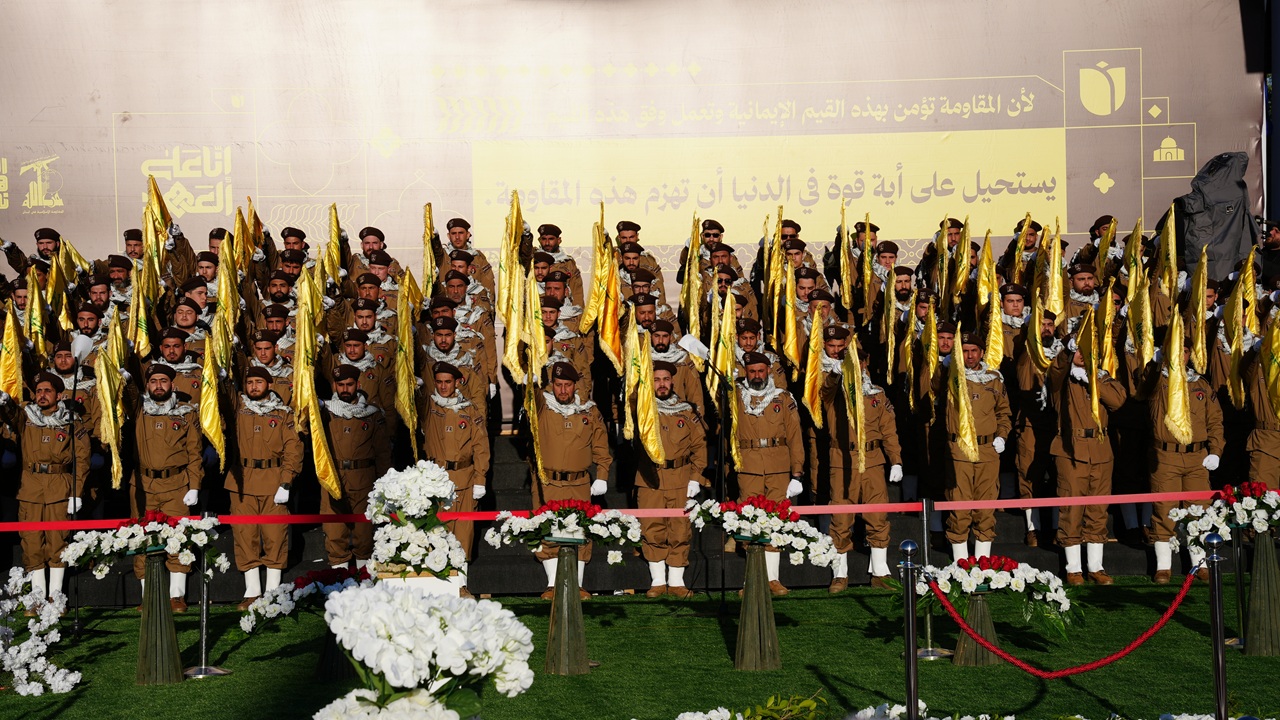
Lebanon: Iran’s most capable and established proxy is Hezbollah in Lebanon. Formed in the early 1980s with aid from the IRGC in response to Israel’s invasion of Shi’a-majority southern Lebanon, Hezbollah has evolved into a hybrid force combining militia units, missile and rocket forces, and an attached political wing with representation in Lebanon’s parliament. Hezbollah reportedly possesses an arsenal of tens of thousands of rockets and missiles, most of which are aimed at Israel. The group has responded to Operation Epic Fury by launching some of its drones and missiles into northern and central Israel, targeting Israeli military facilities and Israeli forces.
Iraq: In Iraq, the weak central government in Baghdad has given rise to a wide variety of sectarian militias with various aims. Iran is allied with a group of these militias within the “Popular Mobilization Forces” (PMF), a group of Shi’a organizations that rose to fight the Islamic State (ISIS) after its conquest of western Iraq in 2014. In the aftermath of ISIS’ territorial defeat, the PMF militias have remained intact and gained political influence, and some have reorganized as the “Islamic Resistance in Iraq” (IRI). These militias are formally a part of the Iraqi armed forces, yet they operate autonomously and should not be understood as part of Baghdad’s command structure in any meaningful sense.
Typical IRI tactics include drone attacks, rocket strikes, and the harassment of US bases and diplomatic facilities. In response to Epic Fury, IRI has launched repeated attacks on US positions near Erbil and northern Iraq.
Syria: Iran has struggled to rebuild influence within Syria after the fall of longtime Syrian dictator Bashar al-Assad, a close Iranian ally. For understandable reasons, the successor government of Ahmed al-Shara—who spent years fighting against Iran and its Axis of Resistance proxies—has little interest in developing constructive ties with Tehran. In fact, some analysts have speculated that Iran attempted to organize an uprising among the Alawites, a Shi’a offshoot sect that dominated Assad’s government, against al-Shara in early 2025. That uprising ended in failure, and Iran functionally has minimal influence in Syria today.
Yemen: In Yemen, Iran supports the Houthi movement, which controls large portions of northern Yemen. The Houthis have developed sophisticated missile and drone capabilities (many derived from Iranian designs). These weapons have been used to attack Saudi oil facilities, shipping lanes in the Red Sea, and Israeli-linked maritime targets.
The Houthis have exercised notable restraint since Operation Epic Fury began, limiting their response to rhetoric for the time being. The Houthis previously fought against the United States during “Operation Rough Rider,” a two-month aerial campaign during early 2025 that inflicted some losses on the Houthis but basically left its strength intact.
The Axis of Resistance’s Uncertain Future
Operation Epic Fury has significantly disrupted Iran’s traditional proxy command structure. The targeted killings of senior IRGC leaders has weakened centralized proxy coordination. As a result, many proxy groups are now operating more independently in what some analysts have described as a “mosaic defense” where local commanders make decisions without oversight from Tehran.
Iran’s proxy system remains a powerful tool, but the ongoing conflict has exposed vulnerabilities—reliance on Iranian financial and logistical support, centralized command structures, and a lack of diverse supply chains and redundancies in case of disruption. Still, the network persists, meaning Iran will retain the ability to project influence across the Middle East.
About the Author: Harrison Kass
Harrison Kass is a senior defense and national security writer at The National Interest. Kass is an attorney and former political candidate who joined the US Air Force as a pilot trainee before being medically discharged. He focuses on military strategy, aerospace, and global security affairs. He holds a JD from the University of Oregon and a master’s in Global Journalism and International Relations from NYU.