Prior to its acquisition by the US Coast Guard in 1946, the Eagle went by another—considerably darker—name.
The United States Coast Guard Barque Eagle will be part of the upcoming Sail250, the maritime celebration of the 250th anniversary of the founding of the United States. The event will feature a global gathering of tall ships and military vessels at five major coastal cities—beginning with New Orleans on May 28, then heading to Norfolk for a 26-nautical-mile “Parade of Ships” on June 12, then to Baltimore on June 25, New York City for the Fourth of July, and finally to Boston on July 16.
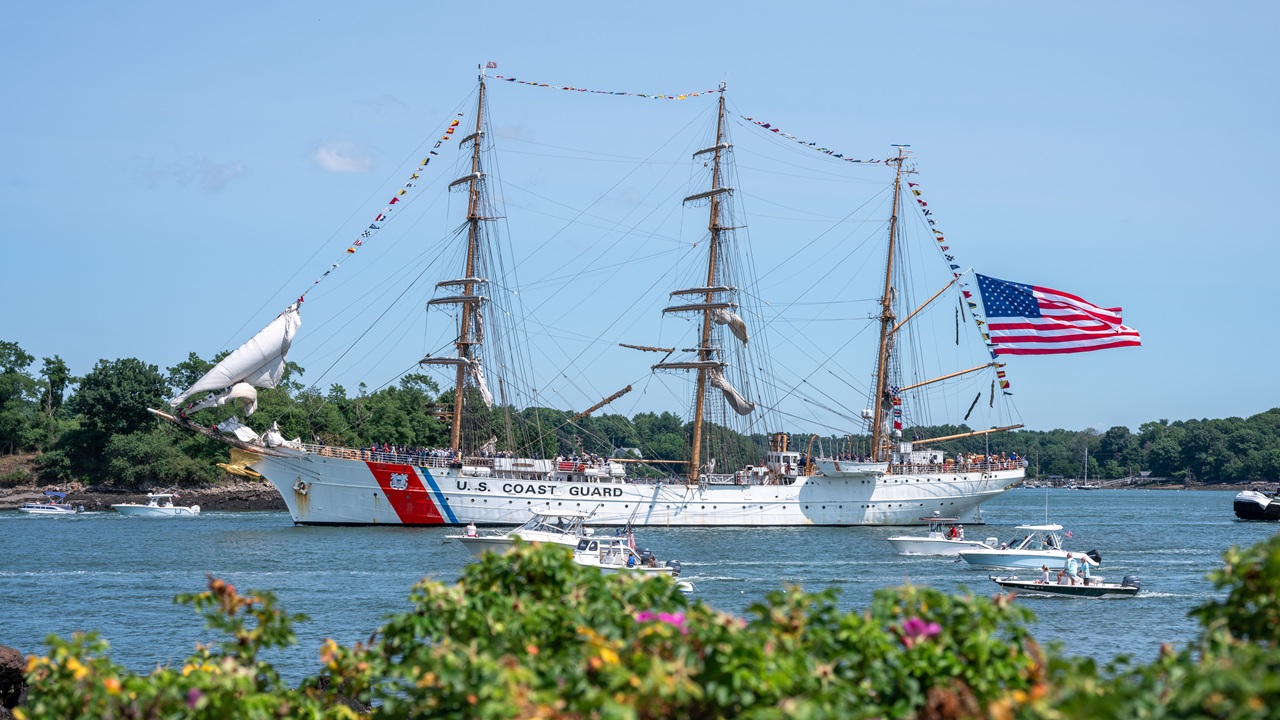
The USCGC Eagle (WIX-327) is often called “America’s Tall Ship,” as it is the largest tall ship in service to fly the Stars and Stripes, and is also the only square-rigger in service with the US Armed Forces.
“It is an immense honor for the Coast Guard Barque Eagle and crew to participate in the Sail250 festivities and celebrate the 250th anniversary of our nation,” said Capt. Kristopher Ensley, commanding officer of the Eagle. “This voyage not only serves as a vital training experience for the next generation of Coast Guard officers but also allows us to share America’s proud maritime heritage with the public. We are thrilled to visit these historic ports and sail alongside magnificent vessels from around the world.”
The USCGC Eagle’s Specifications
- Year Commissioned: 1936 (as Horst Wessel), 1946 (as USCGC Eagle)
- Construction: Steel hull (4/10 inch thick) with teak decks
- Length: 295 feet (90 m)
- Beam: 39.1 feet (11.9 m)
- Draft: 17 feet (5.2 m)
- Displacement: 1,816 – 1,824 tons
- Sail Area: 22,227 – 22,300 sq ft (23 sails)
- Mast Height: ~147.3 feet (main/fore)
- Propulsion: 1,000 HP Caterpillar diesel engine
- Rigging: 6 miles of standing and running rigging
- Speed under sail: 17 knots (20 mph, 31.4 km/h)
- Speed under power: 10 knots (11 mph 18.5 km/h)
- Homeport: New London, Connecticut
- Crew: ~55-86 permanent crew, with capacity for up to 150+ cadets
WIX-327 is the seventh US Coast Guard cutter to bear the name Eagle, part of a proud line dating back to 1792.
Why Does the US Coast Guard Have a Tall Ship?
It might seem unexpected that the United States Coast Guard would even have a tall ship, but there is a very good reason.
Each year, throughout the spring, summer, and fall, cadets and officer candidates of the Coast Guard regularly train aboard the 295-foot (90-meter) barque. The sailing ship serves to provide conditions and situations that can’t be replicated in either a classroom or even aboard today’s more modern vessels.
The cadets who serve on the sailing ship are meant to find themselves completely out of their element, and therefore dependent on wind, waves, and currents. They must quickly learn how those forces of nature affect a vessel. The training is also meant to help with ship-handling, decision-making, and meeting unexpected challenges, while cadets learn the value of teamwork. To maneuver USCGC Eagle under sail, the crew must handle more than 22,000 square feet of sail and 5 miles of rigging.
In addition to its role as a training cutter for future officers of the US Coast Guard, the ship has also been used for public relations and has made numerous foreign port visits as a goodwill ambassador. She has hosted multiple US presidents, including Harry Truman, John F. Kennedy, and Richard Nixon. Her permanent homeport is New London, Connecticut.
Several other nations use tall ships for training, with the UK’s Royal Navy announcing it had carried out trials of a square-rigged sail training vessel last summer.
USCGC Eagle Has a Dark Origin Story
The more sinister part of the story of USCGC Eagle is that it was not built in the United States, but in Nazi Germany. Before and during World War II, the ship—then known as the SSS Horst Wessel—was used to train German sailors in sail techniques. She was one of three Gorch Fock-class sail-training ships built at the Blohm+Voss Shipyard in Hamburg.
Commissioned in 1935, the ship was operated by the Kriegsmarine in the late 1930s, but never saw actual combat—unsurprising given her obsolescence against modern warships. At the close of World War II, the tall ship was taken as war reparations by the United States and re-commissioned as the US Coast Guard Cutter Eagle.
The tall ship was originally named after Nazi Sturmabteilung (SA) member Horst Wessel, an early supporter of Adolf Hitler who was killed by German Communists in 1930 at the age of 22. His greatest legacy is that he wrote a rousing march, “Die Fahne Hoch,” for the fledgling Nazi Party. The song was rechristened the “Horst-Wessel-Lied” (Horst Wessel Song) after his death, and served as a co-national anthem of Germany from 1933 to 1945.
Wessel was raised by Nazi propaganda into a martyr for the Nazi cause, and his eponymous ship’s launch was a major public event for Nazi Germany. Hitler was present at the ceremony, while Deputy Führer Rudolf Hess gave a speech about the sacrifices of the early party members. Wessel’s mother even christened the vessel.
The choice of name was somewhat controversial. Historically, German vessels had been named to honor German naval heroes of ages past, and the Nazi decision to name the vessel after a street thug appalled many in Germany’s relatively apolitical navy.
The US Won the Eagle Through a Game of Chance
The vessel’s actual service with the German Navy as a training ship was short-lived, but in 1938, she undertook a four-month voyage to the Caribbean, visiting St. Thomas and Venezuela. Decommissioned with the outbreak of World War II, she was later used as a training vessel of the marine branch of the Hitler Youth.
Following the end of World War II, the Horst Wessel was “won” by the United States in a drawing of lots to determine which nations would receive Germany’s four sailing vessels as war reparations. Horst Wessel went to the American delegation. Soon after, the tall ship was requested by the United States Coast Guard Academy’s Superintendent—and subsequently renamed Eagle, a fitting name given the ship’s original large eagle figurehead, which remains in place to this day.
The transfer itself was something of a legend. In June 1946, an American crew, assisted by the original German captain and his remaining sailors, steered the newly rechristened Eagle from Bremerhaven, through an Atlantic hurricane, to New York.
About the Author: Peter Suciu
Peter Suciu has contributed to dozens of newspapers, magazines, and websites over a 30-year career in journalism. He regularly writes about military hardware, firearms history, cybersecurity, politics, and international affairs. Peter is also a contributing writer for Forbes and Clearance Jobs. He is based in Michigan. You can follow him on Twitter: @PeterSuciu. You can email the author: [email protected].